Featured

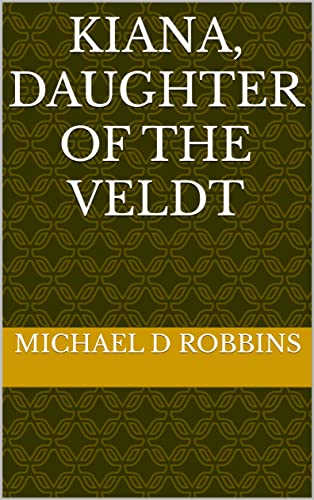
The Last Day of the Great Laibon [a story]

by Michael Robbins

This story is dedicated to my father.


Kiana had been in the wilderness alone. It was against protocol, and exactly what she needed. That’s what she told herself anyway. Lions came to nuzzle her belly, rumbling softly, perhaps due to that acute animal instinct for knowing when something was wrong. Usually they scattered when the Old man came around.

The first time was on the first day of the month, on the first hour past noon. Of course it was. He popped around a tree on those sand scattered Kalahari plains and waved. Kiana started, then bent over the hand-held UV monitor in both her mitts and muttered, “It’s not real.”

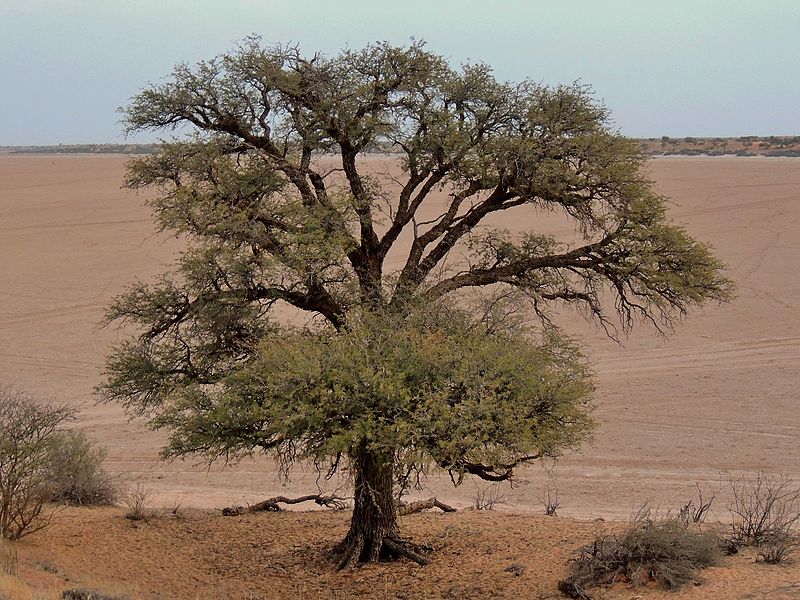
800px-Vachellia_erioloba_-_Camel_thorn

On the second day, at the appointed hour, he climbed into the sun-screened Jeep with her with a cheery “Hello!” Her grip tightened knuckle white on the steering wheel. “You’re not real,” she repeated, almost as a mantra. Her bright green eyes shunted her off onto a vision, flashing to the live-feed six weeks past, to the same man, now more emaciated than he’d been at their last contact, seemingly plied with ever-more tubes in every vein. She blinked, jerking to the side, but the man was gone, at least for now.

Twice more she saw him, at a distance paralleling her as she did her job, collecting genetic samples from the indigenous wildlife. It wasn’t normally dangerous work, but it was always better to work in teams. Especially on the Kalahari with its hundred-degree-plus temperatures, sparse grasses, pale sand pans and gnarled camel thorn trees clawing infrequently at the sky. On the sixth day, it almost cost her.

Kiana had sampled some weaver birds but hadn’t been paying enough attention to her surroundings. Which was how the cheetah had stumbled into her. They literally tripped over one another. Luckily Kiana rolled one way and the spotted cheetah the other. Her heart hammered at her ribs with startling ferocity. That was nothing compared to the snarl issuing from the big cat.

Its eyes were cloudy. It must have an older cat who stumbled carelessly into the noonday sun and been blinded. With all the other adverse effects of climate change it couldn’t have been helped. This was not helping her at all, though. Her limbs were still trying not to move. She didn’t seem to have much control over her shrill breathing, something the cheetah’s ears tuned in on with terrible accuracy.

That’s when the Old man stepped around her, waving both long arms and yelling, startling the cat enough that she could get off a shot with her tranq pistol. It took a couple of shots to flatten the agitated beast, but it was done.

The pistol thunked to the brittle yellow grass as the Old Man swung back to her with that familiar grin. “That’s why you shouldn’t be out here by yourself,” he said. “Baby? What’s wrong?”

“…please stop,” she whispered, her overflowing eyes burning. “…god, please stop…you can’t be here…”

“I don’t see why not. The cheetah seemed to agree with me.”

“B-but, Poppa, you’re gone. You’re…y-y-you’re…”

It all came spilling out, all the tears dammed for the past six weeks, all the suppressed emotions, stealing her breath, choking her. The Old Man returned from the truck with a paper bag for her to breath into. He held onto her with soothing words as she hunched over herself, hyperventilating for how long, an hour? All she was able to choke out in all that time was, “forgive me.”

“What for, baby?” he asked.

“I-I wasn’t there, Poppa. I-I didn’t come for the end.”

“The cancer was pretty far along this time. There wasn’t a lot anyone could do.”

As he’d done when she was younger and brought home every stray dog in the neighborhood, teary-eyed, he now dabbed her cheeks with a kerchief that was the same safari-brown as his sleeveless shirt and shorts. “It’s okay, Baby. Say what’s really bothering you.”

She could look at him now, into the smiling eyes that had raised her, the face now smoothed of all aches. “Is heaven real?” she asked.

“It’s better than heaven,” he shrugged. “Go on. You can do it.”

“I can’t.”

“What, the little girl who frolicked with lions? That’s not who I remember.”

“That’s just it. I didn’t want to remember you like that, all wasted away. I wanted you to be strong in my memory. I wanted to remember all the fishing trips with you and Momma. I wanted to remember that big hug you gave me when I came home from my mission.”

“You can still have that. Nothing wrong with that.”

“But I-I’m not ready.”

“I wasn’t. Nobody’s ever ready. That’s okay. I have faith in you, baby.”

“Does Momma hate me, for not coming home?”

He blew a raspberry out the side of his mouth. “Never. ‘Worried’ is more like it. You should give her a call.” Together they stood. “I’ve been allowed this one visit. I’ve probably overstayed it already. Why don’t I help you load that cat in the cage before I get back?”

This was done in no time at all. As she slammed the metal cage shut in the back of the Jeep, he tipped her chin up, chucking her on it. “I’m proud of you, baby.”

She ducked her head with a smile. A stiff breeze whipped through her bones and he was gone. In the depression in the grass where he’d stood, there remained a small red book of Psalms, the one he’d always carried with him for forty years. The one Momma swore she’d buried with him.

Sanity’s Edge 1

[I’ve been sitting on this for years. I’ve had a lot of bad years recently, we’ve all had. This novel has been gestating for decades–really. But sometimes, it’s hard to dream about a future if you don’t believe we have any future. I’m struggling to see past the narrow vision, or absence of one, in our tech brothers oligarchy or the presidency destroying us. We have to believe we’ll survive these bastards.

[I’m posting this section just to see if anyone thinks it’s worth pursuing. Comments are welcome and encouraged.

[This is an original work. No AI was involved in its creation.]

Poem: A CHILD’S SONG TO NYOKA

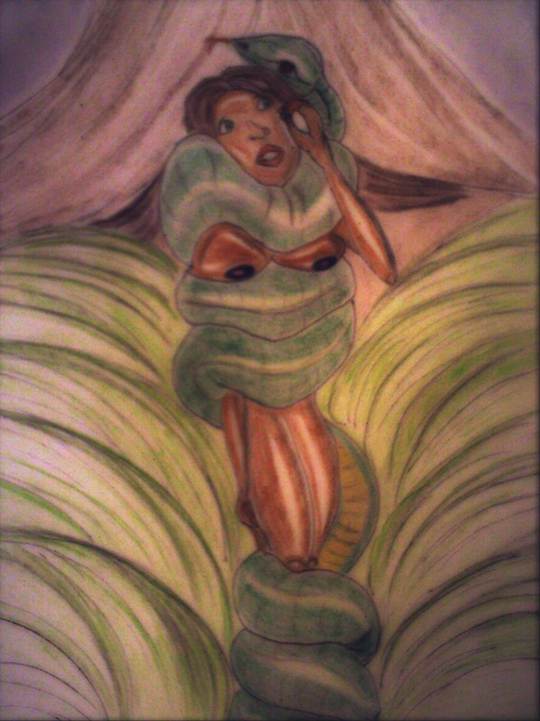
Oh wise Nyoka, may I nestle in your coils?

I have done a wicked thing

And I crave your indulgence

You sigh, little butterfly

What have I to do with thee?

For you are little and my hunger satiated

Why sleekest thou my embrace?

Oh wise python, may I sing of my sorrows?

I heard my friend call my name

And I behaved most shamefully

Sing on, sing on, sad child

You have aroused me at last

Thine heart is heavy, my blood cold

Bask on my scales and sing on, sing on

Wise Nyoka, cast your rainbow about me

The life of my friend is expired

And her spirit taken wing

Rest, rest, little child

For I perceive thy disparities

Thy skin is as the copper

Which flows through our soils

Thine emerald hued eyes glow with spirit power

Are we two not alike

We who embody the twin aspects of the other realm?

Thou art the light and I the darkness

Could the one be without the other?

Oh Nyoka, how thy skin ripples ‘gainst mine

Your coils are glossy and supple to the touch

Have your scales been born anew?

They have, they have, little butterfly

My old skin now basks on the summer stones

Soon the rains fall, lifting its colors from the dirt

And renewing the bow in the sky

But you grow still, little child

Thy limbs do not squirm so freely

Dost thou find my embrace too heavy to bear?

Dost thou fear me?

Oh grandfather of serpents, of you I have no fear

I have watched you in the twilight of the hunter’s stream

Clinging by my fingertips to the slippery stones

Wishing I could be your friend

For though I am small, I perceive that the same holds for you

Your giant brothers have all been forgotten

Except in rainbows and folklore

Alas, alas little spirit

Truly the days of my brothers are done

In this too we are allied

Both spirits shorn of relations

I of my brothers and you, your sister

Thou seekest counsel, warm skinned one

Such has been Man’s way in all the ages

From Natal to the shores of Delphi

I have counselled thy kind

What insights, pray tell, would I offer thee?

Oh Nyoka, my friend cried to me for shelter

But my foolish anxiety had undone her

Panic seized my heart and shut her from my thoughts

Listen, Nyoka! Even the drums condemn my trespass

My friend’s spirit has been cast away

And I know not where it has gone

Attend, attend little child

And heed, for what thou seekest is near

Search not the other realm

Mine eyes have beheld all its trespasses

Of thy spirit-kin I have seen none

Thy friend lives in spirit still

It is for thou to find her earthly vessel–

Ah! Thou squirmiest in me most pleasurably

Do you find my counsel not comfortable?

Oh wise python it is, but I am afraid

My strength is feeble, my inner sight poor

How can I accomplish this task?

You will try, little butterfly

Because you wish it–but not this night

Snuggle thyself tight, child, slumber in my blanket of coils

And we two will share thy warmth

Tonight the darkness and light are one

Dawn’s light shall find thee alone

But fear not

I will be near, to guide thee in thy quest

Though you see me not…

Prelude: RAW NERVE

The writer dropped everything when he received the cable. Laptop, medicine satchel all hit the mattress of his rented suite. The message was in the form of a text. Oddly enough it hadn’t come from Youssou but his uncle, Ismalla. Of course Jamai had sent him periodic updates, though recently at fewer and fewer intervals. He slumped onto the edge of the too-puffy mattress and re-read the message: 

MADRID; JAMAI IN HOSPITAL. SITUATION CRITICAL. KEEP HER IN PRAYERS. YOUSSOU NOT WELL. ISMALLA 

 The second question he had after the state of Jamai’s condition, was how in the hell had they both gotten to Spain. What kind of adventures had she been dragged into this time? He hesitated a bit longer, concerned that this might be a bad time. Mutual sympathy and more than a little of his writer’s curiosity compelled him to make the call.  

At first Youssou was unresponsive on his end of the connection. The writer tried twice more, and on the third try got his head bit off.  

“What the hell do you want? I suppose you want the whole story, do you? Haven’t you done enough already?”

            The writer was stunned into silence. Well, yes eventually he probably did. But he’s spent close to a decade getting to know her, digging into her past and yes he’d become a bit fond of them both, despite Youssou’s overprotective nature. Right now all he was concerned with was her safety–

 “I can’t talk to you right now!” Youssou growled. “The doctor’s already beaten me. He thinks this is my fault!” 

This? This what? What was happening–? He never got to ask those questions, never got one word in edgewise before Youssou shut him down. 

Now that the connection was severed a part of him was livid. He wasn’t after another juicy scoop, he was only responding to a desperate call! How the hell was he supposed to know what’d been going on?  Why hadn’t anybody told him they were in trouble? 

Over the next couple of hours he talked the situation over with his editor and family. He’d invested not only a lot of time but a lot of himself in those two feisty Africans. Whatever slow boil was consuming Youssou, he couldn’t let this go.

The best advice anyone could give was patience. Standby but don’t contact them. This was a time for family to come together. When the time was right, they’d be sure to open up. 

Fine advice, up to a point. Jamai didn’t have much family to pull around her. In fact her father was the one who’d exiled her in the mountains in the first place. By nightfall he was still in his newly wrinkled shirt, half-swallowed by the bed when Youssou called back. 

He seemed very much contrite this time around. While only a couple of years has passed since the last time they’d talked, Youssou’s voice seemed ages older. He apologized for his emotional outburst. Jamai was still critical, they’d know more in a few hours, but he felt he owed the writer this much. He’d been a good friend for many years, Youssou said, and didn’t deserve his antipathy. 

The writer assured him it wasn’t necessary, but Youssou couldn’t stop now. Whatever stress the pair of them had been through together had apparently been bottled away for a long time; he had to get it out. He didn’t know if another chance to talk would come.   The writer didn’t understand; why “if” and not “when”? He resisted the instinct to grab pad and scribbler; it seemed far too cold and insensitive given Jamai’s condition. Then Youssou began the painful journey, explaining that for a long time he and Jamai hadn’t actually been together at all. As quietly as possible, while Youssou spoke, the writer gave in to instinct. 

EXTRACT        

Counseling Session

Location: Undisclosed

Subject: Goukoni Hadebe/ suicide watch

–You tried to commit suicide two nights ago, correct?

–No, not correct. 

–You were discovered in your isolation cell hanging from your surveillance lens fixture, using a rope fashioned from strips of your own trousers. Must we confine you naked as well as alone? 

–If you’d read any of my court transcripts, or any of the interrogation logs kept by the Rangers, you’d understand I was simply trying to connect with our Mistress.

–But, according to Interrogation Log 7, you are supposed to perceive the entity known as ‘Mistress’ as your ‘Mother’. ‘Mistress’ implies a sexual context. 

–That is one interpretation. Another viewpoint is to conceive of her as our chief in exile, the agent on whose behalf we have operated. 

–And where would this personage be today?  

–Where? Where? Ha! If I knew that, would I have wasted my time feeding the unworthy to her?  

–Your parents have expressed an interest in communicating with you periodically.  

–I have no parents. 

–Now that is not correct. DNA/RNA comparisons…    

–They left me! I was abandoned in the Nairobi market and left to die!

–And who told you this?

–The Father, what others may call our Master, Bren Auflauring. 

–He was the one who told you they hadn’t looked for you. 

–Yes. Haven’t we gone over this before?

–Do you understand that this simply is not true? That they conducted a systematic search, ongoing for 19 months… 

–Now, that is the lie! That was their intention, to leave me alone, trembling in the market, surrounding by shopping, screaming parasites.  

–Would you accept the truth of what I have suggested, should I present the proof, search logs, diaries… 

–All that can be fabricated. All of it obviously was, if you were stupid enough to be taken in by it.

–Would you be at all interested in establishing a communication with your brother? 

–[static] 

–Mr. Hadebe? Is that a no? 

–I don’t know that he’d care to carry on such a dialogue. We parted on very strained feelings. 

–If you’d allow, we can establish a format for dialogue. It will be under strict control. Restrictions will be applied as to the topics of conversation you will be allowed to pursue. 

–Yes. Yes, I understand. I should like some time to consider. 

–I understand. You may give me your answer at our next session.

SHE’S LEAVING HOME

One: Continental Drift

Jamai: The one hope I’d clung to throughout this whole unpleasant adventure was that I’d be able to reconcile with my father. That I could tell him I forgave him for what he’d done. How could he know I wouldn’t understand why he abandoned me in the mountains? How could he know that I’d be stupid enough to come home, that I’d kill those Poppy Girls…

            Well, it didn’t matter. He wasn’t there and I didn’t see him. His possessions were either packed in our crawlspace or gone. Even our basement, which once overflowed with clutter, was a hollow shell. Only crickets skritched across the empty walls of our home.

            Youssou’s lost brother had been behind everything, from the murder of Bren Auflauring to the kidnapping of Mama Hadebe to the murder of his sister Ahela. The Children of Sydelle had taken over an abandoned rock church in Gondar, Ethiopia. That little misadventure had cost me the second hand I’d lost in barely two years as well as the life of our local Magistrate Jomoro al-Amain.

            I didn’t know of the bargain between Youssou and Jomoro. In exchange for liberating me from the Abyei-Bentiu prison barge, for what I then assumed was a temporary assignment, Youssou had essentially agreed to take me into exile, away from Baba Elgonyi forever.

Yousou’s father told us Mama Hadebe had commissioned two new holo-displays in our memories, one for Youssou and one for me to sit alongside Ahela’s holo on their bedroom mantle, so she could feel close to us even though we were gone.

I’d miss the Rangers. Though we’d only spent a few days rescuing Youssou’s mother from the Children of Sydelle, in the end I think they treated me as an honorary member. 

At Captain Cobalt’s direction, we spent the next several days convalescing at a veteran’s hospital in Addis. I hadn’t told anyone about the fist that closed on my chest when Massoud poured through the breach. Or the shade leering down at me through the vision of Sydelle’s home sphere. It was probably nothing; it’d passed. Youssou’s family had already done so much for me. Why add any unneccesary worry?

Youssou was interned in the Ocular Ward, where they fitted him with a prosthetic eye. This was purely functional. It had no special abilities, apart from the perpetual glassy stare it projected, even when he was blinking normally.

As for me, it was a bit of a shock to us both when a party of bare-headed monks greeted us one fine morning. I was convalescing in my recovery room, my arm all swathed in wraps. In appearance, they were very much like the ghosts at Menes Tabot. My nurse flanked me as they unfolded a silk wrap from a box of exquisite wood. Holy symbols were carved in each corner, connected by swirling rosettes. The lid cranked open stiffly and lying inside, cushioned in red velvet, was a new prosthetic hand.  

The epidermal covering was as supple as real tissue and even matched my dead mother’s Somali complexion. The lead priest explained that It had been handcrafted in the monks’ workshop in the Valley of Kings, in honor of my ‘purifying’ Menes Tabot. They had collected some of my stem cells from the Eukaryotic Cell Banks in Nairobi, with my father’s permission. That came as a great surprise to us both. Since the lab-grown tissue was essentially the same as mine, there would be little danger of tissue rejection.

An elderly monk with shriveled eyes, more of a dry husk than a man, smiled unnervingly as he lifted the instrument from the box. His little hands were quite warm as he unwrapped the bandages around my left wrist. He fitted the new member with a sharp ‘clack’ and stepped back as I tried to rotate it several degrees.

We all laughed as it did indeed rotate–360 degrees, and might have gone on doing so all day if I hadn’t slapped my right hand over it. “It will take some getting used to,” the old monk allowed.

Our final days mopping up at Menes Tabot were uneventful. While Youssou was being debriefed by Captain Cobalt, sometimes shouting, I stood in the mausoleum with the Rangers’ Medical Examiner as we removed the encapsulated bodies from their desecrated tombs.

I’d discovered late in our recent adventures that some of the bodies the COS had stored in these amber capsules were still alive. Sometimes I couldn’t help seeing the spirits of dead children, waiting until their particular coffin was catalogued. Sometimes they directed me to an amber capsule where another  poor soul might still be languishing.    

It took a great many days, and the ME managed to revive several trapped souls. By the end, a cue of spirits was standing around me, waiting to be taken.

            I suppose I should be glad to leave those fisis in Baba Elgonyi behind. Our people were a quarrelsome lot at best, and with few exceptions they’d shown the least consideration towards me. No, I wouldn’t miss them.

            What stirred the most trepidation was the certainty that I’d never raise the tinted sunscreen over my bed, and gaze at the first rays of dawn glinting off the peaks of the sacred mountain. I’d never cool myself in the waters of Mokoyo Springs, or relax in Nyoka’s coils under the pale moonlight. Ngai help me, I didn’t know where Youssou was taking me.

            I hadn’t even had a chance to say goodbye to Grandfather Esaias. Even if I could have explained that particular relation to Captain Cobalt, time wouldn’t have permitted it. The Council of Elders, now that it was coherent and aware of the bargains made, had voted to expel me on the completion of our mission. Well, that was done.

            At least they allowed us to stay for Ahela’s funeral. It was a special ceremony intended to re-inter her body, now that it had finally been recovered.  I thought it best if I declined the Hadebe’s invitation to attend the service. Mama Hadebe was very persistent; but my being there, among people who thought I was the one who’d brought last month’s attack down on them, would only be a magnet for trouble. Besides, I couldn’t tell her…couldn’t hurt her.          

No, that wasn’t true. I was being selfish. In a sense, Mama Hadebe had lost a son and a daughter all over again. If she’d known what I’d done, or hadn’t done…

They dressed in all their finery. I stayed behind in mzee Hadebe’s den with the aquarium. Before leaving they showered me with gratitude and hugs, a close circle of love I didn’t deserve. Then they filed out in solemn procession, mzee Hadebe first, followed by his wife and Youssou. He forced a smile but it was a façade, a pleasant face over the Krakatoa of anger boiling inside him.

It was scary to be near him now. I never knew when he’d snap, usually over the simplest things. And we were always together since coming home from Menes Tabot.   

What few possessions I still had had been sent in a duffle bag from Abyei-Bentiu, with a hand written ‘good-luck’ letter from Kimora. Youssou had been parceling out most of his possessions to his age-mates over the past week, distilled his property down to a pair of duffle bags. I stayed inside his family home, out of sight. 

            The quiet should have been soothing. The bubbling of Baba Hadebe’s aquarium had always been his den’s chief attraction. Now it only reminds me of the years Ahela and I used to play there as tots. There were not even ghosts here. Almost no ghosts, anyhow. A blanket settled around my shoulders. Gentle hands followed, easing me onto a heap of cushions below the aquarium, casting green shades over Mama and me.

            After the funeral, Cobalt’s men bundled our bags into the boot of Youssou’s rented skiff. Cobalt would allow us to take the rental as far as the rail station, and no further. There were no hugs, no parting gifts. We simply stood awkwardly nodding until Youssou helped me into the skiff. 

            Our journey on the speed-train was something of a blur. Youssou made liberal use of our dining car credits. As for me, I slept most of the way in our ‘stateroom’. Truthfully it was more of a hole in the wall; we barely had room to shuffle around ourselves to get to the washroom, an even smaller closeted affair.

            Our room was provided with a pair of sleep tubes, similar to the type used in Japan for rail travel. Each one was also provided with a Catch-&-Release strap, in case one or the other of us got stuck in our tubes. And tubes they were, transparent lozenges that barely accommodated my height, and Yousou’s less so.

            Still, at least I could watch the continent blaze past. The ride was so smooth that we barely knew we were in motion but for the savannah rushing past. Perhaps it was precisely because of that speed that grassland became forest, as abruptly as though we’d stepped through a door from one environment to another.

Sand sprayed across the undercarriage as we passed through the Sahara. I wondered what our ancestors would think of the changes we’d made in the past few centuries. Wouldn’t they have been surprised and pleased at the advance of the palm trees and the thick gen-altered grasses and shrubs converting the desert into a new playground.

            Part of me still hoped to see my father, even if it was only a passing glance. This reclamation project was his life’s work. I wondered what he was doing now, if he was alone or with Ms. Duma. Then I’d blink away the wetness and order the tube to go to transition phase. The tube’s surface shifted from glassine to darkness, and I kept sleeping.   

            Several hundred kilometers short of our destination we transferred, not to another rail line, but a boat. Our stop was at Bamako, an ancient city mingling among the forest. Its tall spires tantalized us from beyond the rail station, which was a short reddish soiled walk along a forested path to the port connecting to the Niger River.  

We used the remainder of our travel allowance to buy some snack packs from a shop on the dock beside the river. We grazed in silence while we waited for our ferry to plod up to its berth. Every pier was jostled with covered fishing boats. A fishers’ market buzzed with transactions and people alike. For all that, we sat alone, unminded by the people rushing about their business. The river sloshed beneath the piers, a soft susurration that might lull the unwary into its embrace.

We boarded a spear-shaped, flat-topped launch which soon coasted beneath a pair of oxidized bridges over the Niger River, as cinnamon as the foot paths on the shore. Centuries ago, these spans might have been hundreds of meters above the water, yet now as they blotted out the daylight they seemed only a couple stories above, so huge I could brush it with my hand, if they were as close as they appeared.

I assumed it was an official launch by its austerity; just two rows of double-seats on starboard and port, facing each other across a a narrow walkway. Ahead of us lay a hatch leading to the wheelhouse. To the rear the engines churned the river to a white froth behind an open deck.

My stomach was doing lurches as we weaved among the boats clogging the river as in days of old. Still they allowed for a broad passage between barges to keep the light green river traffic flowing, and to allow space for smaller pirogues to make their berth. I use these terms with experience, but at the time I really didn’t know anything.

A solitary egret balanced impossibly on one twig-like limb a few meters out from the mangroves hemming in the river from one end of the horizon to forever. I had the window seat. Beside me Youssou napped with his chin tucked into his chest, just like my–his father. In the rear pocket of the seat facing me was a small palm padd.

As I picked it up a small antenna extended. I plugged the buds in both ears for privacy, mine and Youssou’s as he snored. Good thing too, as the internal AI boomed through my buds, “Welcome to the West African Data Annex, sister. I will be your server for today. Please state your preferred language: Standard, Bamanakan, Arabic, Chinese–“

West Africa. That was another thing I’d have to get used to. “New Swahili,” I interrupted.

Jambo, sister. What do you wish to know?”

My gaze followed the current churning past these huge floating cabins cruising amidst the endless barges. Cheery bare-chested folk in outriggers paddled between the larger boats, waving to us as they stroked past, at times tying up to a cabin for a meal or supplies.  “Everything, I guess.”

“Certainly, but let’s narrow our information field a little.”

“Oh. Well, what about these barges we keep passing. There doesn’t seem to be an end to them. Why is this?”

“Adaptation, sister. The inhabitants live on these large vessels by necessity. What little arable land they had to begin with, was lost due to oceanic thermal expansion. What you see are not ‘barges’ per se but communities, cooperatives wherein peoples’ needs are grown and stored with the whole–“

“I’m sorry, grown?

“Yes. As you can now see, on several of these cabins are fishermen casting their nets as they have for times untold. Thse vessels closest to the mangrove shore, settled more deeply in the current, employ the science of hydroponics. In effect they are floating rice-growing factories, if we may use such quaint terms. It is not so different from the commerce that was conducted on the Niger ages ago, and is to this day. Have faith, sister. It is but a short journey to Al Zayati.”

So much had indeed changed. Old rivers such as the Senegal and the Gambia, and their namesake nations, were drowned in the polar meltdowns instigated by Western industry. Even the groundwater had been poisoned, by slow degrees, by saltwater infiltration.

I can barely grasp the numbers, but it’s well known that up to five million of my West African brothers and sisters were driven inland, all along our Atlantic coastline, refugees to forces beyond their control. Surely it was worse than the tribulations celebrated by our elders back in Baba Elgonyi. Refugees clustered in camps that could almost be cities of the forgotten. Now look at it.

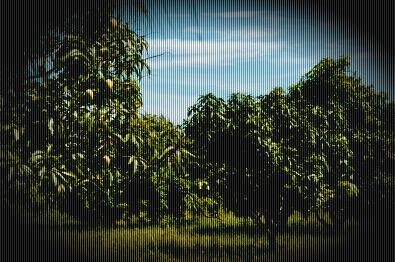
It seemed we passed under one last overhanging bramble, and then the river opened up onto a vast gulf, like a bowl had been hallowed out of the jungle and green water just flowed in. This was an odd sight indeed that so much water seemed to spread out for kilometers, yet at the same time was bracketed by  dense mango forests that retreated along the far horizon.

Dotted around the gulf like dominos were glossy black turrets. I would later discover these were filtration towers, extracting fresh water from the saline that had infiltrated the river from the ocean that now lay not far beyond the forest. Tubes leading like dinosaur necks from each tower transported the extracted salt to onshore depots, for packaging as culinary additives. For now this first sight was a wonder to behold.

Al Zayati was small even by the low standards set by Baba Elgonyi. There was a clinic adjacent to a one-block school house. Across the village’s main courtyard was a mosque and then a cottage hidden among the mango trees, home to the resident fetichers, though again I hadn’t known of this yet.

Along the shoreline, behind the port, ran a market whose stalls brimmed with fresh produce and fish. Admittedly even this was modest in comparison to the market in Addis, though it certainly lacked for nothing.

The docks Yousou led me along seemed a curious mélange of retractable piers extending like fingerlings into the gulf. The reek floating off the water was like the stench of rot that rose from the Sudd many nights around Abyei-Bentiu. This scent was carried on the wind, salt and mangos and algae seething to a fine petruscence.

The dockmaster’s house was a small bubble at the hub of port-side activity. Encircled around it was a gaggle of open-air cafes, servng a hundred sailors a day. Youssou made some inquiries among these fellows, who directed him to Pier 47, to where what we would call home for the next few months was berthed.

The pier was certainly solid enough, though a soft metallic rattle was returned to us with each footstep. The boat we approached seemed much like a cabin supported on pontoons. Good, solid guardrails circled round the boat at waist-height. The pontoons, or transoms, were equipped with swim steps built into their frames. A spread of netting was cast between them.

Right behind the mast, at the approximate center of a raised upper deck–the bridge deck, as I was to discover–lay the pilothouse. This was situated under a hardtop roof, with the helm station and wheel facing aft, to the bathing platform connecting the transoms. The pilothouse gave access to a walkthrough entryway into a salon.

Through this a little man darted across the deck with gangly limbs like a monkey. A thick goatee padded his chin while the hairs of his straggly mustache dangled into his mouth. Bare-chested, he was casually attired in khaki shorts that came to his knees and salt stained slip-ons that seemed better suited for bedtime than sailing. This was topped with a cap that we’d soon discover he was never without.

            “Jambo, Uncle,” Youssou called. “Kukuwazuka, this is my uncle, Captain Ismalla. This is his ship, the Broadside Brawn.

            We exchanged greetings, though mine might have been a little awkward. He gripped Youssou’s arm to steady him as he pulled him onto the stern-deck. Though they were as skinny as vines, the captain’s sinews highlighted every meter of arm. The boat seemed to jimmy beneath my feet as he did the same for me, with a grip like a lion’s jaw.

            Now that we were aboard, he seized Youssou in a full-body embrace full of joie de vivre. We followed him into the pilothouse, where he bid me wait in the salon. Once I was past the walkthrough, a screen slid across the entry. Whatever I could hear of their conversation was cut down to a murmur.

            The salon was a crescent-shaped dining area with maroon seating around the walls and a table down the middle. It was a beautiful room laid out in teak and false wood panels. Stairs to either side of the salon led down to the port and starboard hulls.

            The boat shimmied again, twice. Hearty greetings were exchanged, and I was treated to three shadows thumping along the starboard hull outside my hideyhole. Three young men appeared on the midships deck, all in tank tops and trunks. Each bore a massive crate across their shoulders. Each set their load down carefully as they gazed into the salon at me. I waved, but found myself without words.

            The one I assumed was the eldest was the largest. He was of average height, that being compensated for by a thick barreled chest and limbs like pythons. The next one, though leaner than his sibling, was no less strong. His smile belied a gregarious nature that practically beamed from his spirit. The last man smiled at me, then headed back up the pier, returning with more crates he unloaded onto the deck before going back for more.

I kept my gaze on the deck as the eldest one approached me with a curious swaying seaman’s stroll. He took both my hands in his in a meaty grip and said, “Welcome aboard, sister. How may we be of service?”

Jambo,” I replied. “I came here with my friend Youssou. I don’t know what we’re doing here.”

His eyes alighted with an inner glow. “Ah! Father said you would be coming. Miss Jamai, is it? Good! I’m Leonard Howell, the captain’s eldest son. That one is Marcus Garvey, and the skinny one running up and down the boards is the youngest, little Marley. Don’t worry, he’s flighty but very dependable.”

I was running their names through my mind. “I’m sensing a theme,” I smiled.

“Yes. Father named us for the heroes of Rastafars,” Marcus boomed from the deck amidst a growing stockpile of boxes. Something in that deep basso voice made me feel more welcome. “The fathers of our religion, you might say.”

“There’ll be time enough for that,” young Marley said, dropping what was apparently the last crate on the pile already assembled. “Don’t you think we ought to offer our cousin a bite to eat?”

That would have to wait. I jumped as the pilothouse screen slatted aside so that Captain Ismalla and Youssou could join us. “We’re all here,” the captain said. “Good! Let’s get acquainted.”

“We already have, Father,” Leonard Howell said.

“I see you’ve met my boys. Aye then! Well, my elder bra,  Youssou’s father, has acquainted me with your situation. New hands are always welcome.” At last he approached me. “I remember you as a babe. Told the Council to get off‘a their bums an’ get ridda of that stupid Ant effigy. Dey wouldn’t believe but I knew it was a bad duppy that hurt you. 

“I can put you two up for a spell. I don’t know what duties I can assign to you, but we’ll find something.”

“I-I don’t understand,” I said. “What am I supposed to do? I’ve never been on a boat in my life…not in real life, anyway…”

“Jamai,” Youssou cut in, “we don’t have a lot of options.”

But the captain squirreled between us, waving his hands in an absurd fashion that was probably meant to be calming. “Ahhh, let me explain exactly what we do here. The Broadside Brawn, she is a cat…that is, a multihull catamaran me sons and I built at the docks of Bamako. She’s vitually unsinkable. We’ve made our berth here. There’s a fair amount of traffic, and fewer people here. Not so many questions about who you are or where you came from.

“We rent ourselves out as a charter boat, ferrying interested parties to the sites of undersea ruins so they can dive among the cities that were inundated when the ice caps melted.” He illustrated his words with upper-body pantomimes of swimming bodies and an upward sway of his palms.

“There have been times we been contracted out to actual scientific parties, underwater anthropologists, to have a swim an’ see how marine life made themselves at home in our deluged premises. Everyone pitches in. it’s not the most lucrative enterprise, but we manage.

“One more thing. It’s a sore point my elder bra raised. Do you have a swimsuit?”

“What? No!” That seemed an odd and very inappropriate question. I’d never needed one for my swims in Mokoyo Springs at home.

“See, we know you’re free-spirited, but we’ll be having a great many guests on this boat. Some of them can be more conservative-minded than others. I try to be careful with my clientele but, well, men can’t always be trusted.”

His boys, I noticed, were all nodding while trying very hard to avert their stares. Surely my body couldn’t be that…Still, I fastened the top snaps on my blouse. For all that helped, since it was already soaking in perspiration. “Will I have time to shop before we leave port?” I asked.

“Aye, we have a few days to stow provisions an’ get the pair of you settled in. That’ll be no problem. Tell me, nephew, do you have any mechanical aptitude?” Youssou shook his head. “Nephew,” said Ismalla with a grin, “I guess we got your berth all lined up.”

Her Last Chance 7

SEVEN

“Well, if that isn’t typical. I wonder what I did to provoke that.”

Lianna shrank in her seat as Ernie adapted a power pose, leaning over her with his hand grips pressed to his robotic midsection. “This is hardly a laughing matter,” he said. “FAITH has operated with virtual impunity on this station. Having successfully driven all its non-Human visitors to their respective homes, they will have little to inhibit their efforts to remove you. Their congregation may perceive these deportations as proof of divine sanction.”

“They’ve tried to remove me already,” Lianna said, rubbing the back of her scalp.

“It may be prudent to consider an early departure.”

“What, quit because of a bunch of religious crazies? I’ve been in trouble before, and I have been engaged for a full month with my symposium.”

“Which by all appearances may be suspended indefinitely.” Ernie eased back to his normal posture, his palm pad raised. “You also no longer have only yourself to think of.”

Her gaze followed his to the kitchenette, where Gita and Little Stavros each balanced in a head stand on the kitchen stools. Part of her admired the little tykes, that they could so easily balance on such a small rotatable cushion. A more powerful urge propelled her across the suite with both hands grasping as Gita tumbled down.

She needn’t have worried. As she unfolded from her headstand, Gita’s legs merged into one thick trunk that flowed down to anchor her safely on the deck. Little Stavros’ fluid body performed a similar feat, projecting a fluid column to flow down. Then Granny beckoned from across the suite: “Baby, come here.”

Lianna peeled herself away from the girls and crossed to the couch. Granny took her right hand and pressed it into Amba’s. She overlayed her own large hand over the top of theirs. “This is going to be an adjustment for both of you,” Granny said. “You’re not going to be able to keep on with the hare-brained stunts you’ve done before,” glancing pointedly at Lianna.

“You’re going to find your private time extremely limited, which will make it all the more precious. That won’t mean your love for each other has been diminished. I know Lianna has lavished a lot of attention on Gita in the last few days. Maybe she hasn’t included you as fully as she should have in this transition,” she added now to Amba, “but you needn’t fear. Believe me, Lianna has more than enough love to spare for both of you.”

Gita padded beside Lianna, looking first to her, then at Amba. Now she slipped her small hand beneath Granny’s to grasp Amba and Lianna’s. Initially Amba’s translucent head was bowed. Then she focused on Gita. A smile formed on her lips, and her arms opened wide. Granny stepped back to give them space and found herself standing beside Lianna’s other ameboid companion, Stavros. Below her, Little Stavros signed, –She is very unhappy.

“I imagine so,” Granny whispered. “But now that you’re all together, things will look better.”

-That was not our meaning, Stavros replied.

Granny frowned, but she had witnessed this before, the smiles too thin hiding an inner turmoil. She’d wrestled with such trauma herself often enough. “You’re very perceptive,” she observed. “Have you always been female, or was it something you learned from Lianna?”

Her signing flowed surprisingly well. –Gender is unknown to our colony. We have no need for such fluid concepts.

And for a moment. Stavros smirked. “I never knew ameboids could be such smartasses,” Granny said.

-We have had many years to observe her, and to glean her thoughts. Lianna dwells on her parents much. There is too much time between worlds to think. It is part of why we surprise her daily. It serves to distract her from her pain.

They watched as Amba joined her hands, quite literally, into one long tube uniting her arms, sliding a protoplasmic mound back and forth beneath the surface of her epidermal layer. Gita gazed bright-eyed as the mound shifted between her forearms, occasionally poking it with a forefinger. “You seem more comfortable with this relationship than your partner,” Granny said to Stavros.

-Our home is more hospitable than Amba’s. It contains many warm pockets, geothermal vents in your terms. Amba’s world is harsher, not so blessed with light, which may attribute to her assertiveness. Gender is an adaptive frame for us. It suits our compatibility.

She knelt before the child ameboid next, making eye contact as it were. It was difficult knowing what sensory ability those button-sized orbs possessed, if any. “You seem very wise, for one so young,” she commented, signing as she spoke.

Little Stavros’ body jiggled as though from giggles, but she signed as well as her parent body. –We carry all the memories of our progenitors, as well as of the world-atman we are separated from. We only lack the lived experience of an individual.

“Time will take care of that. Will you carry these life experiences home with you someday?”

-Our thoughts are connected still with the world-atman, our mother colony. All that we know, we share.

Granny whistled. “That’s amazing. Can I hug you?” The baby ameboid nodded, then jumped into Granny’s open arms. Her smooth epidermis was cool to the touch, but the embrace was sincere. The two of them ambled over to Lianna, while Granny approached the last person in Lianna’s extended family.

“You appear to have found joy in Miss Lianna’s happiness,” this great crimson android she’d called Ernie commented. “May I ask why you are regarding us this way?”

Granny frowned. “In what manner do you mean?”

“This intense regard you have focused on us, in correlation with that peculiar tilt of the cranium.”

“I’d just never examined an android in such close proximity before. My people deride your kind as soulless automatons, forgive me, but you…May I?” Granny leaned closer, raising her right hand, palm open. Gently pressing it to Ernie’s cranial unit, she shut both eyes—then stepped back with a sharp gasp. But giggles soon followed.

“Is something wrong?” Ernie inquired.

Granny shook her head. “On the contrary. There’s more to you than you realize, my friend.”

“Thank you.” Ernie inclined his upper torso ever so slightly, then wheeled beside Lianna, who was seemingly entranced with Gita and Amba’s interchanges in sign. “I must return to the ship, Miss Lianna. Enjoy your stay.”

“Will you be all right?” Granny asked.

“I believe so. Androids are not considered living beings by the FAITHful, and are therefore not capable of unrighteous behavior. Be well.” He pat Lianna’s right shoulder while she nestled to his hand. Then as efficiently as any other machine, the door whisked shut behind him.

They settled into an awkward companionability. For an hour they played cards, Lianna at the end table with Stavros and Amba, while Gita, Little Stavros and Granny congregated around the kitchenette counter, though it was hard to bluff beings who could read your tells as easily as they read minds. Granny disappeared at some point that afternoon, so Gita slipped into Lianna’s lap, her trunk wound twice around Lianna’s waist. Little Stavros did much the same to her progenitor, while Lianna reached across to Amba to squeeze her hand.

Granny appeared distracted upon her return, not acknowledging Lianna’s greeting until she repeated it. She prepared a heaping bowl of jollof rice without comment, with sahlab drinks on the side. Lianna grinned at the cinnamon mustache it imparted to Gita. While Amba and Stavros seemed to be meditating over the bowls in their laps, she could almost perceive the silicates draining from bowl into their translucent bodies. All this before the nighttime interruption over the station’s public amplifier:

“The purification of our home system is nearly complete. The invaders have been turned back to their heathen worlds. Therefore, thus saith the Lord God, behold I will stretch out mine hand upon the Philistines, and I will cut off the Cherethims and destroy the remnant of the sea coast—”

Granny lifted her head, then jabbed at her jollof. Lianna scowled as the lesson continued:

‘And I strike down on them with great vengeance and furious rebukes, and they shall know my call sign is Sandy One when I—what the f—Nick! Jesus Christ, this is not Ezekiel–!” Somone must have had hindsight enough to ‘cut the mic’, as it were. Everyone chuckled at this snafu, even the ameboids. Except for Lianna, who had a question for Granny.

“What do you know about Kali?”

There it was, a half-moment of hesitation as Granny scooped another mouthful of rice. “I saw her in your entryway mirror,” Lianna persisted. “While you were dancing.”

Granny huffed, setting her bowl aside and sipping her sahlab. “She is the goddess of Death and Creation, the Divine Mother who leads us through darkness and chaos, into clarity and enlightenment. Time and death are embodied in her, and somehow are nothing to her.”

“That’s interesting. Most people preface that with ‘according to Hindu myth’. You speak as though you know her personally.”

“It’s not possible to know a god personally.”

“Even so, what’s that got to do with me, or you? Are you supposed to set right what once went wrong and whoosh away? That seems kind of silly.”

Granny nodded. Gita’s gaze kept shifting back and forth between them. “I never lied to you,” she said. “My grandson sent me here because he thought I might find solace here. Instead I found myself staring at a reflection that was not my own. At first I thought it was a manifestation of some form of madness, but the reflection followed me in every mirrored surface. I tried to ignore it. And one day, the image stepped out of the glass into my suite.

“I fell back into my lounge as she stood over me, tongue flicking blood drops onto my shoulder. Four hands braced my cheeks, and she made a bargain. I was to be her avatar, your guardian in a time of trial. And when she was satisfied, she would unveil the mysteries of my visions.”

“What did you see?”

Granny pursed her lips, her eyes clouded over. But her hand stroked Lianna’s cheek as she shook her head. “What is Kali to you, baby?”

“You keep calling me that.”

“When you get to my age, everyone seems very young. And?”

It was Lianna’s turn to squirm in her seat. “I-I think she may be my mom.”

“That’s an understandable belief. As an avatar of motherhood—”

“No, you don’t understand. I think she’s my literal mother, reincorporated as an avatar of Kali. I know it’s crazy, I saw her. I was hiding under our sleep bunk when my dad—”

Amba placed her hand on Lianna’s neck. “It’s okay, beloved. She knows. I can see it in your eyes, Granny. There’s a sadness clawing at the surface, even past that sweet smile of yours.”

Granny returned Amba’s gaze. “Lianna doesn’t have to tell me anything. Whatever she chooses to tell me will remain in the strictest confidentiality.”

-But the kid is hearing everything, Amba signed.

-The Kid can read, Gita signed back with a wink.

“It’s hard to explain,” Lianna continued. “My parents studied the ancient Hindi beliefs at university, and they thought they found an intersection where our physical science and the Vedas overlap. They thought there might be some objective truth to be discovered. That was one of their motivations for booking passage on the Lost Ship.”

“The Naga Sentry.”

Lianna shook her head. “Lost Ship suits things better. They spent a big chunk of their savings on a shuttle pod we stowed in the cargo hold. Well, you know how that turned out. She was there when I crossed over the singularity at Alexis 7. I shouldn’t have survived that, but here I am. She set my dad on the path of samsara, Kali knows for how many cycles of rebirth, and…she sent me home. Back to the observatory. The professor was sure surprised when I popped out the wrong end of a garbage chute.” She laughed, suddenly aware of Granny’s hand clasping hers, that she probably had been throughout that whole sad story.

“I saw her again in the microverse. That’s something else those religious nuts would freak out about. She gave me a tail to remember the experience by.” Tea sprayed across the table. Granny gingerly wiped her mouth. “Probably sounds crazy to you.”

Granny smiled. “Hardly. I’ve seen too many things—lived such extraordinary times—that I can hardly dismiss anything lightly.”

“So where does that leave us?”

“A little closer. A little more entangled—” Her mouth scowled as the FAITHful kicked in again over the station’s loudspeakers, an all-male choir bellowing the first verse of “Amazing Grace”.

“Is that the only goddamned song they know?” Granny muttered. Before they knew it, Granny was out of her seat, crossing to the panel by the suite’s entry and flicking the audio from OPEN to DBM. Blessed silence now filled the airspace.

Sleeping arrangements were quicky settled. Lianna would stay in the living area with Amba and Stavros, while Granny would have her bedroom and the children could cozy up in the spare guest room. Sleep itself eluded Granny. Apart from her first two weeks on this bleak, dead rock, she hadn’t spent a night alone in lo these last twenty years. When she cast her thoughts back across those many passionate nights with Arthur—

Fine, time for a sleep aide, she thought, tossing aside the blankets. She yawned , shuffling into the living area, and yelped at what awaited.

Lianna’s skinsuit was tossed across the lounge, while Lianna floated up to her nostrils in a rubbery blob, her body barely an outline within an oozing mixture of red and aquamarine protoplasmic tendrils. Bracing her head and shoulders were the upper torsos of Amba and Stavros, regarding her with almost clinical indifference. Emanating from this shifting mass was a faint aroma of cinnamon and honey. Amba shifted her gaze to Granny, smiling as she lifted a finger to her lips. Granny nodded, sleep forgotten as she inched backwards toward her bedroom.

She kept backing up, jumping when a small hand brushed the back of her thigh. But it was only Gita and Little Stavros standing beside her bed. “H-hello, little ones,” she stammered. “What’s troubling you?”

-You don’t have to worry about Mama Lianna, Gita signed. -Those faithless mortals are afraid of her shakti. It’s powerful, as yours is. It has opened doors that welcomed her on many worlds.

Shakti. If Granny recalled correctly, that was the universal feminine energy manifested in the goddesses Durga, Kali and every other woman on the planet Earth. It was central to the power of creation. -I’m glad you recognize this, child, Granny signaled back. To Little Stavros she asked, -Is that what brought you here as well, child?

-I was just wondering what it is a granny does, Little Stavros replied.

Granny laughed, dropping to her knees to wrap both babies in her arms. “A granny’s there to hug you and spoil you before we give you back to your mama, baby. Speaking of which, would you two like to spend the night here?” They both nodded vigorously. Granny slid onto the mattress and the children bounded up on either side of her, wriggling up to her chest. She smiled as she snuggled the blankets up around them.

Dawn, as least as Earthers such as herself reckoned it, signified as softly as was intended. The internal lights in the living area shifted from pitch black to a soft amber glow. The babies had cuddled close together in the night, Little Stavros snug to Gita’s back. Granny eased off of her side of the bed, making certain the girls were tucked in before padding into the lounge.

Lianna was still lip-deep inside her undulating cocoon, each undulation in synch with her reduced breathing. Granny no longer questioned this; given her own youthful sleeping habits, she understood the attraction, the subtle sensation of safety and companionship so often denied by her own kind. Instead of rousing them as she would have with her own school children, she hiked up her robe, settling into a lotus position three meters away on the floor.

Though Lianna appeared settled within their mass, Granny sensed the ache buried deep, within, and the words were called forth: “Some say love/ it is a river/ that drowns the tender reed…” She had their attention. Both ameboids turned their heads. By some intuitive instinct they settled Lianna’s feet firmly on the floor. Stavros brushed a glistening crimson hand to Lianna’s left cheek. She blinked, and Granny could’ve sworn that Amba mouthed, it’s her song.

Her voice cracked as she finished the first verse. Their swollen torsos meanwhile contracted into more humanoid shapes, two pairs of arms steadying Lianna while she regained her equilibrium. She smiled at her lovers, edging towards Granny with hands crossed over her nakedness. Granny extended a hand to her as Lianna joined her on the hallway floor, rocking slightly to the rhythm of her words.

“My mum knew that song,” she whispered. “It was passed down from mother to mother since the fall of civilization. Where did you…?”

“A young girl taught it to me, on my mission, “ Granny sniffled. “My teammates taught me many songs that were lost in the final wars. We sang them in the refugee camps to cheer the lost, the displaced.”

“You know. What it’s like to be alone. Standing in a crowd of people, and you might as well not exist as far as they’re concerned.”

“Yes.”

“How do you stand it?”

“Oh baby, the hardest lesson I’ve had to learn is to take pride in what you do, make your work the best it can be. Executives, presidents, whoever is in charge, they’ll never be satisfied with what you do. We have to make the best of our own little worlds, and the people closest to you will appreciate what you’ve done.” Her jade eyes bored into Lianna’s an insistent pleading she had to shake off. Luckily the trill of the comm panel buzzed them.

“Excuse me.” Granny patted Lianna’s arm as she eased up, knees popping. She took a seat on the lounge. “Open.”

Cassie’s image, from the waist up anyway, popped into a bubble over the end table, dressed only in an oversized nightgown. “Miss Hadebe, is Lianna still with you?”

“She is, Commander. How may I help you this fine morning?”

Cassie’s features rendered into a scowl, which seem directed towards Lianna. “I regret to report there’s been an incident in the hydroponics garden. I’m making every guest aware of the situation.”

“Sounds bad.” Particularly since Lianna, Granny and Cassie were the only other humans left on the station.

“You haven’t heard the half of it. That bay provided all the fresh produce this station relies on. All the fruits and berries and greens…well, it’s gone.”

“How can it all be gone?”

“We had a cascade failure within storage containment. Coolant control received a faulty series of commands to shut down inside the hydroponics pods. Several of the lines carrying the coolant fluid subsequently ruptured due to the sudden temperature flux, and sprayed all over the produce. We haven’t determined how much produce has been toxified from the resultant condensation. Security is still assessing our losses. It may take weeks to purify the soils in the pods, and weeks before a resupply vessel could dock from the outer planet colonies.”

“That sounds like an awfully specific set of circumstances to be coincidence,” Lianna interjected.

“I know, but you can’t blame FAITH without proof.”

“It still seems self-defeating. Wouldn’t that affect them, too?”

Cassie’s view shifted toward Lianna. “Not in the short term. They declared their personal cargo, which was loaded with processed foods from Mars when they arrived. If they ration, they could extend their supplies into weeks, but yeah, eventually they’ll be in the same situation as the rest of us.”

“Mars? I thought they were an Earth-based congregation.” She glanced irritably at Granny. “Well, they never explained where they came from.”

“Not really,” Cassie explained. “The workers guilds on Mars arose from among the labor class who objected to the excesses of their equally foreign overlords. Look, we’re doing what we can down here. I suggest you ration whatever fresh produce you have and take stock of whatever canned goods you have on hand. We may have to go lean for a while.”

“I understand,” Granny said. “Thank you for your concern, Commander.” After Cassie’s image faded, her fist thumped on the table. Twice. Repeatedly. Lianna inched away, pushing a nervous Gita behind her legs. They both jumped as Granny swept the comm unit, a portable array half the size of her chest, across the halfway into the adjacent bedroom. Components clattered like glass across the floor. Lianna inches closer, every nerve tingling. “Granny…?”

Granny’s head snapped around so violently they both jumped again. But her eyes were strained, almost screaming for any shred of sanity. “I’ve spent the last twenty years fighting this exact kind of insanity!” she snarled. “My people have been freeing the enslaved, protecting the vulnerable from every sadist cloaking themselves ‘in the armor of God!’” –for a moment she struck an exaggerated pose, one hand raised as though to Heaven—“Now when I come here, I find the same voices crying the same false doctrine, raising every voice against the ‘outsider’, the infidel, never seeing the blood dripping from every word out of their filthy mouths–!”

She hunched over the end table, muttering to herself. “Is there anything I can do?” Lianna asked. But her mind seemed to be somewhere else, especially after she turned her gaze toward the time piece set in the wall above the restroom. “I have to go,” she said.

-She’s doing it again, Gita said, and Lianna nodded.

“And what would I be doing, baby?”

“Taking off like you do every afternoon at this time.”

“It doesn’t concern you, baby. You need to stay here where it’s safe. Take stock of our supplies—”

“SAFE?” Lianna laughed. “I’m not paranoid, Granny, and I’m not stupid, either. I know how these stations are constructed. Those hydroponic pods have triple security protocols. There wouldn’t be a systematic failure on this scale. This was deliberate, and I’m not leaving YOU alone, either. I’ve seen this kind of single-mindedness before, in me. We’re coming with you. Right?” She said to Gita, who nodded.

Granny shifted gazes from her to Gita, until at last she sagged. “I don’t suppose I can keep you prisoner here. You’d better get dressed, then.”

A faint metallic ting rang with each footstep through the empty corridors. The lights were dimmed to conserve power, automatically illuminating brighter for the sections they marched through before dimming again behind them. Gita was swathed in a sari with a pink and white flower pattern. Lianna had slipped into her trusty skinsuit, which was all she had with her. Granny slipped into a robe of red and green and gold embroidered with geometric patterns.

They followed her back to the Portal. Once inside the alcove, Granny’s right hand slipped between Lianna’s gloved fingers. She thought skin-to-skin contact would be necessary for what Granny intended. Apparently that wasn’t the case. One moment they were alone and the next she was there, illuminated by an incandescent corona emitted by her pale body. Even seated it was quite evident she would’ve been tall in life, hairless by Terran standards, with a circular plate where a mouth and nose would be.

“Not what you expected, is it?” Granny asked.

Lianna shook her head. “I know her,” she whispered.

Granny frowned. “How could you? She’s been here since this station was constructed 37 Earth years ago.”

“That’s it, exactly.” Lianna stepped around her, hands steepled before coming apart to form signs she knew well. She suddenly understood Bon’s mission to this station. -Freya.

The entity’s head raised, tuned in to Lianna, who continued. -Greetings, star sister. Your passing has not been forgotten. Our brothers sing dirges every season for yourself and all those who have been lost to the Clan.

Freya stared unmoving, seeming to examine Lianna as though she were a doll. Then her hands, all three fingers, flowed into a tapestry of sign. -You speak our words?

Lianna grinned. -I try. Forgive my clumsy attempts. I’m not as good at your language as I wish.

-Do not weep, sister. Your signs are very elegant, even given your stiff appendages.

Gita had joined them, slipping in beside Lianna and brushing Freya’s spectral hand, mouth downturned and eyes downcast. Her hands were as fluid as her flowing trunk. -Be of good cheer, reverend mother. You’re among friends. My mother speaks highly of our many sojourns and the happy festivals our peoples have shared.

-The aliens had driven my brothers afar before our remains could be taken home. Angry beings like your companions. And yet this one knows our ways. She nodded first to Lianna, then at Granny. -That one has a big mouth.

“That’s not the first time anyone’s said that,” Granny muttered.

-These two are not like the others. Granny is a seer among these people and Mother Lianna has been given charge of us in this special time. She could get you home. Gita glanced pleadingly to Lianna. -Pleeease?

-Absolutely, Lianna nodded as she signed. “Granny, come here.”

Lianna beckoned her closer, taking Granny’s hands and raising them to her temples. Briefly she frowned, her thoughts clouded as Lianna focused on the star charts she’d used to navigate to Freya’s home world, narrowing on the journey through folded space onto a pale blue globe with splotches of brown land masses eased into her field of view, until at last Granny knew which star-point to guide Freya towards from here.

Silently she offered her hand to the lost spirit as she gathered her precious bundle to her breast. Freya’s disc seemed to brighten as her hand brushed Gita’s cheek. She followed Granny to stand by the Portal where all visitors seemed to congregate. With a hand rubbing Freya’s back, she pressed a thumb to the glass, pinpointing one flickering point of light in the northeastern quadrant. For the first time Lianna noticed how close in height they appeared, and how short she really was next to them.

For a moment the nimbus glow around Freya increased in intensity as she laid her hand over Granny’s. Then nothing, unless you count a streak of light that seemed to beam towards that distant star like a comet’s tail. Granny’s sad smile spoke of another lost soul given some measure of peace, perhaps another short entry in her log book–

The charges shocked her out of those thoughts.

Granny jumped, too, facing toward the bulkhead housing the Portal viewport. Flashes banged in a ring around that section of plating. Suddenly the wall facing Granny blasted away into space. She had no time to grasp at the edges, not that would have helped against the outrush of atmosphere. In a moment she had been swept into space.

Already the emergency bulkheads were shuttering on this section. Gita squealed as Lianna bundled her in her arms, then tossed her between the doors thundering shut. Without a second thought she whirled, her legs a blur as she pelted into the breach, pushing off after Granny–

review: Al Stewart & the Empty Pockets Live (2024)

Amazing how times passes. Fifty years have gone since The Year of the Cat, the Bicentennial Year of these United States, a once in a lifetime event in the middle of a time of national trauma and doubt. The man behind that album, Al Stewart, is on his Farewell Tour, as perhaps he should since he’s going on 81 years old this coming September. So it was a happy surprise to receive his latest CD in the mail.

(Well, not so much; I ordered it online on purpose, but anyhow…)

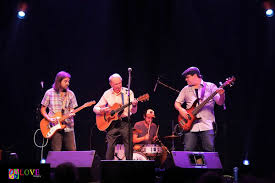
Al Stewart & The Empty Pockets Live was released through Stewart’s own label, Wallaby Trails Recordings in August 2024, a double-CD covering his 1970’s glory days. The Empty Pockets hail from Chicago and play a listener-friendly variety of rock reminiscent of the early 70’s. In 2008 your kids may have heard their music on Nickelodeon shows like iCarly, Zoey 101 and Drake & Josh. They’ve toured with many legendary artists, including Richie Furay of Buffalo Springfield, Gary Wright and Stewart, as well as recording with Simon Kirke of Bad Company.

The Empty Pockets began touring with Stewart in 2022. This CD was recorded at concerts “across America”; it’d have been nice to know where and when, but I’m nitpicking. This is obviously not going to be a loud knockout concert experience like a KISS show, because that’s not how Al Stewart rolls. His music is the kind they don’t play on the radio anymore, a more thoughtful, intimate variety roiling with poetical lyrics and historical references.

It opens with “Sirens of Titan”, a song inspired by Kurt Vonnegut’s 1959 novel. The band seems to replicate the sound of the studio songs well enough. Stewart carries every tune with that familiar Scots voice, though it’s not as expressive as it used to be. That’s to be expected, since he’s not as young as he used to be. Between songs he engages in some light chatter, the first time to segue into “Antarctica”, from 1988’s Last Days of the Century LP.

Of the five studio CDs he recorded between 1993 to 2008, actually, here he performs only two selections, the aforementioned “Antarctica” on CD-1 and “Joe the Georgian” from 1995’s Between the Wars. The setlist leans heavily on his better known works Like 1975’s Modern Times (“Sirens of Titan”, “Carol” & “Modern Times”), 1978’s Time Passages (“The Palace of Versailles” and the title song), and especially The Year of the Cat; six of that album’s nine tunes are performed, strangely enough in the same running order as on the album.

After “Palace of Versailles”, Stewart invites Peter White, his co-writer on ‘Time Passages”, to join them on stage to play his nylon string guitar while Chase Huna blows saxophone; that part on “Time Passages” and “Year of the Cat” was originally performed by Phil Kenzie, one of rock’s great sax players. This is followed by a triple serving from Year of the Cat, first “On the Border”, “Midas Shadow” and then “Flying Sorcery”

The second CD opens with the oldest song in their set, “Soho (Needless to Say” from his 1974 release, Past, Present and Future, where keyboardist Erika Brett offers a haunting backing vocal.  Then comes “Carol” and the longest song of the night, “Modern Times”, an 8-&-a-half minute opus that actually seems to breeze by. “Broadway Hotel” is next (again from the Cat LP), then “Joe the Georgian”, an acoustic song which has the kind of Spanish guitar playing my mother used to play when we were kids. The final two songs are ironically or not, also the last two on Cat, “One Stage Before” and appropriately enough, “Year of the Cat”, a romantic interlude with hints of Casablanca in the opening couplet.

This was an enjoyable listen for people like me who grew up with songwriters like Stewart and Dylan and others who could create movies with their words. I’d liked to have heard some other tunes of his as well; how would they have done “Song on the Radio”, “Midnight Rocks” or “Russians & Americans”? Well done, Al. I wish you a happy life. To the Empty Pockets, great job and may the future bring good prospects.         

Al Stewart- guitar, vocals

The Empty Pockets: Josh Solomon—electric guitar, backing vocals

Erika Brett—piano, organ, strings & backing vocals

Nate Bellon—bass

Adam Balasco—drums

+

Peter White—nylon string guitar, “Time Passages”

Elliot Scozzaro—flute (“Antarctica”, “Palace of Versailles”, “Broadway Hotel”, sax on “Year of the Cat”

Marc Macisso—harmonica, “Flying Sorcery”

Chase Huna—sax, “Time Passages”, “Midas Shadow”

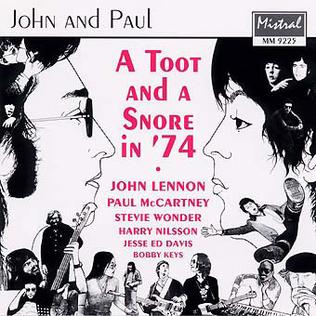
March 28, 1974: John & Paul share a Toot & a Snore

The way May Pang recalls things, “John and I were listening to playback. I was facing the door which suddenly opened and I mouthed to John, “it’s Paul and Linda.” John turned as if he had spoken to him that morning and said, “Hey Paul.” Paul asked, “Is the session over?” “Yeah but we’re about to jam. Want to join?’ And in that moment, five years of animosity and anger simply disappeared…Stevie Wonder came in from the studio next door. Linda joined in on organ. Mal Evans, the original roadie for the Beatles, and me, we grabbed the tambourines and the fun began.” (Narration excerpted from the 2022 film The Lost Weekend: A Love Story, some punctuation added.)

John began 1973 fighting U.S. immigration to stay in the U.S. while undergoing constant surveillance by the FBI, due to his political activism and promotion for peace. Under the pressure cooker of the times, John and Yoko Ono began to experience marital difficulties. He began recording Mind Games in June 1973; by August 1973 he and Yoko would be separated. It was Yoko who prompted May Pang, their personal assistant, to become John’s companion and lover for what turned into that time in L.A. known as the Lost Weekend.

John told journalist Larry Kane, “You know Larry, I may have been the happiest I’ve ever been…I loved this woman (Pang), I made some beautiful music and I got so fucked up with booze and shit and whatever.” May encouraged John to reach out to family and friends and arranged for his son Julian to visit him for the first time in two years. These would be the closest times Julian would share with his father, until Yoko drew him back.  

It’d be unfair to say John was just screwing around for those 18 months. True, he was smashed and doped up, but at the same time he produced the Pussy Cats album for Harry Nilsson as well as two albums of his own (Walls and Bridges, recorded in June to August, 1974, and eventually, Rock ‘n’ Roll) that recaptured the magic of songwriting he lost while on his Peace mission in the early 70’s.

John began recording sessions for his next album, Rock ‘n’ Roll, before producer Phil Spector disappeared with the master tapes. To top everything off, on March 31, 1974, Spector got involved in a car accident that left him in a coma. By his own estimation John waited eight months for Spector to come back with the master tapes. In that time he hung out with Keith Moon, Ringo Starr and Harry Nilsson, which involved getting drunk a lot of the time. With nothing else to do, John decided, let’s do an album with Harry.

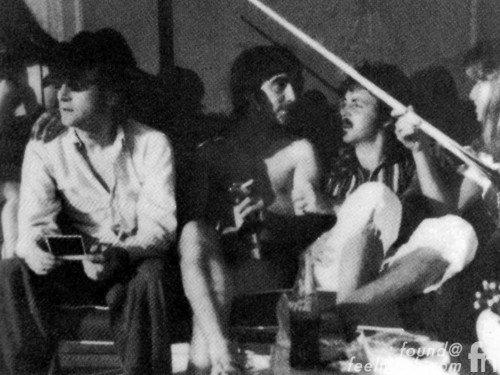
Paul and Linda McCartney dropped in on the first night that John was producing Pussy Cats with Harry at Burbank Studios on March 28, 1974. Paul sat behind Ringo’s drum kit (Ringo wasn’t present, though he has commented, “(he) always messes up my drums!”), and Linda behind the organ. They were joined by Nilsson, Stevie Wonder on electric piano, (he’d played with John at a few of his concerts, including the benefit concert in Madison Square Garden in 1972); guitarist Jesse Ed Davis, and saxophonist Bobby Keys both of whom had been contributing to Pussy Cats, and producer Ed Freeman on bass. Mal Evans was credited with ‘Tea’ and May Pang with ‘Sympathy’ (they actually played tambourine).

It was probably intended to be an impromptu jam session. What emerged was an incoherent mess with fragments of songs and the poorest recording of a jam session in Beatles history.  Do you recall John’s first three albums like Two Virgins and The Wedding Album, those experimental avante-garde records he spun off with Yoko Ono in 1969? This was worse. Which was too bad, since this would be the last recording session with John Lennon and Paul McCartney playing together since the breakup of the Beatles in 1970, unfortunately.  Even so, you know, it was all for fun.

This jam was first mentioned in 1975 in an interview with John, with more details following in May Pang’s 1983 book, Loving John. In a interview with ‘Whistling Bob’ Harris on the BBC2 music program The Old Grey Whistle Test, from March 11, 1975, John said, “I’ve worked with Ringo, I’ve worked with Ringo and George. I haven’t worked with Paul because we’ve had a more difficult time but now we’re really close, you know…I jammed with Paul. I did actually play with Paul. Yeah. We did a lot of stuff in L.A., but there were fifty other people playing too. They’re all just watching me and Paul.”

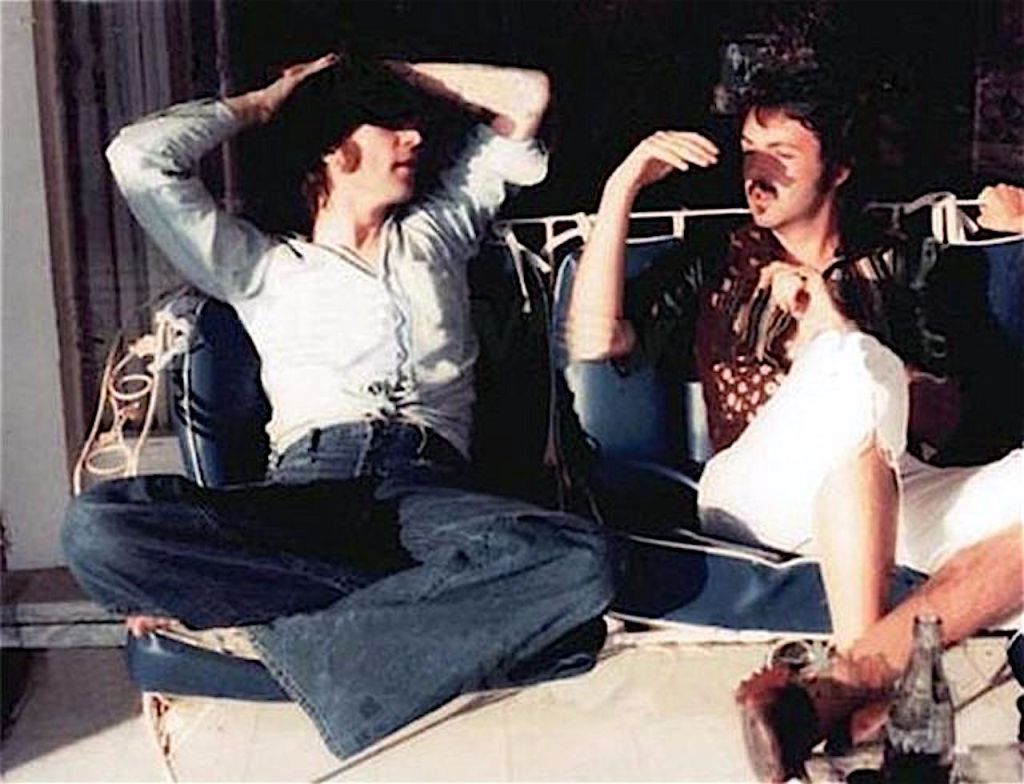
[The Last photos of John & Paul together, March 29, 1974, by May Pang]

Paul’s recollection of this jam went like this: “We were stoned. I don’t think there was anyone in that room who wasn’t stoned. For some ungodly reason, I decided to get on drums. It was just a party, you know. To use the word ‘disorganized’ is completely understating it. I might have made a feeble attempt to restore order—‘guys, you know, let’s think of a song, that would be a good idea’—but I can’t remember if I did or not.”

In a 1997 interview with Australian writer Sean Senett, Paul said, “(the) session was hazy…for a number of reasons.” Bobby Keys had been questioned a number of times about this session, but couldn’t recall any of it.

Track listing:

1-A Toot and a Snort (26 seconds)

2-Bluesy Jam Session (2:31)

3-Studio Talk (2;38)

4-Lucille (by Little Richard, 5:57)

5-Nightmares (2:37)

6 through 8-Stand By Me

9-Medley: Cupid/ Chain Gang (Sam Cooke)/ Take This Hammer (traditional railroad song)

On the first track, all of 26 seconds, John calls, “You wanna snort, Steve? A toot? It’s goin’ around.”  That’s how it begins. ‘Snort’ refers to cocaine, the ubiquitous drug at the time, which is where we get the name of this bootleg.

Paul laid a scattershot, random drumbeat, or tries to; no wonder Ringo was pissed off with what he does to his kit.  John improvised some words while the others tried to follow along: “I just gotta say it, Brooklyn Bridge, San Francisco Boot, Elementary Canal, Boston Strangler…it’s so wonderful to be waiting for my Green Card with thee…I would never doubt it, but I have to shout it, ‘Chicago, Chicago’, it’s a hell of a town, solo, play it man!” We’ve seen John spout these kind of nonsense lyrics before, in songs like “Come Together” and “I Am the Walrus”, or anything from his books like In His Own Write.  

John asked if anyone knew a song they all knew: “It’s gotta be something done around Fifties, or no later than ’63, or we ain’t gonna know it.” Stevie laid down a bluesy refrain for “Lucille” and the others pick up on it, with John screaming the words accompanied by Paul.

“Lucille” may have been the most coherent song of the night. The band began with three instrumental choruses on sax, organ, guitar and bass in a middle-tempo blues style, before John came screaming in with Paul on harmony. This is the only tune where one can hear those old harmonies like on their old records. John turns in a couple of ragged guitar solos. Paul and John sing a middle eight a capella section, followed by another chorus.

“Nightmare” was probably supposed to be the 1961 Shadows instrumental “Midnight”, and it might have been, if this had been a professional session. As it was John ad-libbed some lines, adding “Someone give me an E and a snort.”

John had repeated troubles with his microphone and headphones on ‘Stand By Me’. While the band is trying to find its footing, John says, “OK, OK, let’s not get too serious, we’re not getting paid…we ain’t doing nothing but sitting here together…” Despite a strong start, the second try breaks down after the first verse; worse, John is still having trouble with his mic. “If you’re trying to get rid of me guitar, tell me…It’s gone all sort of dead in the earphones, you know? Dead! Dead!…”

“Hand up, who doesn’t know ‘Stand By Me’?…Just turn up the f—-n’ vocal mic on! McCartney’s doing his harmony on the drums! Stevie might get on it there if he’s got a mic!” They get a decent harmony going between John and Paul on the third go-round, until partway through the song, John’s vocal mic fails and we’re left with Paul’s voice, joined by Harry’s hoarse voice on the last refrain.

Stevie tried to salvage the moment,  singing a couple of verses of “Cupid” by Sam Cooke with Paul; leading into “Working For the Chain Gang” (titled simply “Chain Gang” on the label), with Harry joining on vocals, at which point his mic started going bad, too. Paul leads a short version of the traditional song “Take This Hammer” as the tape fades out. That’s where this half-hour recording ended.

Bootleg Zone: John Lennon & Paul McCartney- A Toot and a Snort in 74

The Last Time Lennon & McCartney Played Together Captured in A Toot And a Snore in ’74 | Open Culture

A Toot and a Snore in ’74 (2023) Supersession, but what a bore/ Aril 23, 2023 by Graham Reid/ Elsewhere

https://www.elsewhere.co.nz/absoluteelsewhere/10686/a-toot-and-a-snore-in-74-2023-supersession-but-what-a-bore/

Availability:  For obvious reasons, there has never been an official release of this session, despite its historic importance as the last time John and Paul played music together. That hasn’t stopped the bootleggers; a CD was issued, unofficially, by Mistral Music, from Luxembourg, in 1992.

Infinity Abyss by Jim Starlin, 2002

That’s the problem with power-mad Titans like Thanos; you don’t have anybody to tell you, “Master, I think this is a very bad idea and I can’t support you.” Because you know what would usually follow: “AAAAAARRRGHHH!”

If there’s any complaint, it’s that we have to contend with yet another of Jim Starlin’s cosmic ninnies manipulating our lives, who never lifts a finger to intervene one way or the other. We also have a Warlock much preferable to the one given in his 1999 miniseries, one who’s finally able to appreciate and return Gamora’s affections, a lady he’s known through several incarnations.

From the first page our old friend Adam Warlock has been given to madness. The next five issues are spent charting how he got to that point. We might as well call this another regeneration, ala Doctor Who, since he keeps crawling into his cocoon and coming back to life. Before anything else, the mad Titan warlord, Thanos, almost dies in the hatching of a black hole. Now that’s one hell of a way to open the series. Starlin seems to have a fondness for motif, though he bends the laws of physics for the purposes of the plot.

His old friend Pip the Troll discovers Adam’s cocoon stuck in an intergalactic insane asylum. This is delivered to Thanos, who is forced to recruit the psychic Moondragon to probe Adam’s sleeping consciousness. By the end of the first issue we know at least that this is not the true Thanos, but four of his illegitimate clones, guiding the Universe towards oblivion. But who is the mysterious mystic bookending these stories?

The villains, all variations of Thanos, are a blend of android, clone and mystical dopplegangers, whatever the hell that means. And we haven’t met the fifth child, the Omega, a being gifted with the genetics of Galactus, which even the mad Titan admits was “a severe lapse of judgement”. But like all bad projects, once he got started it was a challenge he couldn’t resist.

Infinity Abyss was a limited series written and pencilled by Starlin and published by Marvel Comics on a bi-monthly basis, from August to October 2002, and was the last series I had read featuring Adam Warlock to date. Adam Warlock follows us throughout the series, a bleeding head in the margins providing the necessary narration. He’s back to the butch look he had when he was only known as Him.

Ever since the Infinity Gauntlet and the follow-up series, The Infinity Watch, every comic book Starlin did in the 90’s had to have an ‘Infinity’ Something tagged onto it. Jim Starlin pulls together a stellar cast, a near-reunion of the Infinity Watch, consisting of the usual suspects: Dr. Strange, Gamora the adaptive daughter of Thanos, Moondragon  the daughter of Drax the Destroyer,  plus Genis, the son of Mar-vell who became the second Captain Marvel, and…Spider-Man?

The story introduces us to yet another abstract being, Atlez, a nice enough fellow. At least he doesn’t seem hellbent on meddling/ screwing with ordinary people’s lives. He just does his job securing reality, but I think we’ve had enough of these jokers f—ing with the cosmos already. My god, there’s Eon, the Stranger, Chaos and Order, the Tribunal, Eternity and Infinity—AAAUUGH! Just how many more of these interdimensional busybodies are we going to have to contend with?

The time has come for Atlez to surrender his throne to a new flesh and blood abstract. This is a role carried on by representatives of various races since the age of dinosaurs on Earth. Atlez called to Adam two years ago with the knowledge meant to be imparted to his successor, Atleza. However the information was too much, resulting in Adam’s confinement in his cocoon in an asylum for two years. It was also Atlez’s efforts to find “alternate means of salvation” that also accidently revived Thanos’ errant incarnations, who are only good at bringing about universal oblivion.

The heir is Atleza, a cosmically precocious human child who is just adorable, and more articulate than the average two-year-old. Other events in the Marvel Universe have been delayed by Atlez’s heir, and if the child is not brought forward immediately, our reality will cease to be.

Adam narrates this tale as he assembles the usual cast of heroes. Thanos’ failed genetic experiments, titled the Thanosi, are based on Marvel’s mightiest figures; X is modelled on Professor Xavier of the X-Men; Armour, on Iron Man; Mystic on Dr. Strange; Warrior on the Gladiator; and Omega on Galactus. You thought ONE Thanos was bad? Try FIVE.

In defending little Atleza in a tag team battle with Dr. Strange and Adams on one side, and the Warrior and Mystic on the other, Adam is forced to steal Warrior’s soul. Therein lies the cause of what brought Adam to the brink of madness—which requires another pep talk towards the finale from Thanos to snap him out of it: “Adam, you are deluding yourself into self-destruction! THINK!…What copy has the power and clarity of the original? None! So your struggle against Warrior’s insanity is one you can win! For his spirit is but transferred data and not true personality!…Muster your will and you can triumph over his shallow convictions! For they are nothing compared to my own much darker depths!”

“Darker? How much darker?” Adam asks.

“Trust me, you do not want to know! Now GO!”

The final colossal battle is ultimately only a diversion; in the end Omega is left on an unstable planet where Thanos’ entire battle fleet blows him to the oblivion he craves. All in all for a universal Armageddon series this was a enjoyably compact adventure with a thankfully limited cast of characters, leading to a satisfactory conclusion. We can rest easy knowing reality is safe in the hands of little Atleza. In the end she has Adam and Gamora to guide her toward maturity. In the final panels we see Atleza spinning atoms, while Adam is finally able to share the affection he’s owed to Gamora.

Regarding Columbus Day and Donald Trump’s Proclamation

On October 9th, 2025, Donald Trump unleashed his Columbus Day proclamation on the world. I know, I’m a little behind the times but what the hell, there’s always time to address idiocy. I’ve given his statements some thought. Some of them, anyway; his screeches about radical liberals isn’t worth the effort to dismiss them. My focus here is on one particular section, mainly the suggestion that Christopher Columbus brought civilization to America. He (or more likely Stephen Miller wrote FOR him):

“Guided by steadfast prayer and unwavering fortitude and resolve, Columbus’s journey carried thousands of years of wisdom, philosophy, reason, and culture across the Atlantic into the Americas — paving the way for the ultimate triumph of Western civilization less than three centuries later on July 4, 1776.”

Uh-huh. Let’s examine that claim, shall we?

The year 1453 is generally considered the date that the Middle Ages ended in Europe with the fall of Constantinople and the rise of the Ottoman Empire. Europe had been under the dark thumb of the Catholic Church since the fall of the Western Roman Empire in 476 AD. Columbus was two years old in 1453. In those centuries, between the years 1096 AD to 1270 AD there were eight Crusades. The prevailing economic system was a state of feudalism where the peasants worked the land and their lords reaped the benefits. Oh, and in 1346 the Black Death began, claiming up to 50 million lives by 1353—only 102 years before Columbus was born.

‘Civilization’ only began to flourish in Europe again with the beginning of the Renaissance in Italy, from 1350 to 1600. This was the beginning of the end of feudalism and a new era of prosperity and the flourishing of artistic works. Europe DID NOT HAVE thousands of years of civilization behind it when Columbus bumped into the Bahamas and mistook it for China. ‘Civilization’ had barely begun to be revived.

Need more scintillating facts? You’re gonna love this. Everybody ‘knows’ about the Spanish Inquisition. At least we know it was a religious fraternity that terrorized peasants for hundreds of years. Want to guess when it started?

November 1, 1478. Only fourteen years before Columbus sailed the ocean blue.

Ironically it was established by King Ferdinand and Queen Isabella, the same royal couple who sponsored Christopher’s abortive voyages to America—I mean Asia. The first Inquisition had actually been established by Pope Lucius III in 1184. The Spanish version would officially last until it was abolished in 1834 by a decree from queen regent Maria Cristina de Borbon.

Now, does anyone remember when Galileo Galilei was forced to recant his true observations about the solar system?

1633.AD—141 YEARS AFTER Columbus ‘discovered’ America. He was investigated by the Roman Inquisition in 1615 for espousing beliefs contradicting Biblical interpretations. He was found to be “vehemently suspect of heresy” for supporting the Copernican theory that the Earth revolved around the Sun. He would be sentenced to house arrest for the final nine years of his life, and forced to recant.

I’m not here to argue the merits of Columbus or the destruction that resulted from the colonization of America. That’s established. What we have established is that Donald Trump’s claim that Europe was a beacon of civilization for the Americas is a load of hog slop. But what can you expect from a mind like Trump’s?

Her Last Chance 7a: Agendas

“OH LORD we BOW to thee in thankfulness and gratitude that our passage across this desert of space was achieved with only a slight incidence. We lift our voices in our praise that our humble efforts are successful in cleansing our solar system of these loathsome—”

“Pa, we’re too close.”

“Hush, boy. We’re almost done…oh yes. These loathsome aliens who would dilute the purity of our congregants—”

“Pa, I can’t breathe!”

“All right, go to the couch, son, I’ll be right there. Brothers, break the circle to let Nick out. Okay, link up so we can close…BLESS our holy errands as we press forward. Look unto us with favor, and uhh, bless Nick with the peace and tranquility he so desperately needs. Amen, oh Lord, AMEN!”

“Amen,” the half dozen men in the prayer group bobbed their heads in unison and broke from the tight circle. “A masterful prayer,” Pastor Ludden said, patting Beinbouw’s right shoulder. “How is Nick? Is there anything we can do for him?”

“He’s fine,” Bienbouw lied genially. In truth the boy scared him with those wild eyes and sudden fits of temper. He sat quietly on the aquamarine lounge alone, tucking into his food tray. The living area would be a wide-open space, nonthreatening to his erratic moods. The voyage to this remote ice ball had been uneventful indeed, for most of them. Nick had programmed their sleep pods righteously and rigorously. He’d been a quiet, studious boy, well versed in scripture as well as practical engineering. The pods’ onboard sensors regulated their autonomic functions, maintaining their intravenous fluids over the 18-month voyage by data control. No one was quite certain what had gone wrong with Nick’s pod. Maybe he’d been so focused on the safety of his fellow pilgrims, he simply neglected to apply the same care for himself.

Three weeks before planetfall, an error in programming revived Nick from cryosleep. Yet the pod registered that the party had not arrived, so for his safety, in its rigid computer mind it would not break the seal on his pod. When they all awoke three weeks later Nick was screaming, fingernails torn away, bloody scratches like spiderwebs lining the inside of his coffin. The station’s android medic had to administer sedatives for seven days before they could even begin to elicit a coherent word from the poor boy, his only son. The brethren tried to console him, but they weren’t trained psychologists and he seemed to throw a fit in any tightly enclosed space, real or perceived.

Everyone was still scratching their heads over that peculiar fainting incident outside that kaffir woman’s suite. Most of the brethren awoke with puzzlement over how they had ended up slumped together in the beds and on the sofas in their small guest suite. Nick slept the longest, and apparently the most peacefully since he woke trapped in his space pod. At first when he bounded up he seemed normal, almost recovered.

Bienbouw eased onto the cushion opposite Nick, allowing some breathing space between them. Hopefully, enough. “How are you doing, boy?”

“I’m fine, Pa, really. You don’t have to keep asking.” He paused, wetting his lips, gaze turned down to his dinner plate. “Pa?”

“Yes, boy?”

“It stank. In that airlock, it was like burnt steak, a sweet juicy reek, you know?”

“Yes, I smelled it, too,” Bienbouw admitted. “Don’t worry, nobody’s ever died on this space station. It’s just high energy ions that bonded to our sleep garments during the trip here. It’s nothing you need to worry about.”

“Okay. That makes sense. Thanks, Pa.”

“Sure. You take care.” He pat Nick’s leg and left him to finish eating. A hand on his shoulder startled him, but it was only Ludden, his copilot as it were on this grand crusade, the moderating force who kept his baser instincts leashed.

“You’re still thinking about that woman, aren’t you?” Ludden inquired.

“I KNOW her,” Bienbouw persisted. “I’m sure I’ve seen her somewhere before. Some distant memory, a reel—” he scoffed. “It’ll come back to me. I just need to stop thinking about it.” A vibration on his wrist distracted him. One glance at his universal wrist strip displayed a tiny flashing orange light. “Excuse me, brother, I’m expecting a message from home.” They exchanged hand clasps around their elbows. Then Bienbouw ambled to the alcove where their receivers were stabled. The door irised shut behind him.

For a ‘communications hub’ it was roomy enough. Three meters deep and carpeted, with a pair of stools and a blocky communication box with bulbs arranged along its upper panel strip. The middle light stabbed at him, awaiting a response. “A.C.C. post, this is Oren Bienbouw. Ready to receive transmission.”

“Understood,” a stiffly formal metallic voice responded. “Please give your personal passcode to begin receipt.”

“Certainly,” he grunted. Like all codes, his was longer than a comet’s tail. But endless usage had pretty well drilled it into his skull. Without comment the A.C.C. comm ‘bot sent a green light, confirming receipt of his code. The communications stream would take seven minutes to fully connect and secure for maximum privacy. Time enough to reflect.

That had always been the problem with Terra; too many tribes, too much diversity. There was never an opportunity to maintain the purity of the species. Mars would be different; the overlords promised that. Start with a small population, say, a bare million. A work force kept in its place and no intermingling with the lesser races. Shouldn’t have been that hard to keep it so in his absence.

His ancestors had been driven into exile in the aftermath of the Holy Wars. The people had been inexplicably opposed, no, disgusted by the evangelical warriors who’d longed for those wars, knowing it would force Heaven to launch the End Times as promised. That their crusade failed to move Heaven meant little; their FAITH had not been sufficient. The overlords with their billions assured them of a better life, first on Terra’s Moon, and from there to Mars. They never suspected their fate was in the labor class, without recourse to regulations or the protection of socialist organizations.

The absence of a magnetic field to repel cosmic radiation was one complication they hadn’t planned for. How many overlords had perished leading the way from the ruins of Terra—five, twenty? Generating a field powerful enough to protect future colonists seemed impractical at first. There was simply no way to restart the planet’s core. Drilling would take months to reach the core. Explosives were ruled out as insufficient for the job. Luckily there was a viable alternative, via local field generators projecting a magnetic barrier around each outpost. Constant maintenance was essential to keep out the constant barrage of radiation crashing into the planet, but that was a beginning.

Taming the soil was a necessary first step in colonization. The planet was stubborn in that regard. Perchlorates permeated every millimeter of the native soil. There were no Earth-type organic compounds for fertilization, either. It took generations to filter and alter the chemistry of the soil, just within their small agricultural domes, to make agriculture viable, a situation that defied the hubristic dreams of the overlords. At first they were reliant on biodomes supplied with Terran based soils and fertilizers, plus insects suitable for pollination. That was one of the challenges the first stellar pioneers confronted. And then a concession of processed soil bound for Mars was delayed by several weeks, due to the arrival of an alien delegation to Terra. Which meant that their rocket missed its window for launch. Those months meant struggle and deprivation for laborers like Bienbouw’s grandparents. In some cases, it led to suicide. All to accommodate aliens from the stars.

The interminable wait ended. Bienbouw stood taller as the signal booted in, with only a slight buzz of static. A young visage smiled back at him from beneath a yellow safety cap. An oily grime stained his pale cheeks and coveralls, while stubble dabbled his lip and chin. “Oren, brother! How goes the mission?”

“Hello, Gridly, my young lad. We’ve made remarkable progress. And you?”

“It’s going well. Going well,” Gridly nodded, and nodded, whistling. “The overlords are open to a freer labor agreement.” He chuckled. “I guess they realized since we know how to maintain the toilet facilities—and how to shut them down—and they don’t—” He paused as another worker—a black! —handed him a slate, undoubtedly a labor report. Gridly signed it and shook the man’s hand, as if they were—equals? “Abijah, this is Oren. You remember him.”

“Uh-huh. Hi, Oren,” he said and moved on.

“Grid, what’s going on? What are you doing?”

For a moment Gridly’s smiling face seemed to glow with an inner light. Maybe that was the overhead strips lining the below-levels. “I’ve had a chance to mend my ways for the better. Isn’t that the essence of Christian enlightenment?”

“Thank the Maker you’ve kept the women in line—” a slender arm reached across Gridly’s chest to flick a lever. She smiled at Bienbouw, flame haired and freckled, then flounced off. “Oh no.”

“Miss Beth Schreiber! Our oxygen regeneration pump was operating improperly. She reached in and set it right in two seconds flat. The scales have fallen from our eyes, Oren. These women are stronger than I realized before you gave me this assignment. They’re a true asset to the guild.”

A great temptation to rap his head on the wall burned under Bienbouw’s tunic. For a few seconds his vision actually burned red. Huffing seemed to help somewhat. “Grid, I think you’ve forgotten the principals we started on with this revolution.”

“Oren, I’ve read the Book. I think I’m following a path to a just disposition, without the killing we saw on Luna Colony.”

“Wait, is that a robot I see waiting on you?”

“No one’s waiting on me. We’re not overlords down here, Oren. Roger, his name by the way, offers us perspective understanding how to circumvent the overlords, peacefully.”

“You’re working WITH the robots on—wh-what are you working with them on?”

“I’m taking your advice to heart, brother, and you’re right. We’re not free until we’re ALL free. The autonomous people were the first laborers on this colony. They do a majority of its dangerous labor. It’s tedious work and should be rewarded with equal privileges.”

“But they don’t feel pain, they don’t need air. They have no souls.”

“Oren,” Grid shook his head, as though Bienbouw was the wayward child here, “they’re sentient beings, and as such are entitled to the same liberties as our human brethren.”

“Women, ni—blacks! —robots! Oh my–! What’s happened to—AHH!”

Bienbouw jumped as a bell rang shrilly. “Oh, gotta get back to work! We’re all looking forward to a big pay raise this week! I love you, brother! Bye for now!” the screen went blank, leaving Bienbouw shaking, backing away from the comm unit before he shoved it off its little table.

“Oren…”

“WHAT?” For a moment the red overshadowed his vision again, until he realized it was his loyal compatriot Ludden. “Forgive me,” he sighed. “I’m trying to absorb some disturbing reports from home.”

“Never mind that for now. I’ve been reflecting on that woman in 1263.”

“You’re still thinking about HER? Remember, Ludden, even such thoughts are sinful.”

“it’s not in that nature. Listen. As long as that woman is sheltering Dr. Jensen, she has a powerful ally.”

Bienbouw nodded, huffing to calm his thundering heart. “How do you propose we ameliorate this problem?”

“I don’t know. But this may require extreme measures.”

His gaze shifted to Nick, sitting on the edge of his couch cushion, twitching as soon as anyone as much as brushed past him. “He can’t make another passage. I can’t abandon him.”

“Then focus, man. Our stand must be made here.”

Bienbouw nodded, meeting Ludden’s stare firmly. “We started something good on the fourth planet, my friend. Something pure. We won’t allow it to be diluted by any alien inbreeding. Our race will seed the stars, in all its white purity.”