Not All Viewpoints Are Welcome-1

[Note: this is the first chapter of a serialized project I’ll be working on periodically. I don’t know how long it’s going to take, and I’m not sold on the title. If anyone reading this would like to comment, those are welcome. I’d enjoy the feedback. So, on with the show…]

ONE:

“And that’s how we discovered these rocks were only the tip of a much larger organism.” Lianna Jensen punctuated that remark with a last swirl of chalk on the old-fashioned blackboard. It was quaint, of course, but it required no energy to function, and on a station on the far reaches of the Sol system, power came at a premium. Besides, it’s easy to clean.

“Subsequent probes have confirmed these early findings with the loss of but one probe.” Muted clapping echoed through the auditorium. It’s okay, Lianna reminded herself, forcing her legs not to tremble. It’s only a 200-seat venue, about half full. A handful of children were scattered among the red velvet seats, and they clapped the loudest.

The lavender skinsuit under her knee-length laboratory coat insulated Lianna from the station’s chill while absorbing every drop of perspiration, keeping her cool and cozy inside. Her shoulder length honey-blonde hair she’d tucked up in a bun in back. The reading glasses were an affectation suggested by the professor to soften her appearance before an audience probably as uncertain about her presentation as she was.

The station Commander stepped in from the auditorium’s left wing as the clapping ended. “I want to thank Dr. Jensen for this fascinating symposium on her recent discoveries of exobiological life. She’ll be back tomorrow, so bring your friends.”

The room responded by not responding. At all. They stood awkwardly on the stage a moment before the commander pressed on. “We’ll now open the floor for questions. Good luck, kid,” she muttered to Lianna as she left the stage.

A hand shot up, belonging to a little brunette girl, about six. “Were you scared when that monster grabbed you?”

Lianna smiled and knelt on the edge of the stage, almost nose to nose with her. “Yeah, I was scared shi—silly.” (Stop. Remember your audience.) “But I had an emergency transponder I could have used if things really got bad.” She ruffled her hair, which earned her a giggle. “Thanks, sweetheart.”

The girl grinned and bounced back to her seat. “Yes, sir, in the back.”

A skinny fellow with a buzzcut scalp stood up. “Yes, I got a question. What kind of sexual relations did you have with that alien slug?”

Fuck. Not another one of those. She dug deeper to draw in a calming breath, this time. Some of the other patrons shuffled in their seats, waiting on her. Her heart hammered faster, despite her outer calm. “Sir, that is an inappropriate remark,” the commander shouted, stepping forward. “Especially when we have young people with us today.”

“Come on, commander, everybody knows Dr. Jensen shags every odd ball freak she discovers. It’s the talk of every space port. Who knows how much alien trash she’s birthed across half the galaxy?”

Okay, Lianna lied. I’m ready. “Sir, my purpose is interstellar exploration on behalf of the Deep Space Observatory. The liaisons you’ve heard about are innuendo and fetishist dream logs. Considering our disparate biologies, I doubt anything would come of it if I—”

“So you are shagging aliens!”

“That’s not what happened! If you’d been listening you’d recall I almost died—”

“Excuse me. I have a question.”

That came from the back. Lianna couldn’t see who was speaking, except that she was tall and had a gorgeous black mane. Something in her exotic voice soothed her. “Yes, ma’am, what was your question?”

“This is directed at the toubab running off at the mouth. Why don’t you sit down and shut up? Some of us came to listen to what Dr. Jensen has to say!”

Lianna teared up at the round of applause that followed. She didn’t know how long it went on for, except that Buzzcut scowled and slunk out of the auditorium with his head down.

Thank Kali the commander called an end to the presentation for the day. While Lianna packed her props in a satchel and wiped the board, the people filed out a little at a time. She glanced once or twice toward the seats, expecting someone else to accost her. But no one else had stayed behind. Good. She’d had enough harassment for one day.

“You gonna be okay?” the commander asked. Lianna nodded. “I can assign a security detail to take you back to your ship.” She shook her head. “Okay. If you need anything…” and then she was gone.

The Professor and his bright ideas. After ten years alone in space he says, “I think now might be a good time to take stock of your accomplishments. Present your findings in a public setting. I have some friends at Uranus Orbital station who could set you up. No, it’ll be good for you, my dear. It’ll be a chance for you to brush up on your social skills. You know, you don’t interact with people very much. It’s my fault, you did grow up with a bunch of stuffy old scientists all around you.”

There was a reason for that. She was a bit of an animal once they took her off the Naga Sentry, her and all the other children left to fend for themselves for seven frustrating months. Who tells those stories anyway? Even if it was true that every spacefarer in every port thought she was some kind of—

No, the professor was right; he had to be. It’s just those fundamentalist Terran freaks at her last two symposiums questioning her morality. Maybe if there hadn’t been a smidgen of truth to their accusations…Sure. Me spread my alien seed around the solar system. Not much chance of that.

Lianna emptied her chest, breathed in a shallow breath. She’d been so lost in thought she hadn’t realized she’d arrived at the infirmary ahead of schedule. The Medibot floated to greet her before she could turn and leave.

“Doctor!” The ‘bot greeted her. Lianna sighed and sat on the stool indicated by her host. The cushion poofed under her bum, which was more comfortable than expected. Then the ‘bot addressed the door. “Consulting!”

The two-toned panels irised shut, presenting a façade of an inverse ying and yang in crimson and yellow. Lianna was grateful all the same. In this mode the infirmary stood isolated from the rest of the station. No one could barge in uninvited.

“Your lab work has all returned negative. You’re in relatively good health. However,” the ‘bot continued before she could push off and leave. “Your physical health is not the only issue. Your esophagus shows signs of forced intubation, which exerted pressure on your trachea. This trauma appears several years old. Some brain deterioration has resulted, not to the point where it can be an issue, but it does suggest your activities frequently entail unnecessary risks.”

“I, umm, I suppose that’s true,” Lianna nodded, staring at her feet. “Would you believe you’re not the first to point that out?”

“Yes. Insofar as the other matter we discussed…” Wait, was he pausing? “I’m sorry, Doctor. Our labs are consistent with the tests every other facility has conducted. There is no treatment for yourself or any of the Lost Children.”

“It’s okay. A girl could hope.”

“There is one last thing, a curious anomaly we detected in your muscle, epidermal…everywhere. There is a suffusion of cytoplasm, which appears to have bonded to your soft tissues.”

“I can explain,” Lianna said. “I…this goes back to that trauma you mentioned. I suffered some life-threatening injuries. You know about my shipmates?…Okay. Well, one of them donated a part of herself to heal me. I hadn’t realized how much she’d become a part of me, literally. You understand why I have issues with human relations.”

“Yes. I shouldn’t be telling you this,” the medic said, “but you’re not alone in this variety of relationship. There is a captain in the Antarian fleet who has had carnal relations with an Undian, also a amoeboid female. They argue, they disagree, but my sources tell me, by the end of a projected shift they are the best of friends. “

“I had no idea,” Lianna conceded. “So how come I’m getting all the harassment?”

“I’ve cited only one example. And subjectively speaking, while Antarians are a humanoid species, they are not considered human. So perhaps such human prejudices are not applied as liberally to them.”         

“Yeah, and besides, who wants to fuck with an Antarian?”

Before she returned to the ship, there was one last ritual. It’d become a habit, as with so many visitors, to pop by the Portal. Officially its designation was UA-1A7, but visitors and crew referred to it by its vernacular name.

The station was based on one of the inner moons orbiting Uranus. The slush giant’s dusty rings glimmered from the energetic bursts periodically shot from the station’s polar beacon lights, more for its visitor’s amusement than any practical purpose.

Not all the Classic Moons were visible; in fact, the only reason the pole facing her was visible at all was due to the viewport’s scanner being set 27 settings below true visibility. Otherwise, the extreme closeup given of the rapid rotation of Uranus’ cloud layers would leave all and sundry in a perpetual state of nausea. There’s still plenty of moons to go around, well past the first twenty-seven discovered up to the early 21st Century.

The usual mob awaited in the docking bay, a conglomeration of middle-aged men and women, some young adults, all shuffling loosely around the air lock leading to her ship. Some lofted signs such as ‘You Must Have F.A.I.T.H.’ Exactly like that. All eyes focused on her as they parted like the Red Sea, but at least no one accosted her.

At least until that rotten egg splattered her cheek.

Lianna whirled to the sea of faces, but most of them seemed as surprised as her. Others gazed around themselves to see who’d done the deed. She wanted to shout, “All right, who’s responsible for this?”

She fought that instinct, as the Professor had taught her to, and put her back to them, standing as rigid as possible. Then she continued at a measured pace toward the air lock. Any moment now she expected a fusillade of rotten fruit. Everyone seemed to be holding their breath. Without a word, against the heat rising in her chest, she entered her ship’s code for the hatch. With a hiss and the crank of metal, the hatch admitted her, Once that closed behind her, she exhaled.

After ten years in space, you’d think I’d have accumulated more mementos, Lianna thought. Apart from an orchid taken from Orchis 3, some dirty dishes on the pilot console, and an old portrait of her at seven, riding Ernie, the flight deck was relatively spartan. For now, her android companion Ernie detached himself from the charging port just off the docking hatch. She rushed to him and swept her arms around him—well, halfway around, anyway.

He offered the customary hug back with his stiff metal-barred arms. “Welcome home, miss Lianna,” he said, approximating a human voice. “I’m sorry the reception was not what you expected.” He raised a sani-wipe to her cheek and gently scrubbed it.

She clucked as she stepped down from his base. “If they only knew what I was holding back! Then they’d really shit bricks.”

“An interesting metaphor,” Ernie said, handing her a slate. “Which emotionally appropriate. The inspection was conducted in your absence. The ship passed magnificently, as always.”

She scanned the report almost as fast as Ernie would have memorized it. “That’s a bit of embellishment, isn’t it?”

“Informality suits you. I thought I’d practice.”

She tapped his shoulder socket with the slate before tossing it onto the pile of dishes. “I’m kinda tired. Are the girls asleep?”

“DO they sleep? I was told you may expect them in cargo lounge 2. Will you be changing first?”

She’d started to shrug off her lab coat, fingered the broad, important looking lapels, then slipped it back onto her shoulders. The molecular recyclers could always regurgitate another. Shaking her head, she trudged to the spiral step ladder and descended to the cargo deck.

It’d be inaccurate to call a converted cargo hold a ‘lounge’ but after her GFs had signed on, so to speak, she and Ernie converted a couple of spare cells into passable living quarters.

Oddly a red light shone down from the domed ceiling. And was it me, or did the walls seem—bloated? Sweet Kali–!

As soon as she realized the trap, Lianna smiled. It was already too late to retreat. A crimson tendril flopped against the sensor panel. The cargo door sealed shut with a prolonged squeal, meaning the air lock seals had engaged. She wasn’t going anywhere.

An amorphous pillar pushed between her thighs, and then her feet left the deck. She pointed her toes down, encountering only air. Half a meter of space separated the top of her head from the ceiling. The tip of the column expanded to cushion her bum.

The ‘bulge’ in both hulls oozed down, two semi-solid masses of aquamarine goo thick as honey, sandwiching Lianna between them. Engulfed to the shoulders, she moaned as both lab coat and the skin suit beneath it dissolved in a matter of minutes. Lianna surrendered to the pressure against her chest, the brush of rubbery textured membranes clinging to every bit of her bare skin.

Up until a few months ago, she hadn’t believed they were capable of dissolving her garments without harm to her. Maybe that was a choice on their part. Didn’t matter. She was safe with the only pair who really cared for her.

The red light suffusing the lounge initially obscured their translucent forms matted to the actual hull. Now their bodies molded to her in streams of ameboid tentacles. A crimson tongue peeled from the column between her legs. The tongue swelled, taking the form of a matted head nestled to her breast. Another pair of tongues, a translucent shade of jade this time, flexed into a powerful set of biceps, each tip extruding slender fingers. These arms clutched Lianna by the throat. Then she felt the weight of Amba’s head on the back of hers.

The scent of caramel marshmallow wafted up her nostrils, and she drank it in, as they drank her. She’d discovered them on different worlds but in similar habitats, both inhospitable to humanoid life. Each of them, Stavros and Amba, were actual detachments of a larger cellular body, inhabiting caverns deep within their respective planet’s crusts. She’d come to believe such celluloid colonies inhabited a variety of worlds, either unrecognized or undiscovered by previous explorers. She’d just been the lucky one they chose to reveal themselves to.

A loud hiss issued from the quivering mass as Lianna tugged her hands free of the gelatinous goo, to clutch the loving arms around her neck. A voice, half mocking, echoed in Lianna’s thoughts: welcome, beloved.

Lianna nodded, already half asleep. Stavros was nestling her red cheeks between Lianna’s breasts, silent as always and yet gently affectionate. She would float here all night, vulnerable and yet comforted in their gelling caress. “Hey, gals,” Lianna sighed as she slipped into dreamland, “is there something wrong with me?”

Normally the first thing Lianna noticed coming backstage of the auditorium hall was the overpowering reek of sterilized lilac, the residue of the cleanser sprayed over the hall after each day’s events. Even from the corridor outside the backstage door the scent seemed off today.

Lianna strode onto a stage facing empty seating. Her presentation wasn’t scheduled to begin until 9 a.m. station time, which was synched with Terran Greenwich time. As she turned to the display board, she almost fell on her behind. This was no longer a scent. It had been upgraded to a full-blown stench of burnt polymers with a strong undercurrent of mercury.

The blackboard had been defaced with several impact strikes, probably from a common prybar, with icicles radiating out from each strike. Dead center, carved into the board’s surface with a hot plasma torch, perhaps, in bold caps stood out one word: WHORE.

Lianna stared at that, just stared, her thoughts clouded. She stumbled back a couple of steps, back, into the soft touch at the back of her thigh.

She whirled, too quickly. Her feet slipped. A sharp sudden shock rocked her as her head banged into the blackboard. Her mind swirled as her stomach spat acid up her windpipe. Then a little dark-haired girl blinked back at her.

“Oh. Hi, there,” Lianna said, once her stomach settled. The child had waited patiently. Gods, she was gorgeous, her skin a beautiful shade of brown. ”Where did you come from?”

As though forgetting herself, the little one pulled a child-sized slate from the pouch slung over her right shoulder. She shrugged off the pouch, and after a few rapid taps, passed the slate to Lianna.

‘My name is Gita. I’ve been sent to offer you greetings from Patala.’

Lianna wet her lips, working the name over on her tongue, Patala which lay on another dimension plane, parallel to Terra, home to beings…”Hey, are you lost, sweetheart?’

She offered to pass back the slate, but no need. Gita’s fingers danced in a series of signs. “It is your time? I don’t understand. I mean I can see you’re of age, but what…?”

Lianna’s mouth started to drop. Gita grinned, taking the slate back now and tapping furiously. The slate erupted in a fanfare of trumpets before Gita handed it back.

It read, ‘My beautiful daughter Lianna, daughter of my spirit, I have sent you my birth daughter Gita. This is the Time when all Devis must go forth to explore the mortal realm. I commend her to you and designate you Guardian.’

“She wants me…?” Lianna squeaked. That was all she got out before she noticed Gita rising. She stared as Gita’s half-sari flopped to her waist, effectively hiding where creamy brown skin seamlessly blended into scales.

It wasn’t a very thick trunk, as befit her youth, no thicker than Lianna’s calves. Still it held a gorgeous sheen, forest green splattered with mottled patches. She kept rising until she swayed a meter above Lianna. The stage lights cast an iridescent halo around her dark raven hair.

Lianna couldn’t remember the last time she’d cried; maybe it was the night when both her parents died. The tears flowed freely now. “Oh my gods, “she whispered. “You’re beautiful.”

Her arms opened, and Gita settled her head to Lianna’s cheek. Her coils folded into Lianna’s lap as she held onto Gita oh so gently. The child cooed, breathing warmly on Lianna’s neck in their shared embrace, neither aware of their being watched…

–Image of Uranus & its rings courtesy of NASA & the James Webb Space Telescope, 2023

Thoughts on The Ten-Cent Plague (2008) by David Hajdu

Let me tell you a story. I grew up reading comic books and oh, I could tell you stories, but only one is relevant to this blog. I’d just entered high school in the fall of 1979. My father, brother David and I had just moved into a house in University Place. While I’d always loved comics, I also bought into the thinking that they were immature, just for kids. I had a collection at this point of about 700 comics.

One day I let my brother Kenny into my room and said, have at it. He tore into them with glee, literally, ripping my collection to shreds. I’d kept a few hidden, just for sentimental reasons. At the time I thought that was what I was supposed to do, that I needed to grow up. For the next eight years I didn’t buy another comic book.

This book by David Hajdu made me mad. Not that it wasn’t enjoyable—it was—it was written almost in comic book style. It seemed appropriate to read this now, as we’re pulling the same shit all over again. In the early 50’s across the United States, states and municipalities were passing vsguely worded ordinances to ‘protect children’ and our morals. It wasn’t simply the politicians. Police, PTAs and the Catholic Church were rising up in scenes reminiscent of Nazi Germany.

Like Nazi Germany there were book burnings. Not just bannings, which is bad enough, but actual bonfires rising to the skies, under the old saw, ‘our morals are being corrupted!’ This began as early as 1948, only three years after the death of Hitler and his notorious band of hoodlums. The narrative demonstrates how easily masses of people can be manipulated by vague culture war polemics.

I saw some names I knew, like Bill Gaines, the head of EC Comics and the father of Mad Magazine. There were future sci-fi giants like Harry Harrison and Henry Kuttner, forced out of the comic business by the uproar capitalized on by Fredric Wertham and his book The Seduction of the Innocent. The introduction of the Comics Code Authority led to a bowdlerizing of comics that wasn’t overturned for 14 years.

The real irony of this was that none of these high-faluting critics of comic books had bothered to read what they were castigating, the same way none of these so-called Moms for Liberty bother to read LGBT themed or Black History books before throwing a hissy fit and pressuring librarians to ban them. 800 artists and writers never worked in comics again. The kids involved in these book burnings only realized this was wrong after the fact, and then they got mad.

“Though they were not traitors, the makers of crime, romance, and horror comics were propogandists of a sort, cultural insurgents. They expressed in their lurid panels, thereby helping to instill n their readers, a disregard for the niceties of proper society, a passion for wild ideas and fast action, a cynicism toward authority of all sorts, and a tolerance, if not an appetite, for images of prurience and violence. In short, the generation of comic-book creators whose work died with the Comics Code helped give birth to the popular culture of the postwar era.” [pg. 330, The Ten-Cent Plague]

Too bad for those cultural purists that you can’t kill ideas. You can suppress people, you can bury history but you can’t erase either people or true history. Even in the 1950’s, the seeds had already been sown, and Rock ‘n’ Roll was right around the corner.

Star Trek: The Next Generation–season 3

Ironically in the fall of 1989 I had gone to a Doctor Who Day at Book King in Federal Way, Washington. Back when I was single, Book King had these get togethers for fans every weekend, and I attended as often as I could. Everyone was seated in this little room in the back of the bookstore, except instead of Doctor Who, the group was sharing a couple of episodes from the new season of TNG. This time around the show came out of the gate running and didn’t stop for the next three seasons.

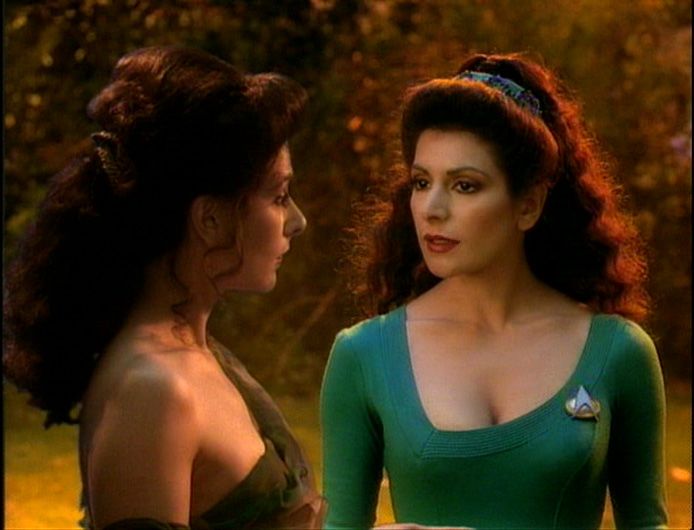
One of the episodes they screened was “The Survivors”, which showed the embrace of bold ideas to go along with the always excellent f/x. They kept the plot twist close to the sleeve, positing a mystery: how did this lone elderly couple survive a planetary bombardment that eradicated all other life? Counselor Troi meanwhile was slowly driven mad by the incessant music of a tiny music box she had never heard before. In fact, no one had survived, including the wife of the older man—in reality a godlike being who in a moment of grief wiped out the invaders throughout the universe. For one of the few times in Trek history, this was a deity with a conscience who relieved the suffering he’d inflicted on Troi. Picard could do nothing but let him go to recreate the woman he loved, and to just leave him alone. And that’s one of the first episodes. It keeps going.

Season Three of the Original Series suffered from subpar writing, some of the worst of any Trek series. Gene Roddenberry had been bumped to executive producer, while Fred Freiberger became the new line producer.  NBC had changed TOS’ time slot to 10 pm—on Fridays, a death slot for any series. Worst of all, the show had lost the sense of humor it was known for. By contrast, by its third season TNG had hit its stride. At least in my hometown, TNG was given a time slot of 7 pm on Saturday nights, and it never moved from that spot.

On September 25, 1989, the worm had turned. Rather than being The Original Series’ poor second cousin, in many ways The Next Generation surpassed it. Star Trek V had been a disappointment that summer. It was one of two movies I’d seen in one day in July of ’89. I’d had a very bad day; all I’ll say is that my brother and I had a falling out which ended with me stomping outside and smashing my windshield—with my bare fist. But enough of that for now.

The revolving door of scriptwriters that had plagued TNG’s first season, and the rewrites imposed by Gene Roddenberry were past. Briefly, Michael Piller was promoted to head of the writing staff, which brought a much-needed stability to the script process. Rick Berman became the chief of day-to-day operations. New costume designer Bob Blackman oversaw a redesign of outfits into real regimental uniforms a space service might issue, though not necessarily any more comfortable for the actors. Hence the birth of what fans refer to as ‘the Picard Maneuver’, where Patrick Stewart pulls his tunic down every time he has to stand up.

Blackman also rendered a one-piece version for the woman, which meant no more legs! A new title segment began this season showing an incoming montage from the Milky Way, instead of the departure angle used in the first two seasons. Best of all, Gates McFadden was back for good as Dr. Beverly Crusher.

This year we encountered aliens who really seemed …ALIEN. Tin Man. The Sheliak. A Douwd. What was also new was that the Enterprise-D encountered more people who were absolutely unreasonable; who were so locked into their own positions, they wouldn’t even consider the facts presented to them, even when said facts will endanger their lives. “The Ensigns of Command”, “The High Ground”, “The Wounded” and “Transfigurations” come to mind. The writing is sharper, the dialogue less formal and more natural; that was reflected in the return of Star Trek’s sense of humor. The crew often were not just put to the test, they were frequently put into life-threatening situations.  

Every season has had its timey-wimey excursions (“We’ll Always Have Paris” and “Time Squared”, for example) where Time is out of sync. “Yesterday’s Enterprise” is a real mindwarp, bleeding seamlessly into a dark version of our universe, where the Federation is on the verge of collapse from a war with the Klingons. And no one is aware of what’s happened, except for Guinan. Even she can’t explain why, she only knows THIS-IS-WRONG! This is the one and only time we see the Enterprise-C, and the consequences of its falling through a time warp in the midst of battle would be catastrophic. Because this is an alternate timeline, they were able to bring back Tasha Yar, at least one version of her, and give her an ending with some dignity. The ramifications of this version’s death would roil through our timeline for seasons to come. Believe me, there is death and destruction enough here to satisfy the most die-hard pew-pew fan.

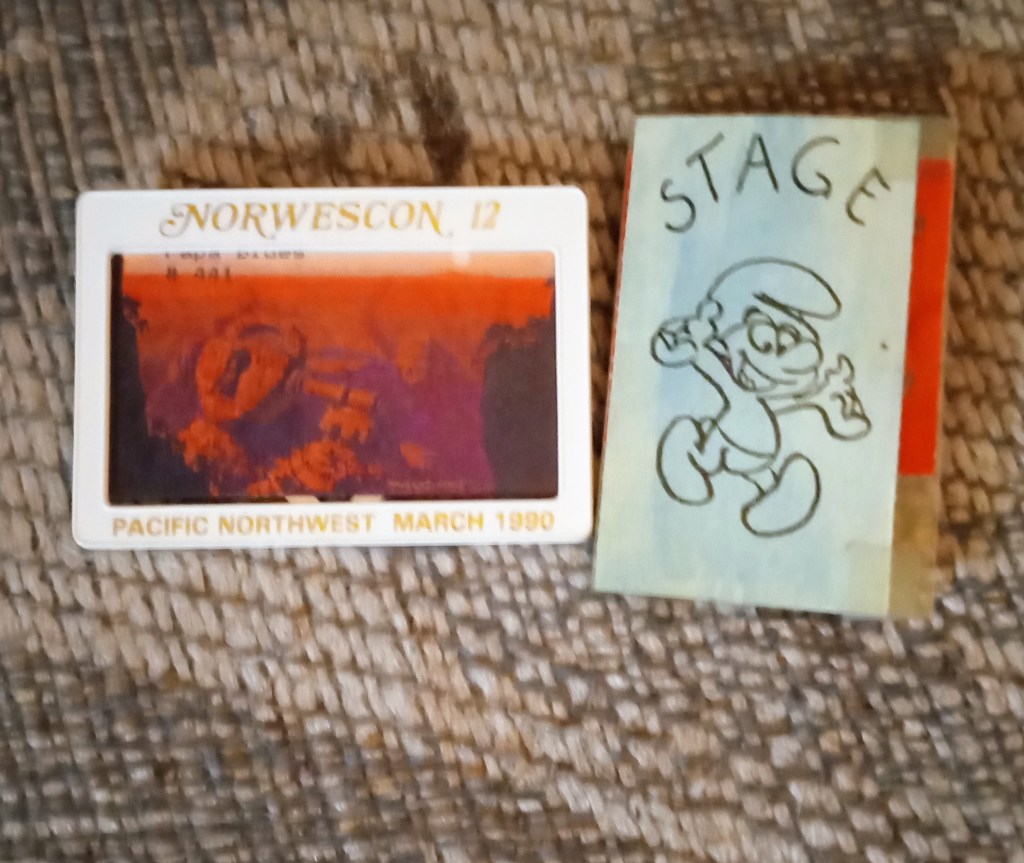
I’m embarrassed to re-read my old diary entries from this time. I seemed very petty and childish then. In 1990 I made it to two conventions, Rustycon 007 in January, and my third Norwescon, no. 12 in April 1990. My friends said I was a virgin when I came to my first sci-fi convention. Four cons in I guess I still was, considering they pinned a condom on the back of my stage pass. I was serving as a volunteer this time, though to be honest I remember very little of that. Rustycon had some good highlights. My friends were all there: Michael Scanlon, Chris and J. Steven York, and Jack and Fran Beslanwitch. The difference between the Sheraton where Norwescon was held and the Radisson, where we had Rustycon was the ambient noise level. There wasn’t a continuous drone of voices at the Radisson, only people’s quiet whispers. For a socially awkward person like me, that’s grand.

Apparently I’d gone to the dance, according to my diary, though odds are I sat in the back. Socially I was like Reginald Barclay. Mark Skullard had put together a fun panel on old Science Fiction radio programs. The lines in those shows were so melodramatic, the plots so preposterous even in the first couple of minutes we couldn’t help laughing. Here’s a shoutout to George Smith, who somehow showed up at nearly every panel I went to.

I met Rebecca Neason at this con, God rest her, at the Victorian SF/ Steampunk panel. She was a very sweet, social lady who kept getting tagged for panels when no one else would show up to empanel them. She was working on her first TNG novel, Guise of the Mind, which would be published in 1993. She and Donna Barr hosted a panel on Mythical Creatures. Apparently only the three of us were attending. Donna Barr has a very black sense of humor; she had me and Rebecca in near hysterics.

Curiously I don’t remember any TNG parodies at this year’s convention. Boy, at LAST year’s con we had a doozy, “Star Trek: Another Regeneration”. This was a taped radio program put together by two British chaps and sent over to Canada’s “The Ether Show”. (I hadn’t mentioned this in my last blog because I hadn’t found my diaries from that time period before.}

I squat on the floor of Room 1906 along with everyone who wasn’t seated on the bed. This had to be the best part of Norwescon 11 for me; this was a hilarious parody of “Farpoint”. Example: Riker has gone to the holodeck to fetch Data. The computer warned him this would be inadvisable, Commander Data was in the Atlantic Ocean simulation. Riker responds, “I don’t care, just let me in!” So it does, and “WHOOOSH!” The saucer section has also accidentally been separated from the ship, so Riker jams the two pieces together. “Make it fit!” he says, sooo, “SHRIIIEEEK!” until Data nonchalantly reports, “Reconnection complete, sir.”

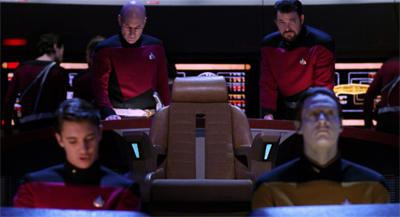
The most badass character for season 3 has to be Jean Luc Picard. Diplomacy becomes a weapon in “The Ensigns of Command”, where he uses the same treaty the Sheliak have been beating him over the head with against them. “You enjoyed that,” Riker says, to which Picard retorts, “Damn right.” “Who Watches the Watchers?” is the story where the Prime Directive is not simply bent, it’s twisted out of shape. It’s the one where Picard is mistaken for a god. He takes an arrow to the shoulder, willingly, to prove his mortality.

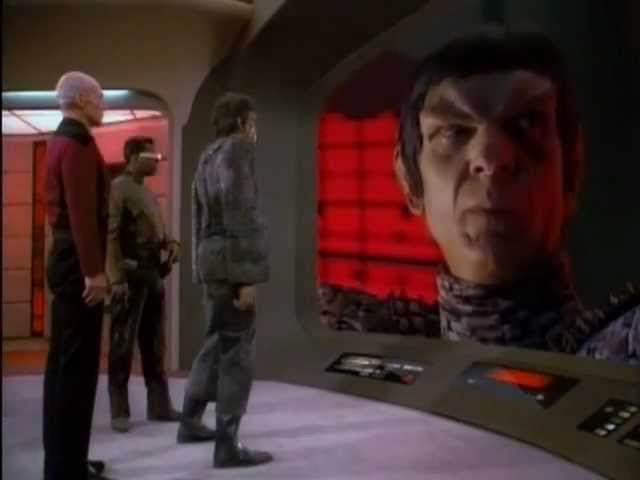
He’s also cunning when he wants to be. While investigating a possible Romulan base in the Neutral Zone on the word of a high-ranking defector, the Enterprise-D finds herself surrounded by three Romulan warbirds. With a word to Worf, the tables turn after three Klingon warbirds decloak on the warbirds’ flanks. “Shall we die together?” Picard challenges. When the Argosian Prime Minister Nayrok finally asks for help after rebuffing Picard for the entire episode, Picard cites the Prime Directive and just leaves (“The Hunted”).

Picard’s role as Patriarch of the Enterprise-D has never been more clearly defined than in “The Bonding”, which reminds us there are children on board, and their lives are just as fragile when a loved one dies. As he reminds Jeremy Aster, “no one on the Enterprise is alone”. To save Jeremy from an alien who wants to take him away to live on the planet, Picard calls together all the crew members who understand loss all too well. For Wesley Crusher this is a brutal reminder of his father’s death, and he admits for the first time that he was angry at Picard for surviving. I know that feeling; that was the moment that Wesley became a real person to me.

The Patriarchal role suits him when Data takes the ultimate step to becoming human, by creating his own child, Lal (“The Offspring”). In another first, this is the first episode in Trek history to be directed by a cast member, in this case Jonathan Frakes. When another asshole admiral wants to take Lal away to study, he responds, “There are times, sir, when men of good conscience cannot blindly follow orders. You acknowledge their sentience, but you ignore their personal liberties and freedom. Order a man to hand his child over to the state? Not while I am his captain.” Having had a child ripped from my family, I feel for them, and I love Picard for taking that stand.

By now his crew is so tight that with only a look, the bridge crew knows exactly what to do after aliens intrude on the bridge (“Allegiance”). Patrick Stewart’s hunger for more actions scenes bears fruit in both “Captain’s Holiday” and “The High Ground”, where he actually punches a terrorist on the bridge of the Enterprise. He becomes Worf’s cha’Dich, a ritual defender, when Kurn is attacked and injured in “Sins of the Father”. No, Picard is taking no shit this time around.

Worf may have been the cast member who experienced the most growth. Dare I say it, I think he became an actual character. I’ll explain. It was established in the first two seasons that he was a warrior, well versed in the ways of Klingons, a heritage he takes exceptional pride in. Beyond that, excepting two episodes, his role was not given the depth it deserved. In a sense he was a caricature much like Frank Burns in M.A.S.H. By its 5th season Frank had pretty much become a petty narrow-minded bigot, an overzealous ‘patriot’ with little to no depth.

So it was with Worf. He had been portrayed as a proud warrior, who frequently got his ass whupped by a stronger opponent. This season he became flesh and blood. Like Frank Burns, Worf is also burdened with prejudice–against Romulans, in this case. Given the chance to save a dying Romulan by giving a blood transfusion, Worf stubbornly refuses (“The Enemy”). To be fair, his prejudice is reciprocated by the Romulan as he dies. In “The Bonding”, out of guilt for an unavoidable tragedy, Worf attempts to bond with the orphaned Jeremy Aster. “Deja Q” proves he’s still king of the one-liners; when Q insists he’s human and shouts what do I have to do to convince you people, Worf replies, “Die.” In “Transfigurations” he plays the role of Lazarus raised from the dead by space Jesus.

With “Sins of the Father”, Worf’s story becomes epic. Treachery within the Klingon High Council brings a challenge Worf must answer to clear his father’s name. But the truth can’t come out; the traitor who betrayed the Klingons to the Romulans has friends on the High Council, which would lead to civil unrest. Only Worf’s discommendation temporarily prevents a Klingon civil war. We’re introduced not only to his brother Kurn but to the family of Duras, a name we’d come to despise in every Trek series to come.

The Ferengi make three appearances, primarily as irritants, moving closer to the comedic foils they’d master in DS9. No longer treated as a ‘major military threat’ to the Federation, they resort to deceit, and poison to narrow the field of bidders in “The Price”. If there’s any justice, a couple of those Ferengi are lost in the Delta Quadrant until their return in ST: Voyager. Michael Grodenchik debuts as Sovak, a pushy trader who deserves the punch in the face Picard delivers. (He would eventually play Quark’s dim brother Rom on DS9). “Menage A Troi” is a case of unrequited lust on the part of a demented Damon, although it finally gives Majel Barrett the opportunity to shine as the eternally flirty Lwaxana Troi. Ethan Philips makes his Trek debut there as Dr. Farek; we’d know him better in a later role, as Neelix on Voyager.

“Hollow Pursuits” introduces us to Reginald Barclay. Like him, I’m socially awkward, though I couldn’t articulate that in 1989. Reg is the guy who sits in the back of the room at parties, trying to blend in while seated next to a potted plant. That’s me. Maybe his escape into Holodiction is something else we have in common; don’t all us writers do that, though not in an actual physical expression? When the series originally came out on VHS, they were released as single episodes. The only tapes I collected were “The Royale” (season 2), “The Offspring” and “Hollow Pursuits”.

Reg was a challenge for Geordi to overcome his disdain and encourage Reg to put his mind to work in ‘the real world’. Troi also tries to guide him, up to the point that she meets the Goddess of Empathy. Then it’s “muzzle it!” The first time I saw this episode was at Jack & Fran’s house in Renton for a Writer’s Cramp meeting. We’re at the point where Picard himself accidentally calls Reg “Broccoli”. Data is saying, “Metathesis is the most common of pronunciation errors, sir, the reversal of vowels. ‘Boc’ to ‘Broc’—” At this point, Picard just glares, and as Data suddenly bends over a console, Fran said, “shut up, Data.” And that is usually the first response everybody gives when viewing that scene: “shut up, Data!”

Somehow I missed “Sarek” when it was originally broadcast. I didn’t find out about it until years later, after the series had ended. It was cool that they brought Mark Lenard back to the role, weaving another connection to the Original Series.

To close the season, they began a new tradition with the cliffhanger to end all cliffhangers, and honestly, I don’t think TNG ever came up with a better one. This led one fan to scream at Piller from his car, “You ruined my summer!” “The Best of Both Worlds” begins with a disturbing graphic. Riker’s away team beams down to a colony in distress, supposedly in the middle of downtown, where all that greets us is a crater.

Twin plotlines parallel each other. The Borg are coming, and we are nowhere near prepared for them. Meanwhile Commander Riker questions his priorities as he turns down yet another command, and Picard has to call him on the carpet for it. The issue would be ludicrous in any real-world military service; Piller’s script addresses that here. Riker is a man grown comfortable, loyal, and apparently will settle for nothing less than the Enterprise. Although this was not how he wanted it. He also faces a foil in Commander Shelby, a cocky young woman whose ambition is only exceeded by her impetuousness. And she pointedly tells Riker, “You’re in my way.”

This is only the second time we’ve encountered the Borg, who remain a great unknown, hostile in purpose even while they’re devoid of intent. It is not spoilers now to declare this as the most distressing cliffhanger in Trek history, perhaps one of the greatest in television history. Picard steps forward on board the Borg cube as Locutus, his voice lifeless as he states, “Your life as it has been is over. From this time forward, you will service…us.”  The camera pans around to Riker, who says, “Mr. Worf…fire.”

And then— ‘To Be Continued’??? ARRRRRGHHHH! In June 1990 we were all going, “What—WHAT?” That would be the longest summer for all Trek fans everywhere. In this one season this crew had become beloved, a part of the family, and we didn’t know if they were going to be blown apart or not. Will Picard survive—COULD he? This would be the nail-biter dogging us for the longest summer ever.