
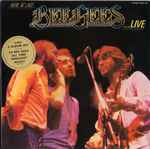
Live albums can be fickle things. Usually, they’re intended as throwaway gifts to keep a band’s fans interested. Sometimes an album fails to capture the excitement of a live performance. Some just fall flat. 1985’s Arena by Duran Duran is one example, which edited out pretty much all of the audience reactions—which is half of why we buy a live record in the first place!
Sometimes, very rarely, a live album can be a game changer. Neil Diamond’s Hot August Night certainly qualifies in that area. Not to mention Frampton Comes Alive, which turned a relatively unknown guitarist named Peter Frampton into a rock god. While not a game changer, Here At Last…Bee Gees…Live was an immensely enjoyable two-record set.
Confession session: I hadn’t heard ANY of the Bee Gees 1960’s hits before this record was handed down to me. How could I, I was five years old in 1969. In the late 1960’s I was focused on the Beatles, and ONLY the Beatles. My earliest awareness of any musical world beyond the Fab Four was Neil Diamond’s single “Sweet Caroline”. To say I’d slept through the 1960’s would be an understatement.
My first awareness of the Bee Gees—brothers Barry, Robin and Maurice Gibb– was their 1970 single “Lonely Days”. That was one of only two songs that had an impact for them in the early 70’s. My brother David bought “Lonely Days”, while I fell for the second one, “How Can You Mend a Broken Heart”, which came out a year later. The fact that they’d had eight hit singles in America before that kind of passed by me. It would be years before they remade themselves as ‘the Kings of Disco’; at least that’s what the media called them.
Shockingly, I still have that album. I had a purge in 1998. It was a very bad year. Basically, my wife and I were separated, temporarily. I was moving out of our apartment and back in with my dad. And I was thinking, why am I carrying all this shit around with me? I didn’t listen to half of it. I pruned my record collection down to a select few, and evidently this was one of them. It’d been passed down to me by David, and I’m glad he did. That’s what we’d do, pass our old records and comic books down to the next sibling. As the youngest I was the frequent recipient of these goodies.
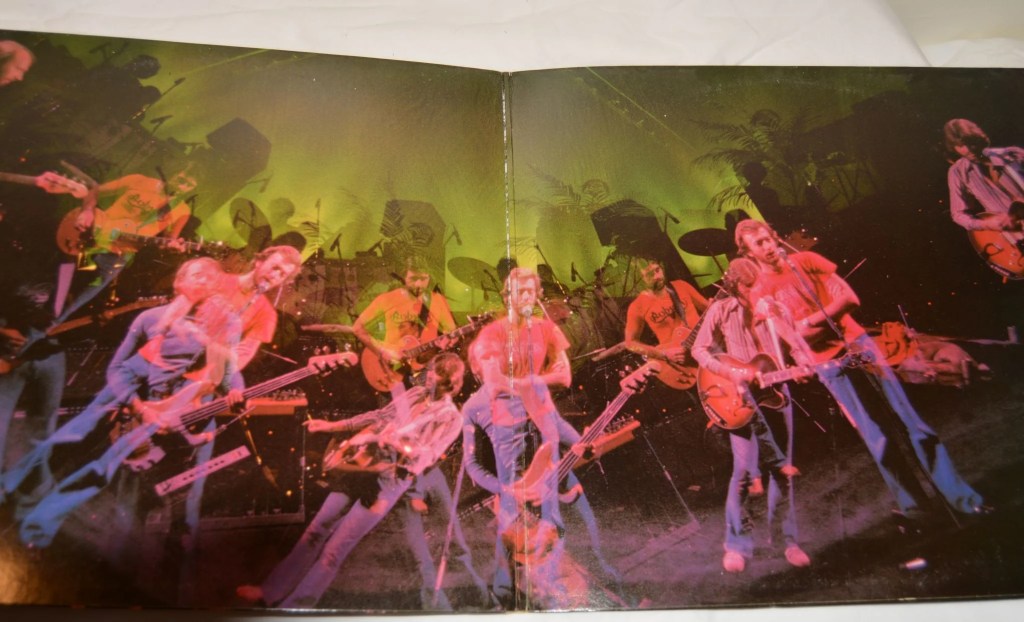
This performance was recorded December 20, 1976, at the Forum in Los Angeles, California, the last concert on their 1976 tour to promote their latest LP, Children of the World. It was a guidebook to who they were as a band, before Saturday Night Fever broke in the fall of 1977. After that they were inescapable, what with their own songs dominating the charts, along with their youngest brother Andy Gibb becoming a pop star in his own right and half the planet covering their songs. You had to be there to know just how big they’d become.
People don’t always realize the Gibb brothers didn’t just write love songs or songs to dance to. A lot of their tunes were absolute heartbreakers. Because those songs were marginally successful, that was the pattern they followed in their early 1970’s LPs. “My World”, “Words”, “Love So Right”, and even “Lonely Days”, if you want to stretch a point, are examples of these.
Very little of these early 70’s material would be found here, probably because it wasn’t the Bee Gees’ better selling periods. Besides the two mentioned singles, only “Run To Me” and “Down The Road” were carried over from that period. After a brief split in 1968 and their reunion in 1970, the boys spent that period trying to find a new direction. Not until they embraced their funky side on Main Course would success come.
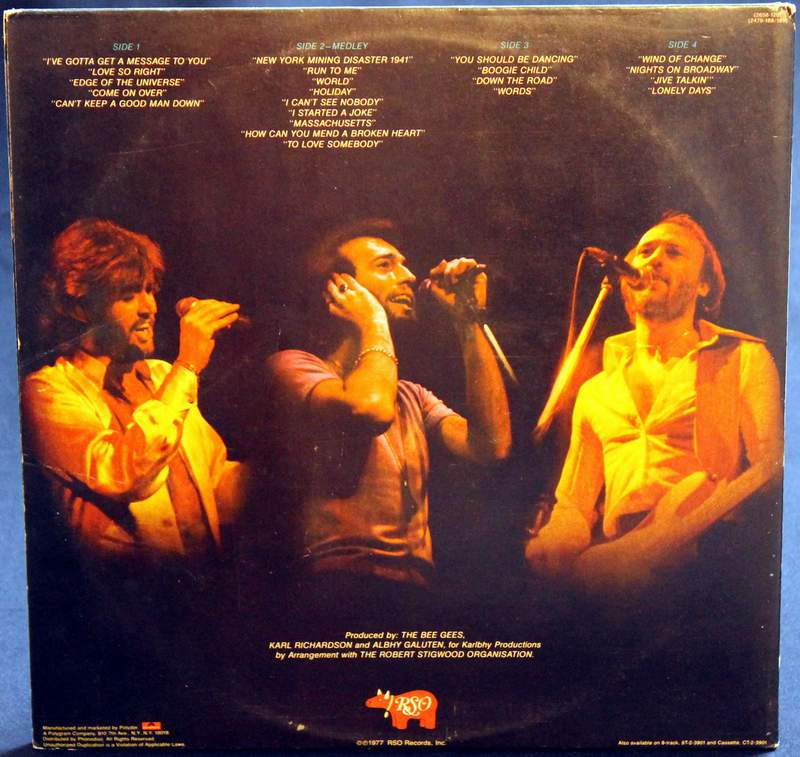

I’m afraid I’ve been spoiled. Since this album was the first place where I’d heard most of their early work, I find I prefer the live versions. Live performance was the perfect venue to showcase their strengths, in particular their harmonies and songwriting. Their older songs especially benefited from a live setting, being presented by an older, more seasoned band updating their 1960s sound for a 1970s audience. The horn section was a definite boost, especially on songs like “I Gotta Get A Message To You” and “To Love Somebody”. The audience interaction was always enthusiastic. This may also be the only time I’ve seen Robin a with mustache and beard; I don’t know when he grew that; on the road perhaps.
The show opens with a flourish of horns on “I Gotta Get A Message To You”, and this is the version I prefer. The audience is whistling throughout the performance. Robin and Barry share vocals; Robin taking the first and third verses, and Barry the second. This leads into their most recent heartbreaker, “Love So Right” another example of their gorgeous harmonies.
On “Edge of the Universe” Barry and Ronin’s voices harmonize gorgeously together, followed by “Come On Over”, where Robin is at his most vulnerable. It’s performed in a distinctly country style; it’d been a hit for Olivia Newton-John earlier that same year. Even a lesser-known song such as “Can’t Keep a Good Man Down” moves at a faster tempo, gifted with a killer funky solo three minutes in.
Barry opens the second side of the LP. “We’d like to enter into a medley of some of our older material.” They usually performed such a medley in the middle of their concerts in the 1970s, leading off with their first hit from 1967, “New York Mining Disaster 1941”. This may have been their only 60’s song I was familiar with. It was a haunting song in its original studio version. The acoustic version presented here is even more stark, just the three brothers harmonizing over guitars with a horn as a backdrop.
“Run To Me” and “World” combined seamlessly into one tune. Robin’s voice always had a vulnerable quality ideal to these songs, and he carries most of the tunes in this medley. Indeed, “Holiday”, “I Can’t See Nobody”, “I Started a Joke” and “Massachusetts” blend into each other without a hitch. Cheers rise at the beginning of every verse of “How Do You Mend a Broken Heart”.
“You Should Be Dancing” gets an extended treatment on Side 3, at 9 minutes 22 seconds, the longest track on the LP. The single version and “Jive Talkin’” were additions to the initial release of Saturday Night Fever soundtrack. (Subsequent pressings would substitute this live performance, but the CD reissue would restore the original version.) Barry’s falsetto was still a new thing at this point, and it’s put to fine use here. The middle section settles down into a driving drum beat backed by guitar and horns that must’ve got the audience on the floor. It closes with a bongo drum solo and a last flourish.
The very next tune was one of their weaker disco songs, “Boogie Child”. “Down The Road” from their 1974 album Mr. Natural was energized in this live version, with a much more aggressive vocal delivery. This performance would be pressed as the B-side to their phenomenally successful SNF single “Night Fever” two years later.
Just as a sidebar: I was there in the 70s. I remember the depression gripping America then; we’d just lost in Vietnam, with Watergate, the Arab oil embargo and rampant inflation piled on top of everything else. Some people despised disco, especially partisans of rock music. My view is, after all the troubles we’d endured in the 1970’s, disco was exactly what we needed at that moment to overcome our national malaise.
The fourth and final side presents three tracks from Main Course. “Winds of Change” gets a funky upgrade, leading off with the entire horn section. The song details a man bowed but not broken. “Sometimes a man breaks down, down, down, down, down/ and the good things he’s searching for/ are crushed into the ground”, the message being to not give in, to “feel the winds of change.”
This leads into “Nights on Broadway”, the powerful opening track on Main Course. This tops the original version. This may be the greatest example of shared vocals with Barry and Robin trading lyrics with Maurice adding his falsetto on the chorus. This leads into “Jive Talkin’”, and from there the piano leads into “Lonely Days”, building to a glorious finish. Barry closes with “Thank you! Merry Christmas and good night!”
It’s kind of sad to realize Barry is the only Gibb brother still alive. After the phenomenal success of Saturday Night Fever, apparently their manager Robert Stigwood thought it’d be a great idea to do a motion picture adaptation of the Beatles’ Sgt Pepper’s Lonely Hearts Club Band, with the Bee Gees as the band and Peter Frampton as Billy Shears. Well, to paraphrase Epstein from Welcome Back, Kotter, “I’ve heard of people bombing, but that was a nuclear explosion!”
That’s okay, their follow-up album Spirits Having Flown was a smash. However, in the backlash against all things disco, their 1981 LP Living Eyes ended their chart success. Their next album wouldn’t be recorded for another eight years, by which time their loyal fans had gotten over their discophobia and the Bee Gees regained their well-earned respectability. Which I’d never lost.
 Papablues Scrapbook