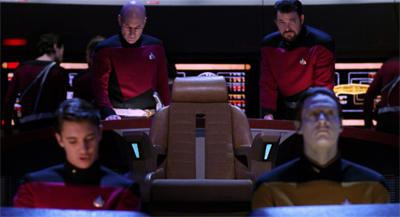
Star Trek: The Next Generation–season 3

Ironically in the fall of 1989 I had gone to a Doctor Who Day at Book King in Federal Way, Washington. Back when I was single, Book King had these get togethers for fans every weekend, and I attended as often as I could. Everyone was seated in this little room in the back of the bookstore, except instead of Doctor Who, the group was sharing a couple of episodes from the new season of TNG. This time around the show came out of the gate running and didn’t stop for the next three seasons.

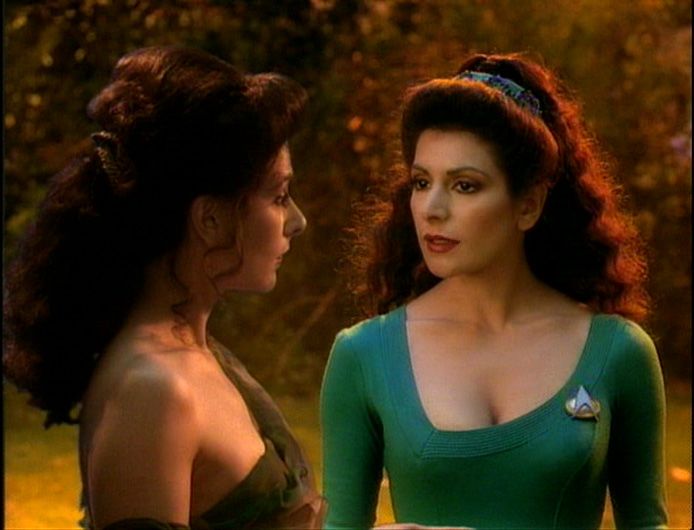
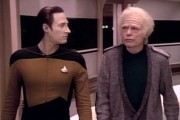
One of the episodes they screened was “The Survivors”, which showed the embrace of bold ideas to go along with the always excellent f/x. They kept the plot twist close to the sleeve, positing a mystery: how did this lone elderly couple survive a planetary bombardment that eradicated all other life? Counselor Troi meanwhile was slowly driven mad by the incessant music of a tiny music box she had never heard before. In fact, no one had survived, including the wife of the older man—in reality a godlike being who in a moment of grief wiped out the invaders throughout the universe. For one of the few times in Trek history, this was a deity with a conscience who relieved the suffering he’d inflicted on Troi. Picard could do nothing but let him go to recreate the woman he loved, and to just leave him alone. And that’s one of the first episodes. It keeps going.

Season Three of the Original Series suffered from subpar writing, some of the worst of any Trek series. Gene Roddenberry had been bumped to executive producer, while Fred Freiberger became the new line producer.  NBC had changed TOS’ time slot to 10 pm—on Fridays, a death slot for any series. Worst of all, the show had lost the sense of humor it was known for. By contrast, by its third season TNG had hit its stride. At least in my hometown, TNG was given a time slot of 7 pm on Saturday nights, and it never moved from that spot.

On September 25, 1989, the worm had turned. Rather than being The Original Series’ poor second cousin, in many ways The Next Generation surpassed it. Star Trek V had been a disappointment that summer. It was one of two movies I’d seen in one day in July of ’89. I’d had a very bad day; all I’ll say is that my brother and I had a falling out which ended with me stomping outside and smashing my windshield—with my bare fist. But enough of that for now.

The revolving door of scriptwriters that had plagued TNG’s first season, and the rewrites imposed by Gene Roddenberry were past. Briefly, Michael Piller was promoted to head of the writing staff, which brought a much-needed stability to the script process. Rick Berman became the chief of day-to-day operations. New costume designer Bob Blackman oversaw a redesign of outfits into real regimental uniforms a space service might issue, though not necessarily any more comfortable for the actors. Hence the birth of what fans refer to as ‘the Picard Maneuver’, where Patrick Stewart pulls his tunic down every time he has to stand up.

Blackman also rendered a one-piece version for the woman, which meant no more legs! A new title segment began this season showing an incoming montage from the Milky Way, instead of the departure angle used in the first two seasons. Best of all, Gates McFadden was back for good as Dr. Beverly Crusher.

This year we encountered aliens who really seemed …ALIEN. Tin Man. The Sheliak. A Douwd. What was also new was that the Enterprise-D encountered more people who were absolutely unreasonable; who were so locked into their own positions, they wouldn’t even consider the facts presented to them, even when said facts will endanger their lives. “The Ensigns of Command”, “The High Ground”, “The Wounded” and “Transfigurations” come to mind. The writing is sharper, the dialogue less formal and more natural; that was reflected in the return of Star Trek’s sense of humor. The crew often were not just put to the test, they were frequently put into life-threatening situations.  

Every season has had its timey-wimey excursions (“We’ll Always Have Paris” and “Time Squared”, for example) where Time is out of sync. “Yesterday’s Enterprise” is a real mindwarp, bleeding seamlessly into a dark version of our universe, where the Federation is on the verge of collapse from a war with the Klingons. And no one is aware of what’s happened, except for Guinan. Even she can’t explain why, she only knows THIS-IS-WRONG! This is the one and only time we see the Enterprise-C, and the consequences of its falling through a time warp in the midst of battle would be catastrophic. Because this is an alternate timeline, they were able to bring back Tasha Yar, at least one version of her, and give her an ending with some dignity. The ramifications of this version’s death would roil through our timeline for seasons to come. Believe me, there is death and destruction enough here to satisfy the most die-hard pew-pew fan.

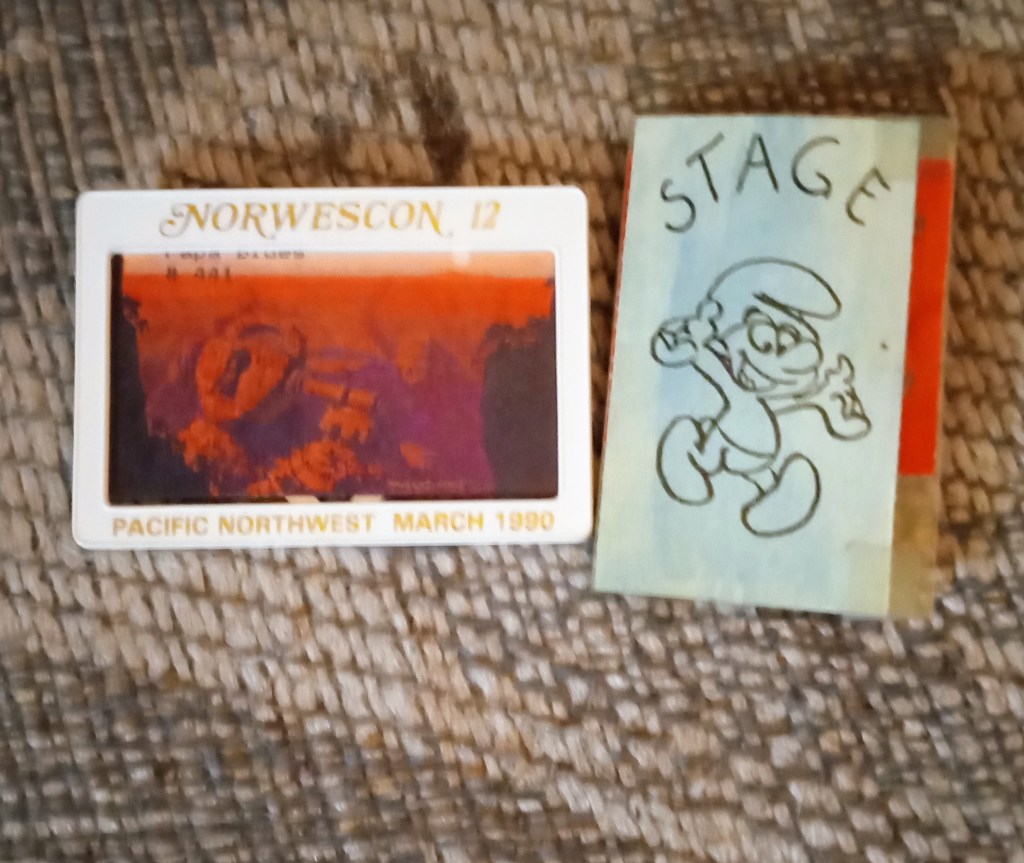
I’m embarrassed to re-read my old diary entries from this time. I seemed very petty and childish then. In 1990 I made it to two conventions, Rustycon 007 in January, and my third Norwescon, no. 12 in April 1990. My friends said I was a virgin when I came to my first sci-fi convention. Four cons in I guess I still was, considering they pinned a condom on the back of my stage pass. I was serving as a volunteer this time, though to be honest I remember very little of that. Rustycon had some good highlights. My friends were all there: Michael Scanlon, Chris and J. Steven York, and Jack and Fran Beslanwitch. The difference between the Sheraton where Norwescon was held and the Radisson, where we had Rustycon was the ambient noise level. There wasn’t a continuous drone of voices at the Radisson, only people’s quiet whispers. For a socially awkward person like me, that’s grand.

Apparently I’d gone to the dance, according to my diary, though odds are I sat in the back. Socially I was like Reginald Barclay. Mark Skullard had put together a fun panel on old Science Fiction radio programs. The lines in those shows were so melodramatic, the plots so preposterous even in the first couple of minutes we couldn’t help laughing. Here’s a shoutout to George Smith, who somehow showed up at nearly every panel I went to.

I met Rebecca Neason at this con, God rest her, at the Victorian SF/ Steampunk panel. She was a very sweet, social lady who kept getting tagged for panels when no one else would show up to empanel them. She was working on her first TNG novel, Guise of the Mind, which would be published in 1993. She and Donna Barr hosted a panel on Mythical Creatures. Apparently only the three of us were attending. Donna Barr has a very black sense of humor; she had me and Rebecca in near hysterics.

Curiously I don’t remember any TNG parodies at this year’s convention. Boy, at LAST year’s con we had a doozy, “Star Trek: Another Regeneration”. This was a taped radio program put together by two British chaps and sent over to Canada’s “The Ether Show”. (I hadn’t mentioned this in my last blog because I hadn’t found my diaries from that time period before.}

I squat on the floor of Room 1906 along with everyone who wasn’t seated on the bed. This had to be the best part of Norwescon 11 for me; this was a hilarious parody of “Farpoint”. Example: Riker has gone to the holodeck to fetch Data. The computer warned him this would be inadvisable, Commander Data was in the Atlantic Ocean simulation. Riker responds, “I don’t care, just let me in!” So it does, and “WHOOOSH!” The saucer section has also accidentally been separated from the ship, so Riker jams the two pieces together. “Make it fit!” he says, sooo, “SHRIIIEEEK!” until Data nonchalantly reports, “Reconnection complete, sir.”

The most badass character for season 3 has to be Jean Luc Picard. Diplomacy becomes a weapon in “The Ensigns of Command”, where he uses the same treaty the Sheliak have been beating him over the head with against them. “You enjoyed that,” Riker says, to which Picard retorts, “Damn right.” “Who Watches the Watchers?” is the story where the Prime Directive is not simply bent, it’s twisted out of shape. It’s the one where Picard is mistaken for a god. He takes an arrow to the shoulder, willingly, to prove his mortality.

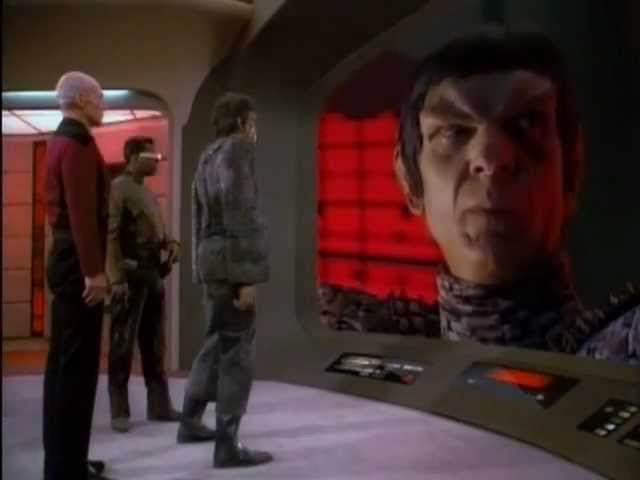
He’s also cunning when he wants to be. While investigating a possible Romulan base in the Neutral Zone on the word of a high-ranking defector, the Enterprise-D finds herself surrounded by three Romulan warbirds. With a word to Worf, the tables turn after three Klingon warbirds decloak on the warbirds’ flanks. “Shall we die together?” Picard challenges. When the Argosian Prime Minister Nayrok finally asks for help after rebuffing Picard for the entire episode, Picard cites the Prime Directive and just leaves (“The Hunted”).

Picard’s role as Patriarch of the Enterprise-D has never been more clearly defined than in “The Bonding”, which reminds us there are children on board, and their lives are just as fragile when a loved one dies. As he reminds Jeremy Aster, “no one on the Enterprise is alone”. To save Jeremy from an alien who wants to take him away to live on the planet, Picard calls together all the crew members who understand loss all too well. For Wesley Crusher this is a brutal reminder of his father’s death, and he admits for the first time that he was angry at Picard for surviving. I know that feeling; that was the moment that Wesley became a real person to me.

The Patriarchal role suits him when Data takes the ultimate step to becoming human, by creating his own child, Lal (“The Offspring”). In another first, this is the first episode in Trek history to be directed by a cast member, in this case Jonathan Frakes. When another asshole admiral wants to take Lal away to study, he responds, “There are times, sir, when men of good conscience cannot blindly follow orders. You acknowledge their sentience, but you ignore their personal liberties and freedom. Order a man to hand his child over to the state? Not while I am his captain.” Having had a child ripped from my family, I feel for them, and I love Picard for taking that stand.

By now his crew is so tight that with only a look, the bridge crew knows exactly what to do after aliens intrude on the bridge (“Allegiance”). Patrick Stewart’s hunger for more actions scenes bears fruit in both “Captain’s Holiday” and “The High Ground”, where he actually punches a terrorist on the bridge of the Enterprise. He becomes Worf’s cha’Dich, a ritual defender, when Kurn is attacked and injured in “Sins of the Father”. No, Picard is taking no shit this time around.

Worf may have been the cast member who experienced the most growth. Dare I say it, I think he became an actual character. I’ll explain. It was established in the first two seasons that he was a warrior, well versed in the ways of Klingons, a heritage he takes exceptional pride in. Beyond that, excepting two episodes, his role was not given the depth it deserved. In a sense he was a caricature much like Frank Burns in M.A.S.H. By its 5th season Frank had pretty much become a petty narrow-minded bigot, an overzealous ‘patriot’ with little to no depth.

So it was with Worf. He had been portrayed as a proud warrior, who frequently got his ass whupped by a stronger opponent. This season he became flesh and blood. Like Frank Burns, Worf is also burdened with prejudice–against Romulans, in this case. Given the chance to save a dying Romulan by giving a blood transfusion, Worf stubbornly refuses (“The Enemy”). To be fair, his prejudice is reciprocated by the Romulan as he dies. In “The Bonding”, out of guilt for an unavoidable tragedy, Worf attempts to bond with the orphaned Jeremy Aster. “Deja Q” proves he’s still king of the one-liners; when Q insists he’s human and shouts what do I have to do to convince you people, Worf replies, “Die.” In “Transfigurations” he plays the role of Lazarus raised from the dead by space Jesus.

With “Sins of the Father”, Worf’s story becomes epic. Treachery within the Klingon High Council brings a challenge Worf must answer to clear his father’s name. But the truth can’t come out; the traitor who betrayed the Klingons to the Romulans has friends on the High Council, which would lead to civil unrest. Only Worf’s discommendation temporarily prevents a Klingon civil war. We’re introduced not only to his brother Kurn but to the family of Duras, a name we’d come to despise in every Trek series to come.

The Ferengi make three appearances, primarily as irritants, moving closer to the comedic foils they’d master in DS9. No longer treated as a ‘major military threat’ to the Federation, they resort to deceit, and poison to narrow the field of bidders in “The Price”. If there’s any justice, a couple of those Ferengi are lost in the Delta Quadrant until their return in ST: Voyager. Michael Grodenchik debuts as Sovak, a pushy trader who deserves the punch in the face Picard delivers. (He would eventually play Quark’s dim brother Rom on DS9). “Menage A Troi” is a case of unrequited lust on the part of a demented Damon, although it finally gives Majel Barrett the opportunity to shine as the eternally flirty Lwaxana Troi. Ethan Philips makes his Trek debut there as Dr. Farek; we’d know him better in a later role, as Neelix on Voyager.

“Hollow Pursuits” introduces us to Reginald Barclay. Like him, I’m socially awkward, though I couldn’t articulate that in 1989. Reg is the guy who sits in the back of the room at parties, trying to blend in while seated next to a potted plant. That’s me. Maybe his escape into Holodiction is something else we have in common; don’t all us writers do that, though not in an actual physical expression? When the series originally came out on VHS, they were released as single episodes. The only tapes I collected were “The Royale” (season 2), “The Offspring” and “Hollow Pursuits”.

Reg was a challenge for Geordi to overcome his disdain and encourage Reg to put his mind to work in ‘the real world’. Troi also tries to guide him, up to the point that she meets the Goddess of Empathy. Then it’s “muzzle it!” The first time I saw this episode was at Jack & Fran’s house in Renton for a Writer’s Cramp meeting. We’re at the point where Picard himself accidentally calls Reg “Broccoli”. Data is saying, “Metathesis is the most common of pronunciation errors, sir, the reversal of vowels. ‘Boc’ to ‘Broc’—” At this point, Picard just glares, and as Data suddenly bends over a console, Fran said, “shut up, Data.” And that is usually the first response everybody gives when viewing that scene: “shut up, Data!”

Somehow I missed “Sarek” when it was originally broadcast. I didn’t find out about it until years later, after the series had ended. It was cool that they brought Mark Lenard back to the role, weaving another connection to the Original Series.

To close the season, they began a new tradition with the cliffhanger to end all cliffhangers, and honestly, I don’t think TNG ever came up with a better one. This led one fan to scream at Piller from his car, “You ruined my summer!” “The Best of Both Worlds” begins with a disturbing graphic. Riker’s away team beams down to a colony in distress, supposedly in the middle of downtown, where all that greets us is a crater.

Twin plotlines parallel each other. The Borg are coming, and we are nowhere near prepared for them. Meanwhile Commander Riker questions his priorities as he turns down yet another command, and Picard has to call him on the carpet for it. The issue would be ludicrous in any real-world military service; Piller’s script addresses that here. Riker is a man grown comfortable, loyal, and apparently will settle for nothing less than the Enterprise. Although this was not how he wanted it. He also faces a foil in Commander Shelby, a cocky young woman whose ambition is only exceeded by her impetuousness. And she pointedly tells Riker, “You’re in my way.”

This is only the second time we’ve encountered the Borg, who remain a great unknown, hostile in purpose even while they’re devoid of intent. It is not spoilers now to declare this as the most distressing cliffhanger in Trek history, perhaps one of the greatest in television history. Picard steps forward on board the Borg cube as Locutus, his voice lifeless as he states, “Your life as it has been is over. From this time forward, you will service…us.”  The camera pans around to Riker, who says, “Mr. Worf…fire.”

And then— ‘To Be Continued’??? ARRRRRGHHHH! In June 1990 we were all going, “What—WHAT?” That would be the longest summer for all Trek fans everywhere. In this one season this crew had become beloved, a part of the family, and we didn’t know if they were going to be blown apart or not. Will Picard survive—COULD he? This would be the nail-biter dogging us for the longest summer ever.

Retrospective: Star Trek: The Next Generation, season 2

I’ve gotta admit, I didn’t catch every episode of season 2 during its original broadcast. I’d pretty much kept up with every episode of the first season at least once, such was my loyalty to Star Trek. My viewing history for the sophomore season was much more spotty. I’d watch two or three stories in a row, skip one or two. For instance, the first story I sat down for was “Where Silence Has Lease”, a significantly darker, unnerving outing than virtually anything in the previous season. I missed both the season opener, “The Child”, and its closer, “Shades of Grey”. The last story I saw would be “Peak Performance”, the penultimate episode.

I can’t explain; it’s been 35 years.  Perhaps I’d lost some interest after the disappointment of season 1. My Saturdays in 1988-89 were tied up in get-togethers with my writing friends, who were giving me much needed instruction. More to the point, I was beginning to put in the research necessary to make my scribblings worthwhile; to be honest, at this point, it stank. I had less time to binge TV. At age 24 I hadn’t really lived at this point. Hell, I’d never fallen in love, yet.

Changes were afoot at TNG. Because of an ongoing Writer’s Strike in 1988, the season was delayed; the first episode wouldn’t be syndicated until November 21st of that year. I had no idea what tensions were going on behind the scenes. The cast had settled comfortably into their roles; the writing had improved considerably. We were still saddled with stories that were not up to snuff (“The Royale”, “Up the Long Ladder”); some that just left us scratching our heads (“Where Silence Has Lease”, “Time Squared”); and at least one that was pulled out of their fannies (“Shades of Grey”). Also, the music scores still tended toward the bombastic.

Looking back a little older, a little more jaded, I can declare that at this point TNG was still guided by a 1960’s naivete of Gene Roddenberry. To wit, humanity had matured into an enlightened species. By definition the governing body of the franchise, The Federation, would also be guided by enlightened principles. Of course, even in The Original Series (TOS) there were hints that Paradise had its worms. They had their share of crazy starship captains and a bureaucracy unwilling to face up to unsavory situations that needed to be addressed.

Elements we’ve come to be familiar with in later years made their first appearances, often in the opening scenes of an episode. Worf’s calisthenics program debuted this year (“Where Silence Has Lease”) as does the officers’ nightly poker game (“The Measure of a Man”). And the Ferengi, that most deadly threat to the Federation in season 1, had been relegated to one appearance this season, and then only in the last 15 minutes of “Peak Performance”, the second to last episode of the season.

As an established series, TNG began to attract a lot of celebrity guest stars, and a few future stars. Joe Piscapo appeared as the Comic in “The Outrageous Okona”; Entertainment Tonight cohost John Tesh was disguised as one of the Klingons inflicting pain sticks on Worf in “The Icarus Factor”, while drummer Mick Fleetwood was even more recognizable as a fish-faced alien in “Manhunt”. One of Teri Hatcher’s early roles was as a transporter chief in “The Outrageous Okona”

There was also The BEARD. Despite what Q would say a year from now, I thought it suited Riker. It made him more distinguished yet somehow still likeable. I was comfortable with it from the start. It can’t help enhancing his irrepressible grin. After a full season of rotating engineers, Picard promoted inhouse from the available personnel, making Geordi LaForge the Chief Engineer for the rest of the series.

Ten Forward appeared in the opener, but that wasn’t the most interesting development. That fell to the casting of the bartender Guinan, a long time Trek fan known as Whoopi Goldberg. This wasn’t a role she needed to take. By 1988 Whoopi already had seven films under her belt, including her breakout role in The Color Purple (1985), which earned her anOscar nomination for Best Actress. This was something she wanted, that she was inspired to by original Trek actress Nichelle Nichols. Though her cameos were small, she acted as that impish elf dispensing wise sayings that the crew needed at any given time.

Unfortunately the worst change was in the medical field. It seems certain people on the production staff didn’t like how Gates McFadden’s character, Dr. Crusher, was being developed. Worse, they managed to convince Gene Roddenberry of that. All I knew was that Dr. Crusher was gone, and you don’t realize how much you appreciate someone until they’re gone. Crusher was traded in for Dr. Kate Pulaski, a Dr. McCoy retread who couldn’t—or wouldn’t—get Data’s name right. In fact, she seemed to have a problem appreciating that Data was a valuable crewman and an individual who required no justification. The fact that she was played by TOS veteran Diana Muldaur (“Return to Tomorrow”, “Is There in Truth No Beauty?”) didn’t help anyone warm up to her.

Curiously, the one thing Muldaur and Whoopi shared in common was that they were not listed in the main cast, not even as guest stars, but solely designated with a ‘Special Guest Appearance’ after the opening teaser.

THE CAST

This season’s scripts were very Data-centric, with five focused exclusively on our favorite android (“Elementary, Dear Data”, “The Outrageous Okona”, “The Schizoid Man”, “The Measure of a Man” and “Pen Pals”). He grew in his study of humanity and endured the slights of Dr. Pulaski with dignity. He retained his childlike nature while mentoring under Picard. Often he has the central role to play in the resolution of a conflict. Data (Brent Spiner) attended the birth of Troi’s son Ian (“The Child”), explored the nature of humor (“Okona”), assisted Picard in deciphering the Iconian language (“Contagion”); gambled the away team out of the casino and out of a badly written novel (“The Royale”); and experienced doubt in his abilities for the first time (“Peak Performance”).

If any crewman comes close to the number of episodes in focus, it’s William T. Riker (Jonathan Frakes). Beard aside, here is a man who welcomes a challenge, whether it’s volunteering for an officer exchange program with the Klingons (“A Matter of Honor”) or bringing a broken-down wreck up to spec to challenge the Enterprise-D in a war game (“Peak Performance”). He faced every obstacle with zeal, ingenuity, and a great big grin. Not all challenges are so easy. Regulations compelled him to participate in a hearing that might cost Data his life (“The Measure of a Man”). For the second time Riker is offered his own command, and the man offering it is his estranged father, which in typical male fashion must be settled in a martial arts contest (“The Icarus Factor”). We also discover he’s a cook, albeit not very good one (though you could never tell Worf that). Could explain how he wolfs down gakk.

Patrick Stewart as Picard had pretty much become the captain we’d come to know and love for the rest of the series. He could be steady, firm, and hews closer to his principles, particularly the Prime Directive than James T. Kirk. We’re starting to get a little more background. For instance, in “Contagion” Picard indulges in his interest in stellar archaeology; while on a shuttle flight he divulges the incident from his misspent youth that forced him to have an artificial heart (“Samaritan Snare”).He even demonstrates a sardonic sense of humor (“The Outrageous Okona”).

Wesley Crusher (Wil Wheaton) grew into adolescence without the support of his mother, under the collective mentoring of the TNG crew. He wasn’t quite the annoying know-it-all we came to despise the previous year. He deals with this separation, with the help of Guinan (“The Child”). He also suffers his first crush in “The Dauphin”, where we the viewer are treated to the first montage of a crew member seeking the advice of every member of the bridge crew, with often humorous results. After endangering the ship so much in season 1, in “Pen Pals” Wesley is given the responsibility of actually saving a planet.

His father-son relationship with Picard deepens as the captain loosens up on an extended shuttle ride, relating an episode of his reckless youth that led to his impalement on a Nausican knife, necessitating an artificial heart that needs replacing (“Samaritan Snare”). For the first time the senseless of death smacks Wes right to his face with the destruction of the starship Yamamoto (“Contagion”) and the deathly aged crew of the Lantree (“Unnatural Selection”).

Worf’s (Michael Dorn) appearance evolved into a fuller mane and the addition of his baldric sash. He’s still inflexible and unbending in his application of Klingon tradition. He’s now permanent security chief, and still king of the one-liners (to wit– “Comfortable chair”, from “The Emissary”). Or how about this exchange with Wesley in “The Dauphin” about Klingon mating rituals: “Men do not roar. Women roar. Then they hurl heavy objects. And claw at you.”

“What does the man do?” Wesley asks.

Worf replies: “He reads love poetry. (beat) He ducks a lot.”

This season we also get to further explore Klingon culture, as in the aforementioned “A Matter of Honor”. Worf tutors Commander Riker, who takes his lessons to heart, first by asserting his authority over a junior Klingon officer (by kicking his ass) and then assuming command of the ship to save the Enterprise. Riker’s plotline in “The Icarus Factor” was almost undermined by the subplot where Worf is out of sorts, almost out of joint, because it’s the anniversary of his rite of ascension. Fortunately Wesley finds out and the crew prepares a proper simulation on the holodeck…complete with pain sticks.

Two problems crop up for Worf in “The Emissary”. First, there is the main issue of a Klingon sleeper ship on an intercept course for several Federation colonies. A more personal problem is the emissary herself, K’Ehleyr, an old love of Worf’s who’s not ready to commit to marriage, especially once Worf jumps ahead and announces they’re one anyway. In later episodes, they will both have to deal with the consequences of their mating.

Finally, Troi got out of that frumpy jumpsuit she was confined in for the previous voyage. Her new jumpsuit was more flattering and form-fitting, one she’d wear for the next five seasons. Also out was the bun and in with a freer floating ‘do. The season’s opening story, “The Child”, was given to Troi, who runs with the material. This story, a script recycled from the abandoned Phase II series from the late 70’s, was adopted when the writers strike clawed into TNG’s production time. While Worf’s first thought is to terminate the child and Riker demands to know who was the father, Troi feels the first stirrings of life in her belly and announces, “I’m keeping this child.” And the lioness has spoken.

THE EPISODES

Again, I won’t be going over every episode…well, any more than I already have. This is a personal rather than a critical remembrance. These will just be highlights.

The first episode I screened for season 2 was in fact the second episode, “Where Silence Has Lease”, and …ohh-kaaay. That was disturbing.  It could have passed as an original series Outer Limits story. The ship faces an amorphous alien antagonist running bizarre, unethical experiments without the slightest concern for his lab subjects—us. The next couple of weeks slipped in the opposite direction. First, in “Elementary, Dear Data”, Dr. Pulaski challenges Data to solve a real mystery in the Sherlock Holmes style. Geordi’s poor choice of words gives him a worthy opponent all right, a holographic version of Professor Moriarty, with all the 23rd century knowledge of the Enterprise. “The Outrageous Okona” was a bit of a comedy of errors; part Han Solo, part Capulets vs. Montagues.

“Unnatural Selection” tread similar ground to the original series episode “The Deadly Years”, though the repercussions for the ‘children’ of the Darwin lab will be more consequential and uncertain. “Loud As a Whisper” dealt sensitively with disability, even having insight enough to cast a deaf man, Howie Seago, in the guest starring role of  ambassador Riva. “Time Squared” has no monsters, no alien antagonists: in the words of David Tennant’s Doctor, it’s pretty much wibbly wobbly timey-wimey.

“Contagion” was probably the most honest Trek story as far as our dependence on computers goes; and how screwed we’ll be if they fall apart. One hidden gem, for myself, was that the co-author (with Beth Woods) was none other than Steve Gerber. That name probably means nothing to many of you younglings, but I knew him from my comic books, the creator of Man-Thing and Howard the Duck. One a horror series, the other a satire of the 70’s. Here he’s at his most inventive, introducing the Iconians, ‘demons of air and light’. It’s both a race to beat the Romulans, and personal for Picard after the Yamamoto explodes in front of his eyes, taking another old friend. It’s also an excuse for him to take a more active role in the story, to exercise captain’s prerogative and lead the away mission himself, as only he has the archaeological knowledge to pursue this mission.  

Now, “The Royale”. My family has loved this episode since we first watched it on a standalone VHS. My wife waits through the entire first season just for this repeat. Putting that aside…it’s best not to question it too much, just enjoy the funny bits. The crew beam aboard a fragment of a 21st century Earth craft. Beaming down to the planet, Riker, Data and Worf find themselves in a recreation of a second-rate novel, as well as a dead astronaut. Picard decides that the answers to the puzzle lie in the novel itself, which he sits down to read. It begins: “It was a dark and stormy night. (Sigh) Not a promising beginning.”

Troi volunteers, “It may get better.” (It doesn’t.)

In fairness to my beloved, this episode’s effects don’t hold up well. It’s no secret that the away team is standing on a dark soundstage with a blurry F/X ‘cloud’ fuzzing above them. This story was also dated only a couple years later when the unsolvable mathematical equation by Fermat mentioned in this story, was in fact deciphered by Princeton professor Andrew Wiles in 1993.

In “Pen Pals” , Data befriends a young alien girl on a planet on the verge of destruction. In so doing he not only becomes a ‘pen pal’ but a surrogate brother. Data also demonstrates a depth and caring I don’t think he recognized in himself. “Manhunt” is basically Lwaxana Troi on steroids. “Up the Long Ladder” couldn’t decide what story it wanted to be. Somehow the writers tried to wedge two stories into one script. We have a humorous story with space Irish on one colony, and on another colony is a sterile, scientifically advanced society. By sterile I mean ‘sterile’; every one in the second colony is (surprise!) a clone. What we have is a mess, touching on issues like resettlement, privacy, ethics. So Picard’s brilliant solution: let’s mash ‘em both together and hope it all works out.

“Shades of Grey”, the season’s closer, was Classic Trek’s first and only clip show. If it’s not the worst, at least it is the laziest written script in TNG’s history. We’re now left with two.

“The Measure of a Man” is our first certifiable classic of the TNG era. Data is confronted by the fact that as an android, in the eyes of Starfleet he has no rights. He doesn’t even have the right to resign his commission to prevent his dismantling so that cyberneticist Bruce Maddox can study him. Picard is having none of that and demands a hearing from Captain Phillipa Louvois, the same person who conducted his court-martial nine years before for losing the Stargazer.

Picard was almost beaten by his first officer’s presentation. Riker is morally beaten because he did his job too well, a job forced on him by regulations. It’s only through Guinan’s sly insights that Picard sees the real danger, which apparently came to pass in season 1 of ST: Picard. On the stand, Maddox’s lofty ideas are exposed as fantasy, implying the creation of a race of androids without agency, a prelude to slavery. Then Picard renders a classic speech in his closing argument. In part:

“Your honor, Starfleet was founded to seek out new life. Well, there it sits, waiting. You wanted a chance to make law. Well, here it is. Make it a good one.” At the beginning of her ruling Louvois refers to Data as ‘it’. Halfway through it she’s calling Data ‘he’. Though its early on in the series, Data had already demonstrated he was more than the sum of his parts. He also has the grace to invite a despondent Riker to the victory celebration.

Finally…until the story we’re about to cover, TNG did not have an enemy. As a force to be reckoned with, the Ferengi were a miserable failure. The Klingons and Romulans were formidable opponents, but the former were our allies in the 24th century. As for the latter, well, they’re just as deceitful and haughty as ever, but they’re still old school—or should I say ‘old series’. In “Q Who”, that rascally omnipotent entity Q committed the most evil act in all his appearances. He introduces us to the Borg.

The Borg were everything Gene Roddenberry would NOT identify as human. They are not evil; that would imply intention to inflict harm. They’re as incapable of feeling as a virus. Cybernetic monsters were not new to science fiction series. Prior to this, Doctor Who got 20 years of mileage out of the Cybermen, not to mention the Cylons from the original Battlestar Galactica. This was different. This was a dark page in the bright future Gene had painted for the previous 20 years.

Q (John De Lancie) had returned to the Enterprise-D, having been expelled from the Continuum, doubtless for his failure to intimidate humanity. After Picard insists humanity was ready for ANY challenge it might face ‘out there’, Q had a fit. With a snap of his fingers Q tosses the Enterprise thousands of light years into the heart of the Delta Quadrant. The first hints of Guinan’s past are given; she knows of the Borg, because they destroyed her people a hundred years ago. Very soon all of Picard’s ingenuity and diplomacy were rendered useless.

All the while Q pops in and out of the action, defining the Borg bit by bit, taking a sadistic delight in Picard’s growing discomfort. “You can’t outrun them, you can’t destroy them. If you damage them, the essence of what they are remains…They regenerate and keep coming…Eventually you will weaken…Your reserves will be gone…They are relentless.”

It is to his credit this one time that Picard asks this small minded omnipotent bastard to save his ship. This Q does. No apologies, no regrets for the lives lost, or for the fact that this one act has overturned the natural order by introducing a Force (there’s no other word for them) we were absolutely not prepared to face.

I have gone on without saying a lot about this episode, I know. I don’t need to explain the details for hardcore Trekkers. For those of you new to Star Trek, well, hopefully I haven’t dropped too many spoilers.

This would be the last season of any Star Trek series where Gene Roddenberry would be in the producer’s chair. Change has always been an essential part of Trek, but a lot of us didn’t feel TNG was essential viewing at the time. What we saw in the coming season was more than change, it was like a soft reboot. That will be another blog.

Retrospective: Star Trek The Next Generation-Season One

Star Trek: The Next Generation may have been the most anticipated new series in the fall of 1987. After four feature films, twenty years since the debut of the Original Series on NBC, a new generation of fearless explorers had arisen to follow the path laid down by James T. Kirk and his intrepid crew. And therein may lay the problem. We Trekkies expected magic, and were promptly let down; at least we thought so. Retrospect gives me a different viewpoint. It wasn’t as bad as I remembered, but at that point it wasn’t close to the quality it would achieve in later seasons.

TNG began airing in syndication on September 28, 1987. In a delicious twist of irony, locally it was broadcast twice a week on our town’s Fox station. One hundred years after events of the Original Series (OS), Jean Luc Picard assumes command of the Galaxy-class starship EnterpriseD. He and his intrepid crew—William T. Riker, Data, Worf, Tasha Yar, Geordi La Forge, Counsellor Deanna Troi, Dr. Beverly Crusher and her precocious son Wesley—set out on their ongoing mission to explore the uncharted regions of space.

The show was one of the most talked about subjects at my first science fiction convention, Norwescon 10, which was held at the Sheraton Inn in my hometown of Tacoma, Washington, on March 24 to 27, 1988. That convention blew me away, being a neophyte and all. I spent a lot of time immersed in panels, seated as far in the back as I could get. What I really wasn’t prepared for was the fire drill we had on Friday night. Everyone in the hotel, hundreds of us, had to hurry down 17 flights of stairs, and once we were all crowded outside, someone announced that it had been a false alarm, and we had to trudge back up 17 flights of stairs. To be that young again…

Trekkies had set up a ‘transporter’ on the second floor, and not too far away was a TARDIS. All day Sunday in NWC6, Room 407, there was a showing of the fan parody, “Star Trek: The Pepsi Generation”, “baldly going where no one has gone before” against the dreadful Ferrari. I’m still laughing about that today. TNG was the subject of a panel discussion in which one of the participants described Tasha Yar as a “bitch in britches.” One of the biggest selling buttons that year was “Kill Wesley Crusher.”

It wasn’t all negative. The Artist Guest of Honor was Rick Sternbach, an illustrator involved in TNG and later Star Trek series. Toastmaster for Norwescon 10 was Trek scriptwriter David Gerrold, the man who gave us the tribbles. At this point TNG hadn’t finished broadcasting its first season. The last episode before the convention, “Heart of Glory”, aired March 21. Tasha Yar would still be alive for a couple more episodes. Once the convention closed, six more episodes remained before the season concluded with “The Neutral Zone”, syndicated on May 16, 1988.

One problem with the series was expectations. All of us Trekkies had spent the last 17 years engrossed in reruns of the Original Series. Kirk, Spock, McCoy, Sulu, Scotty, Chekov, Uhura and the Enterprise herself were our heroes, our models for what our species was capable of. Anyone stepping into those shoes had a lot of overarching expectations to overcome. Additionally, TNG never had a distinctive theme of its own. What we had is a combination of the beginning of Alexander Courage’s theme from  OS, coupled with the main theme from Star Trek: The Motion Picture by Jerry Goldsmith.

Another problem was the new alien threat—the Ferengi. Yeah, you can all pick yourselves off the floor and stop laughing now. They spent a few episodes hinting at the great and powerful menace facing the Federation, and when they finally did appear…they were trolls. Ironically, at the same time Sylvester McCoy stepped in as the new Doctor Who in merry ol’ England, and I thought exactly the same thing about him. In that instance McCoy grew on you, in time becoming one of the most intriguing, sinister Doctors of all. The Ferengi would never rise above the level of a joke. Lets not get into the merry-go-round of Chief Engineers that plagued this season. We had MacDougal, Argylle, the obstinate Logan (who was just a dick), and Leland T. Lynch.

THE CAST

One welcome change would be that all seven main cast members were given a spotlight—not always a good one, but they tried. No one was sidelined in favor of the principals, as in Kirk-Spock-McCoy over everyone else in OS. It is now time to consider those cast members.

Picard (Patrick Stewart) was presented as a French captain, a callback to the original series where everything is a Russian inwention to Chekov . That lasted a few episodes before they largely drop the gag and roll with the English actor who happens to have a French name. He was stiffly regimented, just as Q described him, in their early voyages. Episodes such as “Code of Honor”, “Too Short a Season” and “Symbiosis” defined Picard’s strict adherence to the Prime Directive, an OS rule which Kirk broke repeatedly. Picard is also saddled with a shipload of children, and honestly he’s not too fond of them. To his credit, he’s prepared to risk the ship for their safety, whether it’s just for one (Wesley, “Justice”) or many (“When The Bough Breaks”).

Riker spends most of the season as a James T. Kirk clone. That’s an unfortunate accusation dating to fans early impressions, soon dashed both by improved writing and the natural charisma of Jonathan Frakes. It wasn’t long before we were treated to something the fans refer to as “The Riker Maneuver”; y’know, those times he leans over chairs, one leg propped up on a console. Or all the times he swings one leg over a chair as he’s seating himself. There are rumors Frakes did this to relieve pressure on his back, due to injuries sustained from a former job as a furniture mover. I get that. My brother David frequently suffered back injuries, usually self-inflicted, from lifting doors. Frakes carries out the maneuver as early as the second episode, “The Naked Now”, when he’s leaning over Data while he’s operating the science station. And it’s not a bad thing. It adds a layer to his character; it suited his flamboyance and self -confidence.

Worf growls a lot and spends most of the season getting his ass kicked. On the other hand, he got all the best one-liners. Consider this exchange from “Justice”:

Worf: “For what we consider love, sir, I would need a Klingon woman.”

Riker: “What about plain old basic sex? You must have some need for that.”

“Of course, but with the females available to me, sir—Earth females—I must restrain myself too much. They are quite fragile, sir.”

“Worf, if I didn’t know better I’d say you were bragging.”

“Bragging, sir?”

Then there’s this goodie from “11001001”: “If winning is not important, then, Commander–why keep score?” Finally, Worf’s impassioned speech about duty and honor in “Heart of Glory” may be one of the best of Season One.

The one duo that works right out of the gate is the pairing of Geordi and Data. Geordi could be considered an extension of the actor playing him, LeVar Burton. He was personable, outgoing, the guy who gets along with everyone. In tense situations Geordi was ready with a wry comment that was usually spot on. The fact that he had a VISOR never troubled me, despite the writers constantly bringing it up as some kind of multi-tasking super-duper power.

Data (Brent Spiner) remains the most appealing character. He was the polar opposite of OS’s Spock, though they both served the same function as mirrors on the human condition. Early on Data was characterized as a babbler who defines words and phrases to death, to the point where the captain, crew and even the ship’s computer cut him off. Whereas Spock kept his emotions on a tight grip and frequently expressed disdain at our emotionalism, Data was always reaching, often coming closer to humanity than most of the humans he interacted with. When Tasha, in her farewell log, said he sees things with the wonder of a child, she’s not wrong.

The tragedy of Tasha Yar (Denise Crosby) is that we never got to know her. The one story where Tasha was the focus (“Code of Honor”) was diluted by Picard and Chief Lutan waltzing around the Prime Directive. We have hints of her home world, a place hip deep in anarchy, that were barely scratched at. And yet we can view the effects of growing up in that environment in her self-discipline and the rapier sharp temper, poised to lash out at any time.

And she suffers no fools, as when the aliens are locked in an electric duel (‘Symbiosis”), she casually phasers them with a quiet, “Gentlemen, behave.” When confronted by Ferengi or Qs, she gives no fucks. It would have been interesting to explore her early years, what clever ways she avoided the gangs, the skills she acquired for day-to-day survival. That was not to be.

Troi starts off in a skant miniskirt and boots for the pilot. Once we get to the first episode she’s confined for the rest of the season in a doughty jumpsuit; now if the intent was to deemphasize her sexuality, they went too far the other way. The Riker-Troi romance was kind of a carry-over from the planned-&-cancelled Phase II series from the 1970s, where the romantic pair was Dekker and Ilia, brought to life in ST: The Motion Picture.

The romance here is not only unsustainable, it’s unbelievable. This is especially true given the considered and intelligent portrayal of Benjamin Sisko and his son Jake on DS9. Anyone can see this as a sham perpetuated by TV writers, that a protagonist can’t be weighed down by a family or love interest. Horseshit. Career military men from the lowest ranks to the most decorated generals have been married, with children. People can make a commitment to family and the service. The two are not incompatible.

Miles O’Brien also makes his first appearance, on the battle bridge in the very first episode, although he wouldn’t be given a surname until the second season (“A Matter of Honor”), and his full name would not be given until season 4.

And then there’s Wesley Crusher, child genius. In early forays, from “The Naked Now” up through “Datalore”, Wesley was the one person who can rescue the ship—after he was the one who put it in danger in the first place. This was in line with Gene Roddenberry’s showcasing Wesley as an indispensable genius; it also portrayed the rest of the command crew as foolish. After “Where No One Has Gone Before”, it became Picard’s job to mentor Wesley, becoming a surrogate father of sorts.

THE EPISODES

The early stories were painful to watch, though the scriptwriting improved after the first block of episodes. I’m not going to nitpick over every single episode. I’d just like to cover some highlights. Let’s begin with the pilot, “Encounter at Farpoint”. First, there was Q. At this point Q remained a mustache twirling villain with contempt for all lesser species. Q joins a long line of godlike entities that peppered OS like Apollo, the Metrons and Trelaine, possibly a Q himself. Unlike previous encounters with supposed ‘deities’, a larger spectra of existence was hinted at (“Hide and Q”), and would be explored in future episodes across three different Trek series.

I liked most of it, BUUUT…Picard surrendered. He actually did it twice. And god, they recycled that damn Motion Picture theme at every dramatic moment. I love that theme, but there’s a point where you have to scream “ENOUGH ALREADY!” To be fair, we met the crew; this was the first time we saw a saucer separation on a starship; and those space jellyfish were absolutely gorgeous. Who had an absolute legitimate grievance. Original Series actor Deforest Kelley’s cameo in “Farpoint” was a highlight. It was also the beginning of a Trek tradition where a character from the previous series acts as a bridge linking the two series.

“The Naked Now” was basically a retread of an OS episode. “Code of Honor” was possibly the most unintentionally racist episode of any Trek series; it has my vote for the worst episode on TNG’s entire 7-season run. The idea may have been to portray the Ligonians as Samurai warriors, but they came across as hide-bound, tradition bound jackasses. “Too Short a Season” presented our first modern, self-important, dickhead Starfleet Admiral. There would be more. 

“Angel One” was a busy episode, what with the plague-of-the-week and a lost party in a matriarchal society. Unfortunately, the women of that society came across as obnoxious and closed-minded. Honestly, I found it hard to sympathize with any of the guest cast. At least “Home Soil” gave us the alien’s tagline: “Ugly bags of mostly water.” “Skin of Evil” was the kind of weird story one could expect from the pen of Outer Limits creator Joseph Stefano. Poor visual effects did this in, but the main issue was that it was a pointless episode designed to kill off a member of the main cast.

I’m not prepared to tag any of these early voyages as Classics, but there were a handful of Good ones. “Where No One Has Gone Before” showed us the seeds of greatness, positing new ideas with the Traveler and the possibilities of higher levels of consciousness. I’m sure we’ve all seen the meme-worthy scene where Picard is about to step out of the turbolift—and almost into warp space. Unfortunately, it also established Gene Roddenberry’s vision of Wesley Crusher as Will Robinson, the smartass kid who had all the answers.

“The Big Goodbye” set the standard for all holodeck adventures that go terribly wrong. It also introduced Picard’s unlikely fascination with 20th Century pulp hero Dixon Hill, an analogue to Data’s parroting of Sherlock Holmes (“Lonely Among Us”). Another holodeck adventure, “11001001” gave Riker a chance to shine while introducing Frakes’ real-life trombone playing skills. The duo of Picard and Riker was unbeatable. It also had the most honest answer as to why these aliens carried out their actions. When Picard asked why they didn’t ask for our help, the Bynars reply, “You might have said no”.

“Heart of Glory” gave us our First Klingon Episode, in which we learn more about the Klingon race than we had in the entire Original Series, and that’s including the first four movies! For the first time, though not the last, Worf emerged as a character of depth and honor. In “Conspiracy”, we had the grossest head splatter in Trek history.

THE MOST BADASS CHARACTER IN SEASON ONE

In fact, the most badass character in the first season of TNG was– Dr. Beverly Crusher, played by Gates Mcfadden. I didn’t like her in the first viewing; most frequently her catchphrase seemed to be, “I don’t know.” But truthfully, she was a lioness in defense of her son (“Justice”, “When the Bough Breaks”). In “Conspiracy”, the possessed Admiral Quinn kicks Riker’s ass, throws Geordi through the bulkhead doors, kicks Worf’s ass—and then Dr. Crusher walks in and phasers the SOB; no fear, no fucks given. In “The Arsenal of Freedom”, while in shock and bleeding, with an automated program loading ever-deadlier probes at both the away team and the EnterpriseD, she is the only one with enough clarity to see the solution: “Why don’t you just shut it off?”

Despite its early shortcomings, TNG was a success right out of the gate. There was little question it would be renewed for a second season. But changes were coming, and that will be the subject of a future blog.