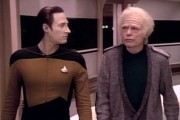
Retrospective: Star Trek The Next Generation-Season One

Star Trek: The Next Generation may have been the most anticipated new series in the fall of 1987. After four feature films, twenty years since the debut of the Original Series on NBC, a new generation of fearless explorers had arisen to follow the path laid down by James T. Kirk and his intrepid crew. And therein may lay the problem. We Trekkies expected magic, and were promptly let down; at least we thought so. Retrospect gives me a different viewpoint. It wasn’t as bad as I remembered, but at that point it wasn’t close to the quality it would achieve in later seasons.

TNG began airing in syndication on September 28, 1987. In a delicious twist of irony, locally it was broadcast twice a week on our town’s Fox station. One hundred years after events of the Original Series (OS), Jean Luc Picard assumes command of the Galaxy-class starship EnterpriseD. He and his intrepid crew—William T. Riker, Data, Worf, Tasha Yar, Geordi La Forge, Counsellor Deanna Troi, Dr. Beverly Crusher and her precocious son Wesley—set out on their ongoing mission to explore the uncharted regions of space.

The show was one of the most talked about subjects at my first science fiction convention, Norwescon 10, which was held at the Sheraton Inn in my hometown of Tacoma, Washington, on March 24 to 27, 1988. That convention blew me away, being a neophyte and all. I spent a lot of time immersed in panels, seated as far in the back as I could get. What I really wasn’t prepared for was the fire drill we had on Friday night. Everyone in the hotel, hundreds of us, had to hurry down 17 flights of stairs, and once we were all crowded outside, someone announced that it had been a false alarm, and we had to trudge back up 17 flights of stairs. To be that young again…

Trekkies had set up a ‘transporter’ on the second floor, and not too far away was a TARDIS. All day Sunday in NWC6, Room 407, there was a showing of the fan parody, “Star Trek: The Pepsi Generation”, “baldly going where no one has gone before” against the dreadful Ferrari. I’m still laughing about that today. TNG was the subject of a panel discussion in which one of the participants described Tasha Yar as a “bitch in britches.” One of the biggest selling buttons that year was “Kill Wesley Crusher.”

It wasn’t all negative. The Artist Guest of Honor was Rick Sternbach, an illustrator involved in TNG and later Star Trek series. Toastmaster for Norwescon 10 was Trek scriptwriter David Gerrold, the man who gave us the tribbles. At this point TNG hadn’t finished broadcasting its first season. The last episode before the convention, “Heart of Glory”, aired March 21. Tasha Yar would still be alive for a couple more episodes. Once the convention closed, six more episodes remained before the season concluded with “The Neutral Zone”, syndicated on May 16, 1988.

One problem with the series was expectations. All of us Trekkies had spent the last 17 years engrossed in reruns of the Original Series. Kirk, Spock, McCoy, Sulu, Scotty, Chekov, Uhura and the Enterprise herself were our heroes, our models for what our species was capable of. Anyone stepping into those shoes had a lot of overarching expectations to overcome. Additionally, TNG never had a distinctive theme of its own. What we had is a combination of the beginning of Alexander Courage’s theme from  OS, coupled with the main theme from Star Trek: The Motion Picture by Jerry Goldsmith.

Another problem was the new alien threat—the Ferengi. Yeah, you can all pick yourselves off the floor and stop laughing now. They spent a few episodes hinting at the great and powerful menace facing the Federation, and when they finally did appear…they were trolls. Ironically, at the same time Sylvester McCoy stepped in as the new Doctor Who in merry ol’ England, and I thought exactly the same thing about him. In that instance McCoy grew on you, in time becoming one of the most intriguing, sinister Doctors of all. The Ferengi would never rise above the level of a joke. Lets not get into the merry-go-round of Chief Engineers that plagued this season. We had MacDougal, Argylle, the obstinate Logan (who was just a dick), and Leland T. Lynch.

THE CAST

One welcome change would be that all seven main cast members were given a spotlight—not always a good one, but they tried. No one was sidelined in favor of the principals, as in Kirk-Spock-McCoy over everyone else in OS. It is now time to consider those cast members.

Picard (Patrick Stewart) was presented as a French captain, a callback to the original series where everything is a Russian inwention to Chekov . That lasted a few episodes before they largely drop the gag and roll with the English actor who happens to have a French name. He was stiffly regimented, just as Q described him, in their early voyages. Episodes such as “Code of Honor”, “Too Short a Season” and “Symbiosis” defined Picard’s strict adherence to the Prime Directive, an OS rule which Kirk broke repeatedly. Picard is also saddled with a shipload of children, and honestly he’s not too fond of them. To his credit, he’s prepared to risk the ship for their safety, whether it’s just for one (Wesley, “Justice”) or many (“When The Bough Breaks”).

Riker spends most of the season as a James T. Kirk clone. That’s an unfortunate accusation dating to fans early impressions, soon dashed both by improved writing and the natural charisma of Jonathan Frakes. It wasn’t long before we were treated to something the fans refer to as “The Riker Maneuver”; y’know, those times he leans over chairs, one leg propped up on a console. Or all the times he swings one leg over a chair as he’s seating himself. There are rumors Frakes did this to relieve pressure on his back, due to injuries sustained from a former job as a furniture mover. I get that. My brother David frequently suffered back injuries, usually self-inflicted, from lifting doors. Frakes carries out the maneuver as early as the second episode, “The Naked Now”, when he’s leaning over Data while he’s operating the science station. And it’s not a bad thing. It adds a layer to his character; it suited his flamboyance and self -confidence.

Worf growls a lot and spends most of the season getting his ass kicked. On the other hand, he got all the best one-liners. Consider this exchange from “Justice”:

Worf: “For what we consider love, sir, I would need a Klingon woman.”

Riker: “What about plain old basic sex? You must have some need for that.”

“Of course, but with the females available to me, sir—Earth females—I must restrain myself too much. They are quite fragile, sir.”

“Worf, if I didn’t know better I’d say you were bragging.”

“Bragging, sir?”

Then there’s this goodie from “11001001”: “If winning is not important, then, Commander–why keep score?” Finally, Worf’s impassioned speech about duty and honor in “Heart of Glory” may be one of the best of Season One.

The one duo that works right out of the gate is the pairing of Geordi and Data. Geordi could be considered an extension of the actor playing him, LeVar Burton. He was personable, outgoing, the guy who gets along with everyone. In tense situations Geordi was ready with a wry comment that was usually spot on. The fact that he had a VISOR never troubled me, despite the writers constantly bringing it up as some kind of multi-tasking super-duper power.

Data (Brent Spiner) remains the most appealing character. He was the polar opposite of OS’s Spock, though they both served the same function as mirrors on the human condition. Early on Data was characterized as a babbler who defines words and phrases to death, to the point where the captain, crew and even the ship’s computer cut him off. Whereas Spock kept his emotions on a tight grip and frequently expressed disdain at our emotionalism, Data was always reaching, often coming closer to humanity than most of the humans he interacted with. When Tasha, in her farewell log, said he sees things with the wonder of a child, she’s not wrong.

The tragedy of Tasha Yar (Denise Crosby) is that we never got to know her. The one story where Tasha was the focus (“Code of Honor”) was diluted by Picard and Chief Lutan waltzing around the Prime Directive. We have hints of her home world, a place hip deep in anarchy, that were barely scratched at. And yet we can view the effects of growing up in that environment in her self-discipline and the rapier sharp temper, poised to lash out at any time.

And she suffers no fools, as when the aliens are locked in an electric duel (‘Symbiosis”), she casually phasers them with a quiet, “Gentlemen, behave.” When confronted by Ferengi or Qs, she gives no fucks. It would have been interesting to explore her early years, what clever ways she avoided the gangs, the skills she acquired for day-to-day survival. That was not to be.

Troi starts off in a skant miniskirt and boots for the pilot. Once we get to the first episode she’s confined for the rest of the season in a doughty jumpsuit; now if the intent was to deemphasize her sexuality, they went too far the other way. The Riker-Troi romance was kind of a carry-over from the planned-&-cancelled Phase II series from the 1970s, where the romantic pair was Dekker and Ilia, brought to life in ST: The Motion Picture.

The romance here is not only unsustainable, it’s unbelievable. This is especially true given the considered and intelligent portrayal of Benjamin Sisko and his son Jake on DS9. Anyone can see this as a sham perpetuated by TV writers, that a protagonist can’t be weighed down by a family or love interest. Horseshit. Career military men from the lowest ranks to the most decorated generals have been married, with children. People can make a commitment to family and the service. The two are not incompatible.

Miles O’Brien also makes his first appearance, on the battle bridge in the very first episode, although he wouldn’t be given a surname until the second season (“A Matter of Honor”), and his full name would not be given until season 4.

And then there’s Wesley Crusher, child genius. In early forays, from “The Naked Now” up through “Datalore”, Wesley was the one person who can rescue the ship—after he was the one who put it in danger in the first place. This was in line with Gene Roddenberry’s showcasing Wesley as an indispensable genius; it also portrayed the rest of the command crew as foolish. After “Where No One Has Gone Before”, it became Picard’s job to mentor Wesley, becoming a surrogate father of sorts.

THE EPISODES

The early stories were painful to watch, though the scriptwriting improved after the first block of episodes. I’m not going to nitpick over every single episode. I’d just like to cover some highlights. Let’s begin with the pilot, “Encounter at Farpoint”. First, there was Q. At this point Q remained a mustache twirling villain with contempt for all lesser species. Q joins a long line of godlike entities that peppered OS like Apollo, the Metrons and Trelaine, possibly a Q himself. Unlike previous encounters with supposed ‘deities’, a larger spectra of existence was hinted at (“Hide and Q”), and would be explored in future episodes across three different Trek series.

I liked most of it, BUUUT…Picard surrendered. He actually did it twice. And god, they recycled that damn Motion Picture theme at every dramatic moment. I love that theme, but there’s a point where you have to scream “ENOUGH ALREADY!” To be fair, we met the crew; this was the first time we saw a saucer separation on a starship; and those space jellyfish were absolutely gorgeous. Who had an absolute legitimate grievance. Original Series actor Deforest Kelley’s cameo in “Farpoint” was a highlight. It was also the beginning of a Trek tradition where a character from the previous series acts as a bridge linking the two series.

“The Naked Now” was basically a retread of an OS episode. “Code of Honor” was possibly the most unintentionally racist episode of any Trek series; it has my vote for the worst episode on TNG’s entire 7-season run. The idea may have been to portray the Ligonians as Samurai warriors, but they came across as hide-bound, tradition bound jackasses. “Too Short a Season” presented our first modern, self-important, dickhead Starfleet Admiral. There would be more. 

“Angel One” was a busy episode, what with the plague-of-the-week and a lost party in a matriarchal society. Unfortunately, the women of that society came across as obnoxious and closed-minded. Honestly, I found it hard to sympathize with any of the guest cast. At least “Home Soil” gave us the alien’s tagline: “Ugly bags of mostly water.” “Skin of Evil” was the kind of weird story one could expect from the pen of Outer Limits creator Joseph Stefano. Poor visual effects did this in, but the main issue was that it was a pointless episode designed to kill off a member of the main cast.

I’m not prepared to tag any of these early voyages as Classics, but there were a handful of Good ones. “Where No One Has Gone Before” showed us the seeds of greatness, positing new ideas with the Traveler and the possibilities of higher levels of consciousness. I’m sure we’ve all seen the meme-worthy scene where Picard is about to step out of the turbolift—and almost into warp space. Unfortunately, it also established Gene Roddenberry’s vision of Wesley Crusher as Will Robinson, the smartass kid who had all the answers.

“The Big Goodbye” set the standard for all holodeck adventures that go terribly wrong. It also introduced Picard’s unlikely fascination with 20th Century pulp hero Dixon Hill, an analogue to Data’s parroting of Sherlock Holmes (“Lonely Among Us”). Another holodeck adventure, “11001001” gave Riker a chance to shine while introducing Frakes’ real-life trombone playing skills. The duo of Picard and Riker was unbeatable. It also had the most honest answer as to why these aliens carried out their actions. When Picard asked why they didn’t ask for our help, the Bynars reply, “You might have said no”.

“Heart of Glory” gave us our First Klingon Episode, in which we learn more about the Klingon race than we had in the entire Original Series, and that’s including the first four movies! For the first time, though not the last, Worf emerged as a character of depth and honor. In “Conspiracy”, we had the grossest head splatter in Trek history.

THE MOST BADASS CHARACTER IN SEASON ONE

In fact, the most badass character in the first season of TNG was– Dr. Beverly Crusher, played by Gates Mcfadden. I didn’t like her in the first viewing; most frequently her catchphrase seemed to be, “I don’t know.” But truthfully, she was a lioness in defense of her son (“Justice”, “When the Bough Breaks”). In “Conspiracy”, the possessed Admiral Quinn kicks Riker’s ass, throws Geordi through the bulkhead doors, kicks Worf’s ass—and then Dr. Crusher walks in and phasers the SOB; no fear, no fucks given. In “The Arsenal of Freedom”, while in shock and bleeding, with an automated program loading ever-deadlier probes at both the away team and the EnterpriseD, she is the only one with enough clarity to see the solution: “Why don’t you just shut it off?”

Despite its early shortcomings, TNG was a success right out of the gate. There was little question it would be renewed for a second season. But changes were coming, and that will be the subject of a future blog.

I Hope My Grandchildren Forgive You

I hope my grandchildren forgive you    

for what you brought on our land  

for the world we leave to them

Forgive the desert that was once California  

the parched land and tongues of ordinary souls  

rationed to a few drips a day  

or will that be a week, who knows?

Forgive the 30 years wasted in deceit and denial  

while simulations became fact

and facts piled on facts  

and opportunities to act became wasted in dithering politics

And to the passing of the Floridas  

while salt of sea infiltrated our children’s drinking supplies  

I fear not for New Orleans, she’ll adapt  

she always does

Forgive us the storms like no other   

coming to a landmark near you   

New York barraged by tides she’ll not soon forget   

Lady Liberty will stand as a beacon still   

even waist deep in the ocean

I certainly hope they can find it in their hearts   

to forgive your cowardice, your avarice,  

your blind blinkered stupidity   

‘Cos God knows I won’t

What’s your problem?

I’m trying to understand something. I don’t know why we’re still talking about it. Seriously, what is everyone’s problem with Jews?

I’ve never been hurt by anyone of the Jewish faith. I’ve never been robbed, bamboozled or financially taken advantage of by said people. If its the tenets and/or rituals they practice, oooh boy have you looked at the Catholic Church lately? I have one rule regarding my level of hate, and that is, I reserve it for anyone who acts like an asshole.

Oh wait, I get it. It’s that business where Jesus was condemned by all the Jews in Jerusalem way back in the Stone Age, Roman Age whatever. One question…how do you know that’s what happened?

The Gospels of Matthew, Mark & Luke, were written second-hand, according to tradition, according to the testimony said to come from Peter and Paul. The only gospel written by an actual apostle was that of John the beloved–again, ACCORDING TO TRADITION. Which proves nothing, as these books were transcribed a hundred years after Jesus’ resurrection.

Putting that aside, I’m supposed to believe that every single Jew in the city rose up against Jesus, after all the miracles he bestowed, after raising both Lazarus and the daughter of Jairus from the dead? I say unto you, IDBY. It certainly wasn’t true of Joseph of Arimathea–you know, the guy who provided the tomb where Jesus lay until his resurrection?

Even IF that were so, which I doubt, so what? That was 2,000 years ago. The Jews of today weren’t alive then. Their ANCESTORS weren’t alive then. In the Mormon church we have an interesting set of guidelines, known as the Articles of Faith. You may be interested in Article no. 2, to wit, “We believe that men will be punished for their own sins, and not for Adam’s transgression.” Whoever killed Jesus, 81 generations ago, they ain’t alive anymore. You can’t hold their descendants responsible.

As for that BS that “eww, Jews own everything, they control everything”, I’m not even wasting time on that nonsense. Elon Musk was raised in an Evangelical family and now is agnostic. Rupert Murdoch professes to be Christian. The Koch brothers are Catholic. The actual number of billionaires following the Jewish faith is closer to 19.8%-30%.

https://www.quora.com/How-come-50-of-billionaires-in-the-USA-are-Jewish-when-Jewish-people-only-make-up-1-4-of-population

I’m not expecting to convert any haters; if you’re convinced of some bullshit conspiracy theory, nothing I say is going to help you. But I’m not going to be silent about it either.

John & Yoko live at the Jerry Lewis Telethon/ September 4, 1972

The Jerry Lewis Labor Day Telethon was a mainstay of our youth. You’d know every fall exactly when Labor Day came around because that was always the day Jerry Lewis held his annual fundraiser for the Muscular Dystrophy Association. Coincidentally this was also held the day before school started up again in the fall.  For 24 hours that telethon dominated our local broadcast, featuring musical acts, celebrities and others all called together for the cause.

Four days after his monumental One on One concert in Madison Square Garden, and a year after George Harrison’s historic Concert for Bangladesh, coincidentally also at the Garden. The couple’s association with Yuppie radicals like Abbie Hoffman & Jerry Rubin brought the FBI to focus an investigation on them and their suspected plans to disrupt the National Republican Convention scheduled for August 21-23, 1972, in Miami Beach FL, the same city where the Democratic Convention was held that year..

Although Hoffman & Rubin were in love with the idea, John & Yoko had no part in any such plans, and the convention went on despite anti-Vietnam War protests on August 22. John & Yoko would face deportation in 1972, based on a past marijuana charge in the UK. While Yoko was granted permanent resident status in 1973. John was ordered to get out. Such was the backdrop to this seminal performance.

The 1972 Muscular Dystrophy Telethon was broadcast from New York City’s Americana Hotel on 7th Avenue. Jerry Lewis began his intro: “Ladies & gentlemen, presenting, and I’m proud to present, two of the most unusual people in all the world, and I don’t mean just in the world of entertainment. They fit no patterns, meet no standards except the standard of excellence. Ladies & gentlemen, John Lennon & Yoko!”

They were joined for the last time by their unofficial backing band, Elephant’s Memory. John sported a faint mustache & beard as he segued into another heartfelt performance of “Imagine”. John couldn’t do a bad version, and here, on keyboard instead of piano it has more of an ethereal tone. He was joined by the saxman on the first bridge, which always brings a bit of soul to any song.

And no, I won’t be excluding Yoko from this. Introducing the second number, she said, “John & I love this country very much and we’re very happy that we’re still here.” This led to “Now or Never” a peace song from her upcoming LP Approximately Infinite Universe. Apparently she was trying it out on a live audience before committing the song to vinyl, just as they’d done with ‘Cold Turkey” in 1969.  There was no screaming this time, instead taking a turn at a folksy style, again highlighted by a saxophone backing.

Next, John praised Jerry as “a great comedian–I wish he never grew up!” He closed with a reggae version of “Give Peace a Chance”, just as they had at the evening show for the One on One concerts. “This is how they do it in Jamaica!” John called, inviting the audience to sing along. This was at a time when most Americans hadn’t had much exposure to reggae. Bob Marley & the Wailers breakthrough in America, Catch a Fire, would not be released until 1973. Johnny Nash’s hit “I Can See Clearly Now” wouldn’t begin to chart until October 1972, the month following this performance.

This would be the last time he performed “Give Peace a Chance”. The sax certainly livened things up, but it didn’t quite hold up to the standard version offered up three years in Toronto. To their credit, the audience seemed charged up throughout the show. While Yoko encouraged viewers to give, John shouted “no more war!” Jerry Lewis joined in with a trumpet to dance with John & Yoko onstage. Even John joins in with the shouts for “money money money!”

Jerry led the audience in a call for an encore: “John, Yoko, John, Yoko!” But as has often been said of Elvis, they had already left the building. Once he realized they weren’t coming back, Jerry covered himself admirably. “I would suspect that John Lennon is probably one of the wisest showmen I’ve ever met,” he said. “He knows what he’s doing. He did two things tonight. He, one, came here to help, the primary purpose of his visit. And two, he meant to say something. I think he did both these things. He has split. Let’s thank him very much.” This was met with the appropriate applause.

Sidebar: Hot Chocolate Covers ‘Give Peace a Chance’

Years before they dropped hits like “You Sexy Thing” and “Every 1′ a Winner”, the Caribbean-British band Hot Chocolate recorded their first single, a reggae version of ‘Give Peace a Chance” where they changed some of the lyrics. One problem, though: then-band leader Errol Brown was told he needed permission.

Brown probably never expected John Lennon to approve, but when Apple Records contacted him, John not only approved but he agreed to release their version on Apple. Recording as the Hot Chocolate Band, their only single on the Apple label was released in October 1969.

The Apple connection fell apart with the Beatles’ breakup, but this interpretation might be where John got the idea to perform reggae versions of “Give Peace a Chance” at both the One on One concerts and the Jerry Lewis telethon.

https://www.songfacts.com/facts/john-lennon/give-peace-a-chance

Two months later in November 1972, Richard Nixon won re-election by a landslide. In April 1973 John appealed his deportation order and with Yoko, declared a new conceptual country, Nutopia with the slogan, “No land, no boundaries, no passports, only people…No laws other than cosmic.” His Lost Weekend was not far off.

In May of 1972 John & Yoko moved from their Bank Street apartment to their lifelong residence at the Dakota. John’s appearance on the Jerry Lewis Telethon would be his last public performance for the next two years, his last with Elephant’s Memory and in fact his last live appearance with Yoko. The Lennon’s Peace campaign had effectively been stymied by the Nixon Administration’s paranoid efforts to get John deported. The legal fight would consume the next couple of years of John & Yoko’s lives.

John Lennon battled the deportation proceedings until October 8, 1975, when the deportation attempt was barred. In what would become the foundation for DACA, a Court of Appeals stated: “the courts will not condone selective deportation based upon secret political grounds.”3 Leon Wildes’ strategy had worked, he successfully demonstrated that just because the government could deport someone did not mean there was an obligation to deport the individual. In 1976, Lennon became a permanent resident.

Jerry Lewis hosted his first MDA telethon on September 4, 1966. He would continue to serve in that capacity from 1968 to 2010, raising 2.45 billion dollars for the MDA. The telethons continued, with other hosts, until 2012. Jerry passed away on August 20, 2017, aged 91 years.

Availability: Officially John Lennon’s performance on the Jerry Lewis Telethon has never been up for release, but that’s never stopped bootleggers. One source is a 1996 item, John Lennon-Telecasts (JL-517-CD), label unknown. This collects his performances on David Frost, Dick Cavett & Mike Douglas in 1972, including the Jerry Lewis program.

The concert can be found on several YouTube channels. We also have more options on DVD, again via bootleg. As far as listing every relevant bootleg, this is in no way to be considered inclusive. The Complete Live Lennon Tapes (misterclaudel 4637577, c. 2006) may be true to its word. Along with Jerry Lewis, it contains performances from the Rock & Roll Circus, the Fillmore East with Frank Zappa, the John Sinclair benefit, David Frost, the Attica State benefit (without Yoko), Mike Douglas, Dick Cavett, Madison Square Garden with Elton John, the Old Grey Whistle, A Salute to Sir Lew Grade, as well as seven tracks from the evening One on One concert.

From HMC’s TMOQ Gazette series comes John Lennon-Holy Grails, Upgrades & Reconstructions Vol. 1 (TMOQ Gazette HMC 042), which among other items, includes news footage from the Bryant Park Peace rally, as well as two versions of the Labor Day Telethon, in color and B&W.

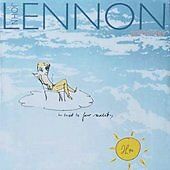
Among the curiosities on The John Lennon Anthology, on CD 2: New York City. While Track 20 is labelled “Jerry Lewis Telethon”, all it offers is Jerry Lewis’ call for an encore & his gracious speech once he realizes they were gone.

Perspective

“We’re all in the same boat.”

You hear that a lot as a metaphor to explain away hard times, to buck up and press on, pull yourself up by your bootlaces, as another cliche goes, I must tacitly disagree.

We are NOT all in the same boat. We are all in our own leaking boats, trying desperately to plug the holes with snips off our bootlaces; except after the last 30 to 40 years, our bootlaces have been snipped away to nothing.

A lot of us, too many of us, don’t have ‘boats’ at all. They’re just clinging to a garbage bag that holds all they have in the world. We don’t see them for the most part, try to ignore their existence, and when that becomes too hard, we use our paddles to shove them as far out of our sight as possible.

Some of us are throwing rocks at people in other boats ‘cos they cain’t stand t’ look at their faces: “Mabel, get mah shotgun, that there colored boat is gettin’ too close to us!”

Let’s not forget the yachts blissfully plowing through us, not a care in the world, not even if a passing boat happens to get pulverized by their rudders.

That’s my metaphor, which I think is closer to the truth,

John plays “Jealous Guy” to a lost Japanese couple

There are a couple of eyewitness versions to this story, a little-known incident that took place in Japan during John Lennon’s years as a homebody. Clearly neither he nor Yoko were entirely housebound in those five years. They were out and about, just not making records at that point. I’ll try to present the version I like best. In all the nine years since he first conceived this song in Rishikesh, India, John had never played it live. And the one time he did, it was to an unwitting audience.

After winning his appeal to stay in the United States, John & Yoko visited Japan at least three times before his passing, beginning with a 1977 trip that lasted from May to October of that year. Yoko’s parents were upper class people who had a summer home in Karuizawa in Nagano Prefecture. During a stay at Tokyo’s Okura Hotel in 1977, while Yoko was visiting her family, John and his friend Elliot Mintz were lounging around in the presidential suite when an elderly couple evidently took the elevator to the wrong floor.

This couple has never been identified as anything other than an ‘elderly couple’. I’d love to know who they were, although at this point, only their relatives would know for sure.   They wandered in and sat down, apparently thinking they were in a lounge bar. John found this entertaining and as Mintz related, he began to play “Jealous Guy” on his acoustic guitar.

The couple sat and listened for a few minutes before walking back to the elevator and going, which left John and Mintz in fits of laughter. “It was the only time I think he ever performed for a party of two,” Mintz wrote. “They did not leave a tip.”

https://www.nippon.com/en/japan-topics/g00979/

Karuizawa, Japan: In the Footsteps of John Lennon

John & Yoko in Japan, c. 1971
John Lennon in an electronica shop, c. 1979

A History of David Frost and John Lennon, 1967-1972

-The Frost Programme, Sept. 29 & Oct. 4, 1967

Frost on Saturday, Aug. 24, 1968, repeated on The Best of Frost, May 18, 1969

The David Frost Show, June 10, 1969/ July 10, 1969 & Dec. 16, 1971/ Jan. 13, 1972

As a talk show host David Frost was not a flamboyant fellow, but he was intuitive and could tease your dirty secrets out without making you uncomfortable. That’s probably what made his interviews with Richard Nixon so effective. While his name is intimately associated with the Beatles, as a band they put in an appearance on only one occasion. That would be for the world premiere of the extraordinary promotional clip for “Hey Jude” on Frost on Sunday on September 8, 1968. In order to maintain the illusion of a live appearance, Frost taped some clips at Twickenham Film Studios where he seemingly introduces the band.

By this time Paul McCartney had already made three appearances on one iteration or more of the Frost Show, the first as far back as April 1964, while they were neck deep in the filming of their first film, A Hard Day’s Night. Ringo showed up twice in 1969 & 1970; George Harrison appeared once in 1971 alongside Ravi Shankar, while he & John had expounded on Transcendental Meditation on two episodes back in 1967.

GEORGE: Your actions – whatever they are – are your actions. It’s all about your attitude toward other people. If you treat them good, they’ll do the same; if you hit them in the face, they’ll probably do the same thing. And that’s not much to do with religion. Action and reaction, that’s the thing Christ was saying. Whatever you do, you get it back.

JOHN: It’s the same in the whole universe, in all religions. It’s just opening your mind to see that. Buddha was groovy, you know. And Jesus was all right. It’s exactly the same thing.

https://tmhome.com/experiences/interview-lennon-and-harrison-on-meditation/

John & Yoko made their first appearance as a couple one month after the premiere of “Hey Jude”, on the fourth edition of the latest iteration, Frost on Saturday on August 24, 1968, recorded live from Wembley Studios on London Weekend Television. while he was still a Beatle. The other guests included singer Blossom Dearie and satirist Stan Freberg. This interview took place two days after Ringo had left the group, during the sessions for The White Album; in fact it was also the day after the group had carried on and recorded all of “Back in the USSR”, without Ringo.

On this occasion the couple arrived in black clothes with small white badges on their lapels. They discussed their art project “You Are Here’, basically an unfinished art piece that invited people to participate.

Yoko Ono: “Usually people think in vicarious terms, they think ‘Somebody’s there,’ ‘John Lennon’s there,’ or somebody. But it’s not that. YOU are the one who’s here, and so in art, usually art gives something that’s an object and says ‘This is art,’ you know, but instead of that, art exists in people. It’s people’s art, and so we don’t believe in just making something and completing it and giving it to people, we like people to participate. All the pieces are unfinished and they have to be finished by people.”

Further on John elaborated, “The thing is, there’s no such thing as sculpture or art or anything, it’s just a bit of – it’s just words, you know, and actually saying everything is art. We’re all art, art is just a tag, like a journalist’s tag, but artists believe it. But sculpture is anything you care to name. This is sculpture: us sitting here, this is a happening, we are here, this is art, but yeah, if you gave that to a child, he wouldn’t have any preconceived ideas, so you wouldn’t have to say ‘This is sculpture’ or ‘This is a broken cup’, you’d say ‘There’s that – there’s glue, what do you do? You stick it together’.”

 Other examples were Hammer a Nail In. Frost didn’t always get it when they talked about ‘vibrations’ or art in general, which was probably where most proper people were at in 1968. As someone with an odd imagination I found John’s comments on art insightful, and his sense of humor was as joyful to experience as ever. He was intuitive enough to connect his piece to the first time John met Yoko at the Indica Gallery in 1966, this may be the first time John told the story of how he met Yoko to an audience and how they connected over art.

Frost: I know this is a terrible condemnation of you, but I just felt like a man hammering in a nail.

Lennon: Winner! I felt like one hammering it in on TV.

 Frost: Well in fact, because this is interesting, the thing with the nails for instance, it was banging the nail in – that the two of you found that you agreed on art and so on.

They also had a long discussion of their film “Smile”, wherein John just stares into the camera. When three minutes get stretched into one hour, one can see how much the facial expression changes.

Ono: Well, we’re not trying to explain, John. We’re just trying to communicate. And communication itself is art and art is communication. And so that, erm, people are getting so intelligent that you don’t have to explain too much, all you have to do is just touch each other, just shake hands, and so this is a way of touching each other.


 Interestingly, as the credits roll “Hey Jude” is playing. John joins into the coda and encourages the audience to join in as the episode ends. The interview was so intriguing it was repeated on a highlights series, The Best of Frost, which was transmitted in some regions by LWT on late night Sunday, May 18, 1969.

Link: Beatles Bible,

https://dangerousminds.net/comments/john_yoko_discussing_art_on_david_frosts_show_1968

By this time Frost had become a host of some repute. In 1969 he launched a weekly TV series in the United States, The David Frost Show, produced for the Westinghouse group for syndication. This involved Frost flying back and forth across the Atlantic every week holding down this series as well as his LWT series in England. On June 14 John & Yoko filmed a pre-taped sequence for the July 10, 1969 segment at Stonebridge Park Studios, where the previous December they’d participated in the Rolling Stones’ Rock & Roll Circus. Other guests included actors John Cassavetes, Peter Falk, Ben Gazzara & Julie London.

Lennon: What’s Bagism? It’s like a tag for what we all do, we’re all in a bag, you know, and we realized that we came from two bags – I was in this pop bag going round and round in my little clique and she was in her little avant-garde clique going round and round and you’re in your little tele clique and they’re in their…you know? And we all sort of come out and look at each other every now and then, but we don’t communicate. We all intellectualize about how there is no barrier between art, music, poetry… but we’re still all – ‘I’m a rock and roller’, ‘He’s a poet’. So we just came up with the word so you would ask us what bagism is – And we’d say we’re all in a bag, baby!

John’s first act was to throw acorns into the audience, calling them “acorns for peace”. John came in full Gandalf mustache & beard, and a blindingly white suit; Yoko was still in black. They came to discuss their peace campaign and bagism. John also held up a copy of Unfinished Music 2: Life With the Lions, playing snippets from ‘Cambridge 1968″ & “No Bed for Beatle John”. Yoko gave Frost a ‘box of smiles’; when he opened it he found a mirror inside that reflected back his own smile. Two Virgins was also discussed; Frost joked that the price tag had been placed in a ‘strategic place’.

Lennon: We’re trying to sell peace, like a product, you know, and sell it like people sell soap or soft drinks, you know, the only way to get people aware that peace is possible and – It isn’t just inevitable to have violence, not just war, all forms of violence. People just accept it and think ‘Oh, they did it’, or ‘Harold Wilson did it’ or ‘Nixon did it’, they’re always scapegoating people. It isn’t Nixon’s fault, we’re all responsible for everything that goes on, you know, we’re all responsible for Biafra and Hitler and everything. So we’re just saying ‘SELL PEACE’. Anybody interested in peace – just stick it in the window, it’s simple but it lets somebody else know that you want peace too, because you feel alone if you’re the only one thinking ‘Wouldn’t it be nice if there was peace and nobody was getting killed’. So advertise yourself that you’re for peace if you believe in it.

Links: https://www.beatlesbible.com/1969/06/14/television-john-lennon-yoko-ono-david-frost-show/

http://www.beatlelinks.net/forums/showthread.php?p=372840

John’s fifth & final appearance on a David Frost program was taped December 16, 1971 for later syndication, about a week after the Ann Arbor benefit for John Sinclair, & a day before his appearance at eh Apollo Theater. John is still in his black leather jacket. After Frost introduced John & Yoko he said we are in for a musical treat. They were joined onstage by David Peel & the Lower East Side for a rendering of Peel’s “The Ballad of New York City”, a simply folksy tune with John on a tea chest bass.

David Peel had served two years in the U.S. Army, around 1960. He was stationed in Alaska, which is kind of funny, because that was where my Dad served as a radio operator in the late 1950’s. John Lennon befriended Peel in 1971 when his band was performing in New York’s Washington Square Park in Greenwich Village. Peel had joined John & Yoko at the Ann Arbor benefit on December 10, 1971, and less than a week later, joined the pair again on this segment of The David Frost Show.

Both songs that Peel performed on this show would appear four months later on his third album, The Pope Smokes Dope (released April 17, 1972 on Apple Records). John produced the album as well as provided background vocals with Yoko Ono. The album managed to offend almost everybody, subsequently being banned in most of the world expect the United States, Canada & Japan.

This would be John’s first live appearance on U.S. TV as a solo artist. Joined by Yoko, Jerry Rubin & David Peel & company, he would perform “Attica State”, a bit of “Luck of the Irish” “Sisters, O Sisters” & “John Sinclair”, closing with Peel’s “The Hippie From New York City”.

Once more these were all acoustic performances. John & Yoko harmonized on “Attica State”. Yoko, in a green pullover sweater & blue jean, was multi-tasking, tapping a bongo while holding a lyrics sheet, which John refers back to. It was a problem he’d had in the Beatles too; he always had a hard time remembering the words to the songs he wrote himself. While he & the Lower East Side performed on the edge of the stage, a man in a red felt cowboy hat in the back was tossing paper airplanes over their heads.

After the song Frost invited members of the audience into a discussion about a fairer penal system. At one point a middle-aged couple questioned whether the Lennons were glorifying the prisoners in their song.

Yoko performed ‘Sisters, O Sisters”, then joined Frost for a multi-pointed discussion, including her struggle against discrimination of women, a realization that the public always listens to famous people, and the belief that communication is the key to peace. The pair then invited Chief Lion of the Onondaga tribe onstage for a discussion about plans for the New York State Department of Transportation to expand a highway through tribal land. A short film clip was shown with John & Yoko joining in the Onondaga protest.

Six days after their appearance at the Ann Arbor benefit, John & Yoko & the Lower East side performed “John Sinclair” in a more intimate setting. Yoko’s bongo was more perceptible, and John threw in a few variations to the tune: “Bring him home to his wife and kids/ We did!/ They gave him ten for two/ What else can the whole world do?/ Got to got to got to got…set him free/ Free!”

After the song, John talks about their part in the protest to free John Sinclair and their fight for peace. Finally, everyone stands as David Peel & the Lower East Side perform “The Hippie From New York City”, with John & Yoko standing in back. Again it is an acoustic version of a song about ‘a cockroach & Mayor Lindsey’ with bongos & flute.

Show would be broadcast a month later on January 13, 1972, on ABC-TV.

Links:  https://www.paleycenter.org/collection/item/?item=T:60182

David Peel died in a veteran’s hospital, April 6, 2017.

David Frost passed away on Saturday, August 31, 2013, at the ripe age of 74.

Available on: Seven surviving segments, including John & Yoko’s appearance from 1968, are included on a two-disc DVD set, Frost on Saturday (1968), released by Network, October 4, 2010. Sadly, this seems to only be available in Region 2, i.e., Europe, Japan & the Middle East. There may not be any official release of the Lennon’s other appearances on DVD.

Unofficially, there is at least one bootleg I’m aware of, now. John Lennon Live & Sessions 1971-1972, a two-CD program featuring rehearsals as well as the Tea for Two Rally, The Attica State benefit at the Apollo & all the songs from his last David Frost segment, taped on December 16, 1971, plus 0music from TV appearances on Aquarius & the Mike Douglas Show.

On a different bootleg, THE BEATLES: MOVIES AND MEDITATION 1967 VOL. 4, a 90 Mn. DVD. Among random Magical Mystery Tour home movies & How I Won the War premiere clips, there is also John & George’s two appearances on The Frost Programme on September 29 & October 4, 1967, although only the second program is presented complete.