August 30, 1972, Madison Square Garden: One to One Benefit with John and Yoko

“I love it, and that’s why I’m fighting so much to stay here, so I can be in New York,” he said. “Maybe they could just ban me from Ohio or something. Nothing against Ohio. I’d like to live here. I don’t harm anybody. I’ve got a bit of a loudmouth — that’s about all. I make a lot of music. That’s what mainly I do. I’m either making music, watching TV or listening to the radio. Occasionally I get into a little spot of trouble but nothing that’s going to bring the country to pieces. I think there’s certainly room for an odd Lennon or two here.”

On August 30, 1972, John Lennon delivered his biggest concert performances in Madison Square Garden in a benefit for needy children. It would be a last moment of glory before the Nixon administration piled on him. The concerts were intended to raise money for Staten Island’s Willowbrook State School for children with intellectual disabilities, a place where horrifying conditions of overcrowding, neglect and abuse were brought to light in an expose by Geraldo Rivera earlier that year. He came all the way to San Francisco to meet John and Yoko to convince them to perform.

The Plastic Ono Band was no stranger to benefits, having done the 1969 UNICEF benefit at the Lyceum Ballroom with George Harrison, as well as the John Sinclair rally and the Apollo benefit for the families of the Attica Prison inmates in 1971. These would be John’s only full-length concerts as a solo artist, apart from his appearance at the Toronto Rock and Roll Revival in September 1969. The proceeds would go to establish new accommodations for the residents of the Willowbrook institution.

For this concert he recruited Elephant’s Memory, a New York group, as his backup band. According to their bassist, Gary Van Scyoc, the band met the Lennons in September 1971, recording a live set for a Long Island radio station. That tape wound up with Jerry Rubin, who passed it on to John, and for all we know Yoko still has her hands on it. Elephant’s Memory would be their backing band for Sometime In New York City as well as Yoko’s solo album Approximately Infinite Universe (released January 1973).

As Rolling Stone’s Jann Wiener described it, “John and Yoko permitted themselves to be exploited in this way because they were trying to clean up their act, to impress the immigration authorities that they were good citizens.”

Paul McCartney came close to performing a set but bowed out due to concerns about how Allen Klein would handle the proceeds. That would be a legitimate concern; George Harriosn was livid at how Klein had mishandled the money raised from the Concert for Bangladesh only a year earlier.

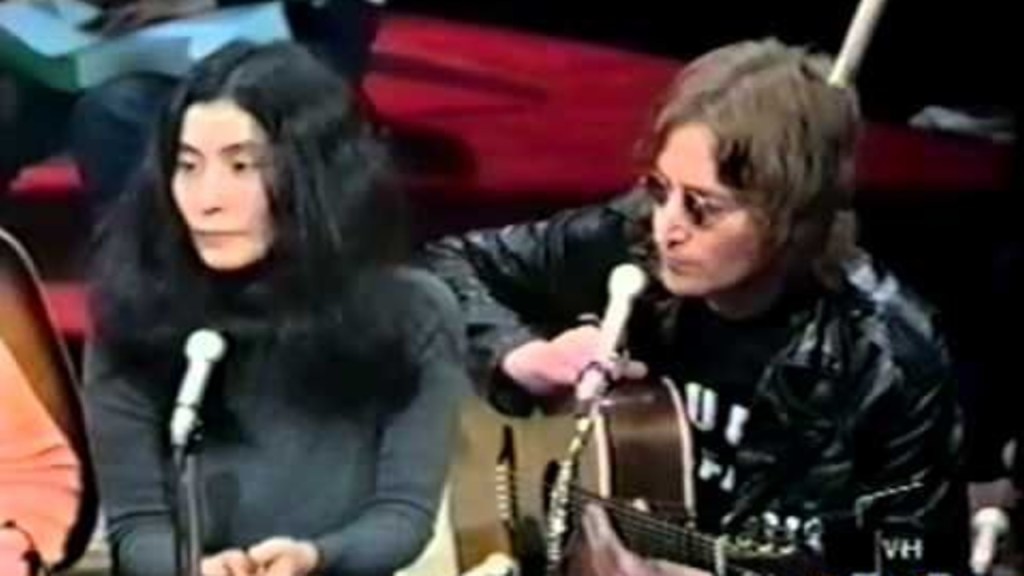
Sha Na Na, Roberta Flack and Stevie Wonder were also at the show, but John Lennon was the headliner. For once Yoko actually SANG, instead of just screaming, but don’t worry. She put in her share of wails. John did both an afternoon matinee and an evening show. The evening performance is believed to have been the better show. According to a New York Times review, “Some of the rough edges of the afternoon performance were smoothed off for the evening show. Interchanges between the Lennons and Elephant’s Memory began to jell, aided in no small measure by Jim Keltner’s drumming.” (“Lennons’ Elan Infuses ‘One to One’ Garden Concert” by Don Heckman, August 3, 1972).

Sha Na Na Playlist: “Yakety Yak”—“Tears On My Pillow”—“Tell Laura I Love Her”—“Rock & Roll is Here To Stay”—“Rama Lama Ding Dong”

I remember watching Sha Na Na with my Dad in 1977, between divorces to his second wife. One of the joys of that show was the endless pranks they played on their celebrity guests. They were a 1950’s revival group popular in the ‘70’s. I didn’t know they’d sung at Woodstock in 1969, right before Jimi Hendrix closed the festival at 7:30 Monday morning, August 18. They were also one of the highlights of Grease (1978); I believe they were allotted a whole side of the 2-record soundtrack. Two of the songs they performed that day, “Tears On My Pillow” and “Rock and Roll is Here to Stay” would be done during the dance scene in Grease

There was an aura of innocence to their music, the illusion that all’s right with the world. That’s probably why 1950’s nostalgia was so big in the 70’s; it’s what our country needed after spiraling into a national malaise after Vietnam and Watergate. During “Tell Laura I Love Her”, the audience banged tambourines with the band. I hope John appreciated their energetic performance; this was the music that shaped him, this early rock ‘n’ roll magic.

Roberta Flack’s Playlist: “Reverend Lee”—“Somewhere”

Roberta Flack did not appear at the afternoon show. I wish I could have found some video or audio tracks from this concert, but no such luck. Nevertheless, she was a star in her own right. In Don Heckman’s article he states the “black goddess of music proved that her hit song, “The First Time Ever I Saw Your Face” was not a one shot phenomenon. She came out and entranced the audience with a program that blended her sometimes unrecognized ability to play superb jazz with her well known gifts as a fine pop vocalist.”

Stevie Wonder’s Playlist: “For Once In My Life”—“If You Really Love Me”—“Superwoman”—“Heaven Help Us All”—“Superstition”—“Keep On Running”

Stevie Wonder was no stranger to the Garden. He’d spent most of 1972 supporting the Rolling Stones on their Exile on Main Street tour. He’d played four shows with the Stones by the end of July with his band, Wonderlove, which included young up-and-coming musicians such as Ray Parker Jr on rhythm guitar and Greg Phillinganes on keyboards. His appearance at this concert was part of Berry Gordy’s plan to expose him to a wider, more diverse audience.

He gave an energetic performance, albeit of the same songs he’d been playing all summer. But he brought the audience alive with a new song called “Superstition”, which turned out to be an even funkier version than what was soon to be committed to vinyl, with Trevor Lawrence blasting an even livelier sax solo. “Keep On Running” closed to the shriek of a police siren.
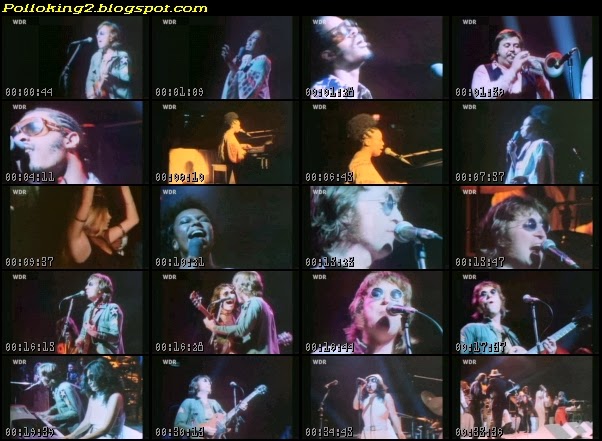
John and Yoko’s Playlist, afternoon matinee: Power to the People (excerpt)—New York City—It’s So Hard—Move On Fast (Yoko)—Woman is the N—– of the World—Sisters O Sisters (Yoko)—Well Well Well—Born in a Prison (Yoko)—Instant Karma (We All Shine On)—Mother—We’re All Water (Yoko)—Come Together—Imagine—Open Your Box (Yoko)—Cold Turkey–Don’t Worry Kyoko (Mummy’s Only Looking For Her Hand in the Snow) (Yoko)—Hound Dog

Evening playlist: Power to the People (excerpt) with introduction by Geraldo Rivera—New York City—It’s So Hard—Move On Fast—Woman is the N—– of the Word—Sisters O Sisters—Well Well Well—Instant Karma—Mother—We’re All Water—Born in a Prison—Come Together—Imagine—Open Your Box—Cold Turkey—Hound Dog—Law and Order (statement read by Yoko)—Give Peace a Chance (reggae version)

Five songs performed at these shows, especially Yoko’s, would be drawn from their Sometime in New York City album, released only two months before in June of 1972. Putting that aside, in the past four years John especially had recorded a small but impressive body of albums and singles to draw on. I write this in hindsight, as I was only eight years old at the time of these concerts. Shall we begin?

Over the screams of the audience comes the chant, “Power to the People”, after half a minute it burns into an electric performance of “New York City”. John came onstage in a green army jacket and blue tinted Granny glasses. No politics here, just a homage to John’s adoptive home that thoroughly outdid the studio version. He closed the evening show by shouting “What a bad-ass city!”

Then he growled through “It’s So Hard” and for all the complaints about the matinee being the weaker concert, I think John brought a lot of enthusiasm to his performance. After the drum roll closed the song, John called, “Welcome to the rehearsal.” Lest we forget the other half, Yoko shouted through a new song, “Move On Fast”, a fast paced number that John laid down a decent groove.

“This song is one of those songs of ours that got banned,” John joked, “something Yoko said to me in 1968, took me until 1970 to dig it.” On the count of “one-two-three-four”, the sax opens ‘Woman is the Nigger of the World”. Most people can’t read past the big N-word in the title, which was the point. The song is provocative—it’s SUPPOSED to be provocative! Sadly it’s words are just as relevant now as they were fifty years ago. After the last lyric, “We make her paint her face and dance,” John shouted “Dance—Dance—Dance!” like a wild man, just to emphasize the point.

“This song has the same message, it’s just put in a way she puts it,”, John said. Then Yoko shouted, “This is the time of change! Wake up now!”, jumping right into “Sisters O Sisters”. Yoko was really singing this time, or at least she was trying. John gave the solo a 1950’s rockabilly spin. At the end of the song John called out, “Thank you, sister!  Reggae, baby, reggae! They do it in Jamaica and London, they’re gonna do it here one day.”

 Next up was John’s “Well Well Well”, from his Plastic Ono Band album. John was not like Mick Jagger, dancing all over the stage; he could be carried away by the music and just rock in one spot. He slipped in a cute addendum: “She looked so beautiful I could eat her—I did!” His anguished screams were still not as distressing as Yoko’s. (He did that twice in the matinee show, once in the evening show.)

“Born in a Prison” was Yoko’s second of three songs of hers from Sometime in New York City. The poetry of this song is gorgeous; if it’d been sung by Joni Mitchell or Joan Baez, it would’ve been legendary. With Yoko singing, well, not so much. Still, “wood becomes a flute when it’s broken” remains a beautiful lyric. I’m not sure she and John harmonized very well. In fact, in the evening performance his voice sounded very strained; Yoko in contrast sung more relaxed. I hope they had water on stage when she started yelling “Let me out-Let me out!”, again and again over the saxophone. (And you’re only reading this: God help those people who were there enduring it!)  

“Let us pray the choir comes in on time,” John said, hunched behind an organ for “Instant Karma”. This was the only time he actually performed this song live, as well as most of the rest of his tunes. For the evening show he quipped, “I’m just beginning to understand what this record was about,” bringing an extra bit of energy to his performance. After closing the song in the matinee, John remarked, “we’ll get it right next time.”

The spotlight that shone on John seemed to isolate him starkly behind the keyboard. “This number we’re gonna do now, everybody thought it was about my parents, but it’s about all parents, alive or half-dead.” In his review, Heckman wrote “Mother” was a “smashingly passionate song that drew a shouting, emphatic reaction from the young audience.” The delivery was as haunting as the studio recording, but John shredded the vocals far more powerfully in this concert. For the evening performance he embellished his comments from the afternoon by prefacing, “This is another song from one of the albums I made since I left the Rolling Stones!” I’m sure the audience appreciated that.

Yoko was back for “We’re All Water” The lyrics were slightly different from the album, although I always thought this line was hilarious: “There may not be much difference/ between Chairman Mao and Richard Nixon/if we strip them naked”, although she also compared Nixon to Hitler. And no, we’re not spared the shrieking that closes the number. Her screaming “What’s the difference!” actually seemed more defiant.

“Let’s go back to the past, just once, alright,” John said in the evening performance, “Something about a flat top, that’s all I know.” Elephant’s Memory joined him in a raw, almost spooky rendition of “Come Together”, stretching the song in ways I don’t think he could have with the Beatles. He confused some of the lyrics, which was par for the course for John; he often forgot the words to his own songs while performing with the Beatles. Approprietly enough, after the third chorus he sang, “Come together—right now—STOP THE WAR!” the audience roared their approval; at the time of this concert, young people were still serving and dying in Vietnam.  
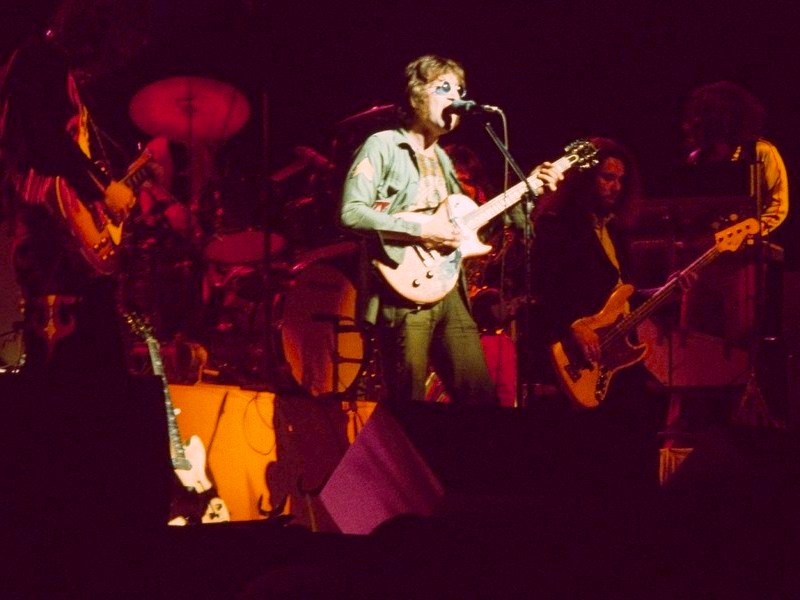
“This song is more about why we’re here, apart from rocking and that,” John opened the evening performance for “Imagine”. He never did a bad performance of this song. The keyboard offered a ringing quality, while he amended the final lyrics to “Brotherhood and sisterhood of man.”

“This is a song that was banned in America but I don’t see anything wrong with it actually”, Yoko said of the next song, “Open Your Box”.

“It’s so banned, we didn’t even notice ourselves,” John added. Lyrics such as “Open your box—open your legs” may have had something to do with that. At the evening concert Yoko commented, “I think they banned it because I’m a woman.” The drums and guitars laid down a  thumping groove. That organ solo was also grand.

In the matinee, the following song stopped after a false start. “Start again! Stop-stop-stop!” John shouted. “Okay, we haven’t been in two weeks of hell of doing that for nothin’!” the evening show went smoother. John quipped, “This is something that happens to all of us, one way or the other.” No false starts for “Cold Turkey” this time, just one of the most intense vocal-guitar-sax assaults of all time. John’s shrieks may have been even more terrifying than on the single, and that scared the shit out of me in ’69.

This segued into “Don’t Worry Kyoko”, appropriately enough since it was the B-side of the “Cold Turkey” single. As painful as this was at Toronto or the Lyceum ballroom, in fairness she poured her mother’s anguish into the vocals. This performance was only four-and-a-half minutes long, as opposed to the 40 minutes she subjected attendees to at the Lyceum. And this was only for the afternoon concert.

For the last number of the matinee, John reached back into his rock and roll roots for an enthusiastic rendition of “Hound Dog”. For the evening performance, an otherwise perfect performance was spoiled by Yoko’s howling behind John. Love it when he shouts, “Elvis, I love you!” near the close.

“Hound Dog” had closed the afternoon concert. The evening show ended slightly differently. Following “Hound Dog”, as an encore, behind a driving groove Yoko reads a statement, “Law and Order” “by a well-known politician”. It might have described the turmoil of the early 1970’s—student unrest, fear of communists and the threat of Russia. The kicker was this statement was given by Hitler in 1931.
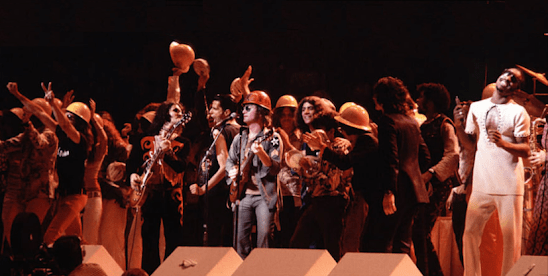
The Lennons were joined in the finale by Sha Na Na, Stevie Wonder, Roberta Flack, the cast of Godspell, Abbie Hoffman, Allen Ginsburg, Melanie Safka and others to sing a reggaefied version of “Give Peace a Chance”. Melanie was another Woodstock veteran, appearing on day one, (August 15, 1969), only three years prior. John and Yoko had invited Melanie to perform. She almost missed the show but made it to the stage in time for the finale. They did justice to the song, I’ll give them that. Stevie Wonder joins in at three minutes—but did it have to be 10 minutes long?
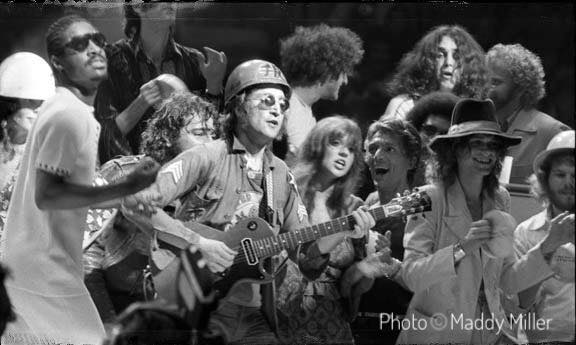
After the concerts, John and Yoko and all the other artists joined a celebratory party at the Tavern In The Green in Central Park. The concerts had raised over $1.5 million dollars for Willowbrook. John was hyped to do more live shows like this. Maybe he would have if he hadn’t got caught in an immigration battle with Nixon over the next couple of years.


Read More: Why John Lennon’s ‘Live in New York City’ LP Was So Frustrating | https://ultimateclassicrock.com/john-lennon-live-in-new-york-city-album/?utm_source=tsmclip&utm_medium=referral

Archive: Lennons’ Elan infuses One to One Garden Concert by Don Heckman, Aug. 31, 1972

https://b1027.com/flashback-john-lennons-only-solo-full-length-concert-video/

Sha Na Na live at Madison Square Garden August 1972

Stevie Wonder’s setlist

https://www.setlist.fm/setlist/stevie-wonder/1972/madison-square-garden-new-york-ny-23c57cd3.html

interview by Jeniffer Dodge with Melanie Safka

Stevie Wonder at Madison Square Garden August 1972

https://www.wolfgangs.com/music/stevie-wonder/audio/20052500-6809.html?tid=2974

Songs in the Key of Stevie blog

https://www.theatrewithin.org/songs-in-the-key-of-stevie

Albums that should exist blogspot

https://albumsthatshouldexist.blogspot.com/2023/06/john-lennon-and-various-artists-one-to.html

Soul Concerts wiki, August 30, 1972, Madison Square Garden

https://soul-concerts.fandom.com/wiki/August_30,_1972_Madison_Square_Garden,_New_York_City,_NY

Ultimate Classic Rock: Why John Lennon’s Live in NYC is so frustrating

https://ultimateclassicrock.com/john-lennon-live-in-new-york-city-album/

Available on: This is something of a mixed bag. In order, then. To my knowledge, none of the other artists have had an official release of their performances from the One to One concerts. An excerpt of “Give Peace a Chance” from the evening concert featuring Stevie Wonder, segued into the tail end of “Happy Xmas” on the 1975 compilation Shaved Fish.

Both concerts were professionally filmed. The recording supervisor for the shows was Phil Spector. A version with seven songs from the evening concert (“Come Together”, “Instant Karma”, “Sisters O Sisters”, “Cold Turkey”, “Hound Dog” and “Give Peace a Chance”, with “Imagine” played to scenes of the One to One fun day activities in Central Park that afternoon) was transmitted on ABC-TV in America, as a 53 minute special, on December 14, 1972. Yoko’s afternoon performance of “Move On Fast” received a rare one-off screening in England during the January 20, 1973 edition of BBC2’s late night show, The Old Grey Whistle.
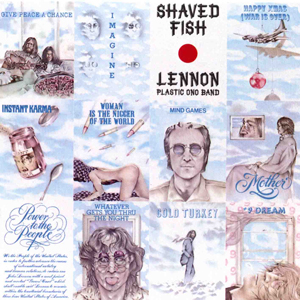
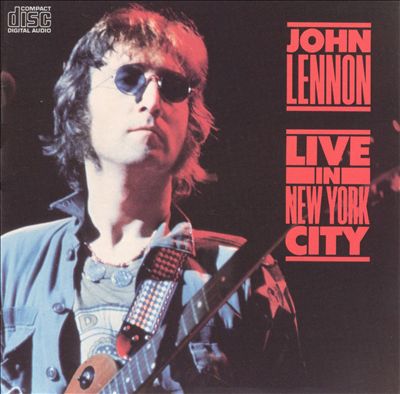
The 1986 posthumous album Live in New York City consisted primarily of songs from the afternoon set, with the exception of “Cold Turkey”, “Hound Dog” and an extremely truncated version of “Give Peace a Chance”, which were taken from the evening show. Even that involved some editing; the spoken intro for “Hound Dog” was taken from the afternoon show, while the performance was from the evening show. Yoko’s music was not included to make an exclusively John Lennon LP. A concert film of the same name was broadcast on Showtime in the same period, and released as a one-hour VHS, with different edits and the inclusion of some of Yoko’s songs.  

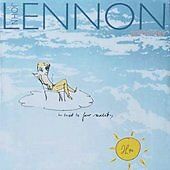
Three songs from the evening show, along with Geraldo Rivera’s introduction, were included on the 1998 box set John Lennon Anthology: “Woman is the N—– of the World”, “It’s So Hard” and “Come Together”.
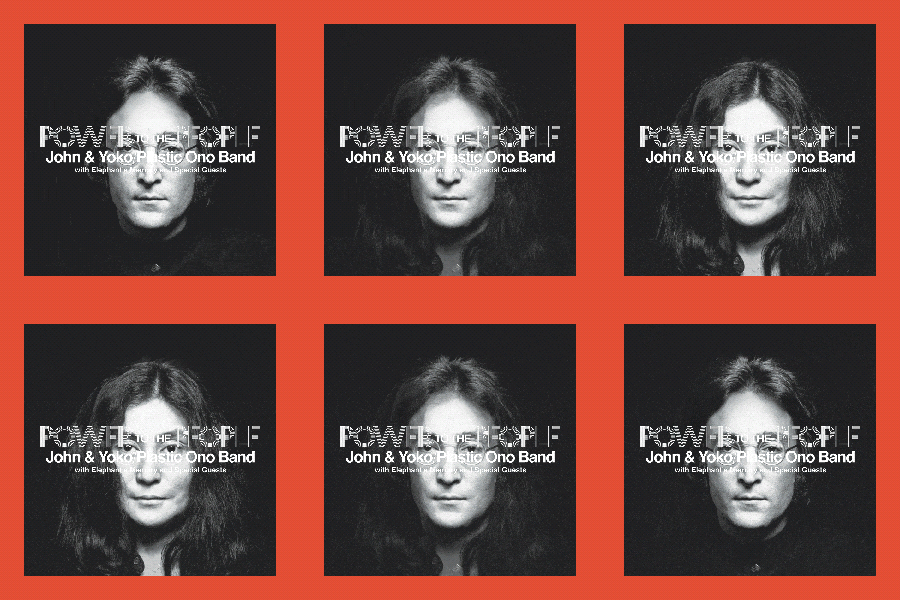
I’d like to say 2025’s Power to the People 9-CD box set finally released the entire concert on its first two CDs, except for some ungodly reason, Sean Lennon removed “Woman is the N—– of the World” (due to cultural sensitivity) as well as Yoko’s ‘Sisters O Sisters” (apparently for lack of space) from both the afternoon AND evening concerts. That’s essentially four songs deleted from the shows. We’ll see if he can get the job done right on the Blu-Ray of the concert, should Sean decide to remaster it properly.  

John Lennon on Not Only…But Also (1964-66)

British comedy takes some getting used to. It’s more outrageous, wacky, and not as straight jacketed by puritanical impulses as American media, then or now. The secret lies in the fact that in the 1960’s, the people making these programs didn’t take themselves too seriously. Try getting Franklin Graham to guffaw along with Benny Hill, Monty Python or Red Dwarf. Hah. Good Luck.

First edition of In His Own Write (1964), and Signet reissue following John’s assassination, late December 1980 or early 1981.

John Lennon’s first book, In His Own Write, was published in March 1964, during the filming of the Beatles’ first movie, A Hard Day’s Night, which also began in March; both shortly before I was born, I might add. 1964 would be the group’s busiest year, and John was still very much invested in their success. And it was grueling, with their world tours to America, Australasia, and Europe, three albums to records along with various singles, television appearances and radio shows, endless interviews in every stop on the road, with only two roadies to assist. Not to mention their legendary first appearance on The Ed Sullivan Show in February and two Christmas Shows bookending the year.

By a strange coincidence a young performer named Dudley Moore was looking to begin his own solo project, but unsure of going it alone, he enlisted a fellow colleague, Peter Cook, his partner in the stage comedy revue Beyond the Fringe (1960+). And thus began the comedy sketch program Not Only…But Also. For three series transmitted in 1965, 1966 and 1970 we were treated to their warped sketches and musical performances, which was very common in shows of that period.

John was acquainted with both Dudley Moore and Peter Cook, as well as Norman Rossington, who appeared alongside him in A Hard Day’s Night. On November 4th Norman and series producer Joe McGrath visited John backstage at the Ritz Cinema in Luton and invited him to participate in the first edition of the new series. John agreed. The first part involved the filming of an outdoor surrealistic sequence on November 20th, to accompany the reading of his poem “Deaf Ted, Danoota, (and me). Shot at Wimbledon Common in Southwest London, this involved John, Dudley and Norman bicycling (over a fence at one point), swinging, dancing with balloons and strolling over the grounds.

Part two was taped the evening of November 29 before an audience at the BBC’s Television Centre in West London. Among the items read to the camera, from In His Own Write, was “About the Awful”, read by John himself. This was his own mangled autobiography, from the book’s back cover.  

John’s prose is not for the linear-minded. His work tends towards the surreal, more like a stream of consciousness with a dash of the comedy troupe, the Goons, thrown in. It’s best experienced as it is here, as spoken performance, or as with his poem “Good Dog Nigel”, with Norman Rossington and a wriggling basset hound in John’s arms. “Unhappy Fred” is a two-hander shuffling back and forth between Dudley and Norman while John, Norman and Dudley do a back and forth to “All About Speeching”. John deadpans his way through “The Wrestling Dog” while Norman barks and ducks in and out. While Dudley mangles and shrieks through the closing number, the other players prance in front of his piano, ending with John flitting manically across the stage.

This first edition was broadcast on BBC2 on January 6, 1965. John enjoyed the experience so much he returned for the Christmas Special, broadcast on Boxing Day, December 26, 1966. John recorded his part on November 27, appearing briefly as Dan, a doorman in a 15-minute segment, a “Swinging London” parody masquerading as The Pipesucker Report, from Idaho. Cook plays an investigative reporter and towards the end of the sketch he approaches an exclusive club, the Ad Lav only to be stopped by Dan (John). He is only allowed access once he convinces Dan he is the Duke and Duchess of Windsor—and also offers John a small bribe. (The Ad Lav is a spoof of the Ad Lib Club, which was much visited by the Beatles.)

While these had little to do with music, they stand as John’s first public appearances outside of the Beatles.  Dudley Moore and Peter Cook would enjoy many years, together and solo, as actors and comediennes, notably in the original version of Bedazzled (1967). Moore might best be remembered for his role as the titular alcoholic in Arthur (1981). Sadly all three of these greats are no longer with us, but their works will live on.

Available On: Much of this series is lost, due to the shortsightedness of the BBC. From 1970 to 1974 it became official policy mandating that recordings of programs deemed of less historical or commercial importance be wiped, a cost saving measure so that the master tapes could be reused. Priority was given to preexisting national or local news items; comedy was not considered of cultural value among the BBC higher ups. Peter Cook offered to buy the existing prints for Not Only…But Also from the BBC, but was turned down flat.

What we have, as with the slaughter of 1960’s Doctor Who, The Avengers and other programs, is items recovered from foreign networks and the remaining 16 mm film inserts. These bits were collected into six 100-hour episodes called The Best of What’s Left of Not Only…But Also. These episodes were subsequently released onto a VHS of the same name. In 2003, a 90 minute Region 2 DVD compilation was released as The Best of Peter Cook and Dudley Moore. In America this would see a DVD release as The Best of…What’s Left of…Not Only…But Also by BBC Worldwide in September 2008, featuring all six compilation episodes, with certain edits due to rights issues.

https://www.bbc.co.uk/comedy/notonlybutalso/index.shtml

John & Yoko live at the Jerry Lewis Telethon/ September 4, 1972

The Jerry Lewis Labor Day Telethon was a mainstay of our youth. You’d know every fall exactly when Labor Day came around because that was always the day Jerry Lewis held his annual fundraiser for the Muscular Dystrophy Association. Coincidentally this was also held the day before school started up again in the fall.  For 24 hours that telethon dominated our local broadcast, featuring musical acts, celebrities and others all called together for the cause.

Four days after his monumental One on One concert in Madison Square Garden, and a year after George Harrison’s historic Concert for Bangladesh, coincidentally also at the Garden. The couple’s association with Yuppie radicals like Abbie Hoffman & Jerry Rubin brought the FBI to focus an investigation on them and their suspected plans to disrupt the National Republican Convention scheduled for August 21-23, 1972, in Miami Beach FL, the same city where the Democratic Convention was held that year..

Although Hoffman & Rubin were in love with the idea, John & Yoko had no part in any such plans, and the convention went on despite anti-Vietnam War protests on August 22. John & Yoko would face deportation in 1972, based on a past marijuana charge in the UK. While Yoko was granted permanent resident status in 1973. John was ordered to get out. Such was the backdrop to this seminal performance.

The 1972 Muscular Dystrophy Telethon was broadcast from New York City’s Americana Hotel on 7th Avenue. Jerry Lewis began his intro: “Ladies & gentlemen, presenting, and I’m proud to present, two of the most unusual people in all the world, and I don’t mean just in the world of entertainment. They fit no patterns, meet no standards except the standard of excellence. Ladies & gentlemen, John Lennon & Yoko!”

They were joined for the last time by their unofficial backing band, Elephant’s Memory. John sported a faint mustache & beard as he segued into another heartfelt performance of “Imagine”. John couldn’t do a bad version, and here, on keyboard instead of piano it has more of an ethereal tone. He was joined by the saxman on the first bridge, which always brings a bit of soul to any song.

And no, I won’t be excluding Yoko from this. Introducing the second number, she said, “John & I love this country very much and we’re very happy that we’re still here.” This led to “Now or Never” a peace song from her upcoming LP Approximately Infinite Universe. Apparently she was trying it out on a live audience before committing the song to vinyl, just as they’d done with ‘Cold Turkey” in 1969.  There was no screaming this time, instead taking a turn at a folksy style, again highlighted by a saxophone backing.

Next, John praised Jerry as “a great comedian–I wish he never grew up!” He closed with a reggae version of “Give Peace a Chance”, just as they had at the evening show for the One on One concerts. “This is how they do it in Jamaica!” John called, inviting the audience to sing along. This was at a time when most Americans hadn’t had much exposure to reggae. Bob Marley & the Wailers breakthrough in America, Catch a Fire, would not be released until 1973. Johnny Nash’s hit “I Can See Clearly Now” wouldn’t begin to chart until October 1972, the month following this performance.

This would be the last time he performed “Give Peace a Chance”. The sax certainly livened things up, but it didn’t quite hold up to the standard version offered up three years in Toronto. To their credit, the audience seemed charged up throughout the show. While Yoko encouraged viewers to give, John shouted “no more war!” Jerry Lewis joined in with a trumpet to dance with John & Yoko onstage. Even John joins in with the shouts for “money money money!”

Jerry led the audience in a call for an encore: “John, Yoko, John, Yoko!” But as has often been said of Elvis, they had already left the building. Once he realized they weren’t coming back, Jerry covered himself admirably. “I would suspect that John Lennon is probably one of the wisest showmen I’ve ever met,” he said. “He knows what he’s doing. He did two things tonight. He, one, came here to help, the primary purpose of his visit. And two, he meant to say something. I think he did both these things. He has split. Let’s thank him very much.” This was met with the appropriate applause.

Sidebar: Hot Chocolate Covers ‘Give Peace a Chance’

Years before they dropped hits like “You Sexy Thing” and “Every 1′ a Winner”, the Caribbean-British band Hot Chocolate recorded their first single, a reggae version of ‘Give Peace a Chance” where they changed some of the lyrics. One problem, though: then-band leader Errol Brown was told he needed permission.

Brown probably never expected John Lennon to approve, but when Apple Records contacted him, John not only approved but he agreed to release their version on Apple. Recording as the Hot Chocolate Band, their only single on the Apple label was released in October 1969.

The Apple connection fell apart with the Beatles’ breakup, but this interpretation might be where John got the idea to perform reggae versions of “Give Peace a Chance” at both the One on One concerts and the Jerry Lewis telethon.

https://www.songfacts.com/facts/john-lennon/give-peace-a-chance

Two months later in November 1972, Richard Nixon won re-election by a landslide. In April 1973 John appealed his deportation order and with Yoko, declared a new conceptual country, Nutopia with the slogan, “No land, no boundaries, no passports, only people…No laws other than cosmic.” His Lost Weekend was not far off.

In May of 1972 John & Yoko moved from their Bank Street apartment to their lifelong residence at the Dakota. John’s appearance on the Jerry Lewis Telethon would be his last public performance for the next two years, his last with Elephant’s Memory and in fact his last live appearance with Yoko. The Lennon’s Peace campaign had effectively been stymied by the Nixon Administration’s paranoid efforts to get John deported. The legal fight would consume the next couple of years of John & Yoko’s lives.

John Lennon battled the deportation proceedings until October 8, 1975, when the deportation attempt was barred. In what would become the foundation for DACA, a Court of Appeals stated: “the courts will not condone selective deportation based upon secret political grounds.”3 Leon Wildes’ strategy had worked, he successfully demonstrated that just because the government could deport someone did not mean there was an obligation to deport the individual. In 1976, Lennon became a permanent resident.

Jerry Lewis hosted his first MDA telethon on September 4, 1966. He would continue to serve in that capacity from 1968 to 2010, raising 2.45 billion dollars for the MDA. The telethons continued, with other hosts, until 2012. Jerry passed away on August 20, 2017, aged 91 years.

Availability: Officially John Lennon’s performance on the Jerry Lewis Telethon has never been up for release, but that’s never stopped bootleggers. One source is a 1996 item, John Lennon-Telecasts (JL-517-CD), label unknown. This collects his performances on David Frost, Dick Cavett & Mike Douglas in 1972, including the Jerry Lewis program.

The concert can be found on several YouTube channels. We also have more options on DVD, again via bootleg. As far as listing every relevant bootleg, this is in no way to be considered inclusive. The Complete Live Lennon Tapes (misterclaudel 4637577, c. 2006) may be true to its word. Along with Jerry Lewis, it contains performances from the Rock & Roll Circus, the Fillmore East with Frank Zappa, the John Sinclair benefit, David Frost, the Attica State benefit (without Yoko), Mike Douglas, Dick Cavett, Madison Square Garden with Elton John, the Old Grey Whistle, A Salute to Sir Lew Grade, as well as seven tracks from the evening One on One concert.

From HMC’s TMOQ Gazette series comes John Lennon-Holy Grails, Upgrades & Reconstructions Vol. 1 (TMOQ Gazette HMC 042), which among other items, includes news footage from the Bryant Park Peace rally, as well as two versions of the Labor Day Telethon, in color and B&W.

Among the curiosities on The John Lennon Anthology, on CD 2: New York City. While Track 20 is labelled “Jerry Lewis Telethon”, all it offers is Jerry Lewis’ call for an encore & his gracious speech once he realizes they were gone.

John plays “Jealous Guy” to a lost Japanese couple

There are a couple of eyewitness versions to this story, a little-known incident that took place in Japan during John Lennon’s years as a homebody. Clearly neither he nor Yoko were entirely housebound in those five years. They were out and about, just not making records at that point. I’ll try to present the version I like best. In all the nine years since he first conceived this song in Rishikesh, India, John had never played it live. And the one time he did, it was to an unwitting audience.

After winning his appeal to stay in the United States, John & Yoko visited Japan at least three times before his passing, beginning with a 1977 trip that lasted from May to October of that year. Yoko’s parents were upper class people who had a summer home in Karuizawa in Nagano Prefecture. During a stay at Tokyo’s Okura Hotel in 1977, while Yoko was visiting her family, John and his friend Elliot Mintz were lounging around in the presidential suite when an elderly couple evidently took the elevator to the wrong floor.

This couple has never been identified as anything other than an ‘elderly couple’. I’d love to know who they were, although at this point, only their relatives would know for sure.   They wandered in and sat down, apparently thinking they were in a lounge bar. John found this entertaining and as Mintz related, he began to play “Jealous Guy” on his acoustic guitar.

The couple sat and listened for a few minutes before walking back to the elevator and going, which left John and Mintz in fits of laughter. “It was the only time I think he ever performed for a party of two,” Mintz wrote. “They did not leave a tip.”

https://www.nippon.com/en/japan-topics/g00979/

Karuizawa, Japan: In the Footsteps of John Lennon

John & Yoko in Japan, c. 1971
John Lennon in an electronica shop, c. 1979

A History of David Frost and John Lennon, 1967-1972

-The Frost Programme, Sept. 29 & Oct. 4, 1967

Frost on Saturday, Aug. 24, 1968, repeated on The Best of Frost, May 18, 1969

The David Frost Show, June 10, 1969/ July 10, 1969 & Dec. 16, 1971/ Jan. 13, 1972

As a talk show host David Frost was not a flamboyant fellow, but he was intuitive and could tease your dirty secrets out without making you uncomfortable. That’s probably what made his interviews with Richard Nixon so effective. While his name is intimately associated with the Beatles, as a band they put in an appearance on only one occasion. That would be for the world premiere of the extraordinary promotional clip for “Hey Jude” on Frost on Sunday on September 8, 1968. In order to maintain the illusion of a live appearance, Frost taped some clips at Twickenham Film Studios where he seemingly introduces the band.

By this time Paul McCartney had already made three appearances on one iteration or more of the Frost Show, the first as far back as April 1964, while they were neck deep in the filming of their first film, A Hard Day’s Night. Ringo showed up twice in 1969 & 1970; George Harrison appeared once in 1971 alongside Ravi Shankar, while he & John had expounded on Transcendental Meditation on two episodes back in 1967.

GEORGE: Your actions – whatever they are – are your actions. It’s all about your attitude toward other people. If you treat them good, they’ll do the same; if you hit them in the face, they’ll probably do the same thing. And that’s not much to do with religion. Action and reaction, that’s the thing Christ was saying. Whatever you do, you get it back.

JOHN: It’s the same in the whole universe, in all religions. It’s just opening your mind to see that. Buddha was groovy, you know. And Jesus was all right. It’s exactly the same thing.

https://tmhome.com/experiences/interview-lennon-and-harrison-on-meditation/

John & Yoko made their first appearance as a couple one month after the premiere of “Hey Jude”, on the fourth edition of the latest iteration, Frost on Saturday on August 24, 1968, recorded live from Wembley Studios on London Weekend Television. while he was still a Beatle. The other guests included singer Blossom Dearie and satirist Stan Freberg. This interview took place two days after Ringo had left the group, during the sessions for The White Album; in fact it was also the day after the group had carried on and recorded all of “Back in the USSR”, without Ringo.

On this occasion the couple arrived in black clothes with small white badges on their lapels. They discussed their art project “You Are Here’, basically an unfinished art piece that invited people to participate.

Yoko Ono: “Usually people think in vicarious terms, they think ‘Somebody’s there,’ ‘John Lennon’s there,’ or somebody. But it’s not that. YOU are the one who’s here, and so in art, usually art gives something that’s an object and says ‘This is art,’ you know, but instead of that, art exists in people. It’s people’s art, and so we don’t believe in just making something and completing it and giving it to people, we like people to participate. All the pieces are unfinished and they have to be finished by people.”

Further on John elaborated, “The thing is, there’s no such thing as sculpture or art or anything, it’s just a bit of – it’s just words, you know, and actually saying everything is art. We’re all art, art is just a tag, like a journalist’s tag, but artists believe it. But sculpture is anything you care to name. This is sculpture: us sitting here, this is a happening, we are here, this is art, but yeah, if you gave that to a child, he wouldn’t have any preconceived ideas, so you wouldn’t have to say ‘This is sculpture’ or ‘This is a broken cup’, you’d say ‘There’s that – there’s glue, what do you do? You stick it together’.”

 Other examples were Hammer a Nail In. Frost didn’t always get it when they talked about ‘vibrations’ or art in general, which was probably where most proper people were at in 1968. As someone with an odd imagination I found John’s comments on art insightful, and his sense of humor was as joyful to experience as ever. He was intuitive enough to connect his piece to the first time John met Yoko at the Indica Gallery in 1966, this may be the first time John told the story of how he met Yoko to an audience and how they connected over art.

Frost: I know this is a terrible condemnation of you, but I just felt like a man hammering in a nail.

Lennon: Winner! I felt like one hammering it in on TV.

 Frost: Well in fact, because this is interesting, the thing with the nails for instance, it was banging the nail in – that the two of you found that you agreed on art and so on.

They also had a long discussion of their film “Smile”, wherein John just stares into the camera. When three minutes get stretched into one hour, one can see how much the facial expression changes.

Ono: Well, we’re not trying to explain, John. We’re just trying to communicate. And communication itself is art and art is communication. And so that, erm, people are getting so intelligent that you don’t have to explain too much, all you have to do is just touch each other, just shake hands, and so this is a way of touching each other.


 Interestingly, as the credits roll “Hey Jude” is playing. John joins into the coda and encourages the audience to join in as the episode ends. The interview was so intriguing it was repeated on a highlights series, The Best of Frost, which was transmitted in some regions by LWT on late night Sunday, May 18, 1969.

Link: Beatles Bible,

https://dangerousminds.net/comments/john_yoko_discussing_art_on_david_frosts_show_1968

By this time Frost had become a host of some repute. In 1969 he launched a weekly TV series in the United States, The David Frost Show, produced for the Westinghouse group for syndication. This involved Frost flying back and forth across the Atlantic every week holding down this series as well as his LWT series in England. On June 14 John & Yoko filmed a pre-taped sequence for the July 10, 1969 segment at Stonebridge Park Studios, where the previous December they’d participated in the Rolling Stones’ Rock & Roll Circus. Other guests included actors John Cassavetes, Peter Falk, Ben Gazzara & Julie London.

Lennon: What’s Bagism? It’s like a tag for what we all do, we’re all in a bag, you know, and we realized that we came from two bags – I was in this pop bag going round and round in my little clique and she was in her little avant-garde clique going round and round and you’re in your little tele clique and they’re in their…you know? And we all sort of come out and look at each other every now and then, but we don’t communicate. We all intellectualize about how there is no barrier between art, music, poetry… but we’re still all – ‘I’m a rock and roller’, ‘He’s a poet’. So we just came up with the word so you would ask us what bagism is – And we’d say we’re all in a bag, baby!

John’s first act was to throw acorns into the audience, calling them “acorns for peace”. John came in full Gandalf mustache & beard, and a blindingly white suit; Yoko was still in black. They came to discuss their peace campaign and bagism. John also held up a copy of Unfinished Music 2: Life With the Lions, playing snippets from ‘Cambridge 1968″ & “No Bed for Beatle John”. Yoko gave Frost a ‘box of smiles’; when he opened it he found a mirror inside that reflected back his own smile. Two Virgins was also discussed; Frost joked that the price tag had been placed in a ‘strategic place’.

Lennon: We’re trying to sell peace, like a product, you know, and sell it like people sell soap or soft drinks, you know, the only way to get people aware that peace is possible and – It isn’t just inevitable to have violence, not just war, all forms of violence. People just accept it and think ‘Oh, they did it’, or ‘Harold Wilson did it’ or ‘Nixon did it’, they’re always scapegoating people. It isn’t Nixon’s fault, we’re all responsible for everything that goes on, you know, we’re all responsible for Biafra and Hitler and everything. So we’re just saying ‘SELL PEACE’. Anybody interested in peace – just stick it in the window, it’s simple but it lets somebody else know that you want peace too, because you feel alone if you’re the only one thinking ‘Wouldn’t it be nice if there was peace and nobody was getting killed’. So advertise yourself that you’re for peace if you believe in it.

Links: https://www.beatlesbible.com/1969/06/14/television-john-lennon-yoko-ono-david-frost-show/

http://www.beatlelinks.net/forums/showthread.php?p=372840

John’s fifth & final appearance on a David Frost program was taped December 16, 1971 for later syndication, about a week after the Ann Arbor benefit for John Sinclair, & a day before his appearance at eh Apollo Theater. John is still in his black leather jacket. After Frost introduced John & Yoko he said we are in for a musical treat. They were joined onstage by David Peel & the Lower East Side for a rendering of Peel’s “The Ballad of New York City”, a simply folksy tune with John on a tea chest bass.

David Peel had served two years in the U.S. Army, around 1960. He was stationed in Alaska, which is kind of funny, because that was where my Dad served as a radio operator in the late 1950’s. John Lennon befriended Peel in 1971 when his band was performing in New York’s Washington Square Park in Greenwich Village. Peel had joined John & Yoko at the Ann Arbor benefit on December 10, 1971, and less than a week later, joined the pair again on this segment of The David Frost Show.

Both songs that Peel performed on this show would appear four months later on his third album, The Pope Smokes Dope (released April 17, 1972 on Apple Records). John produced the album as well as provided background vocals with Yoko Ono. The album managed to offend almost everybody, subsequently being banned in most of the world expect the United States, Canada & Japan.

This would be John’s first live appearance on U.S. TV as a solo artist. Joined by Yoko, Jerry Rubin & David Peel & company, he would perform “Attica State”, a bit of “Luck of the Irish” “Sisters, O Sisters” & “John Sinclair”, closing with Peel’s “The Hippie From New York City”.

Once more these were all acoustic performances. John & Yoko harmonized on “Attica State”. Yoko, in a green pullover sweater & blue jean, was multi-tasking, tapping a bongo while holding a lyrics sheet, which John refers back to. It was a problem he’d had in the Beatles too; he always had a hard time remembering the words to the songs he wrote himself. While he & the Lower East Side performed on the edge of the stage, a man in a red felt cowboy hat in the back was tossing paper airplanes over their heads.

After the song Frost invited members of the audience into a discussion about a fairer penal system. At one point a middle-aged couple questioned whether the Lennons were glorifying the prisoners in their song.

Yoko performed ‘Sisters, O Sisters”, then joined Frost for a multi-pointed discussion, including her struggle against discrimination of women, a realization that the public always listens to famous people, and the belief that communication is the key to peace. The pair then invited Chief Lion of the Onondaga tribe onstage for a discussion about plans for the New York State Department of Transportation to expand a highway through tribal land. A short film clip was shown with John & Yoko joining in the Onondaga protest.

Six days after their appearance at the Ann Arbor benefit, John & Yoko & the Lower East side performed “John Sinclair” in a more intimate setting. Yoko’s bongo was more perceptible, and John threw in a few variations to the tune: “Bring him home to his wife and kids/ We did!/ They gave him ten for two/ What else can the whole world do?/ Got to got to got to got…set him free/ Free!”

After the song, John talks about their part in the protest to free John Sinclair and their fight for peace. Finally, everyone stands as David Peel & the Lower East Side perform “The Hippie From New York City”, with John & Yoko standing in back. Again it is an acoustic version of a song about ‘a cockroach & Mayor Lindsey’ with bongos & flute.

Show would be broadcast a month later on January 13, 1972, on ABC-TV.

Links:  https://www.paleycenter.org/collection/item/?item=T:60182

David Peel died in a veteran’s hospital, April 6, 2017.

David Frost passed away on Saturday, August 31, 2013, at the ripe age of 74.

Available on: Seven surviving segments, including John & Yoko’s appearance from 1968, are included on a two-disc DVD set, Frost on Saturday (1968), released by Network, October 4, 2010. Sadly, this seems to only be available in Region 2, i.e., Europe, Japan & the Middle East. There may not be any official release of the Lennon’s other appearances on DVD.

Unofficially, there is at least one bootleg I’m aware of, now. John Lennon Live & Sessions 1971-1972, a two-CD program featuring rehearsals as well as the Tea for Two Rally, The Attica State benefit at the Apollo & all the songs from his last David Frost segment, taped on December 16, 1971, plus 0music from TV appearances on Aquarius & the Mike Douglas Show.

On a different bootleg, THE BEATLES: MOVIES AND MEDITATION 1967 VOL. 4, a 90 Mn. DVD. Among random Magical Mystery Tour home movies & How I Won the War premiere clips, there is also John & George’s two appearances on The Frost Programme on September 29 & October 4, 1967, although only the second program is presented complete.

John Lennon live at the Apollo, December 17, 1971

John Lennon and Yoko Ono in the crowd at The Apollo Theatre for the Attica Benefit in NYC. December 17, 1971. © Bob Gruen / http://www.bobgruen.com Please contact Bob Gruen’s studio to purchase a print or license this photo. email: info@bobgruen.com Image #: R-433

In approximately six weeks from this writing, it will be the 50th anniversary of John Lennon’s concert appearance at the Apollo Theatre on December 17, 1971. Granted it was a very short set (three songs, and one of them was Yoko’s), but this performance was unplugged decades before that term was coined. It was just John & Yoko and his band on the edge of the stage, accompanied by nothing but Yoko’s bongo and their guitars.

December 1971 was a busy month for the Lennons. Only the week before they had performed at the John Sinclair Freedom Rally in Ann Arbor, Michigan before heading back to New York City. The day before his Apollo appearance, in fact, on December 16, they’d taped an episode of The David Frost Show, joined by David Peel and the Lower East Side band. This wouldn’t be broadcast however, until a month later, well into January 1972.

The show was captured on 16mm film, and also completely ignored by mainstream media.  The only reports would come from Harlem’s local Amsterdam News. Aretha Franklin also performed at this benefit for the families of the prisoners shot in the Attica Prison riot in September of that year. Joining John & Yoko were counterculture activist Jerry Rubin, Chris Osbourne and Eddie Mattau. What they were about to offer were three songs that wouldn’t see the light of day until the release of John & Yoko’s Sometime In New York City six months later on June 12, 1972.

“I’d like to say it’s an honor and a pleasure to be here at the Apollo, and for the reasons that we’re all here,” John began. “Yoko is gonna sing a number that she wrote about her sisters.” The show begins with her offering of a beautiful version of “Sisters, O Sisters.” For once Yoko’s voice is gorgeous, as are the harmonies she shares with John on chorus. Next up is “Attica State”, a song John began composing at his 31st birthday party. The lyrics are strident but softened somewhat by the acoustic guitars, and the slide guitar adds a bit of flavor.

“Thank you,” John said, three times actually. “Some of you might wonder what I’m doing here with no drummers and no, nothing like that, but as you might  know I lost me old band or I left it. I’m putting an electric band together, it’s not ready yet and these things like this keep coming up so I have to just busk it. So I’m gonna sing a song you might know. Its called “Imagine”. This may be the most sincere performance of John’s classic, and may quite possibly be better than the official studio version. The acoustic guitar seems deeper somehow than the piano on the original; Yoko’s bongo is not intrusive this time. It’s hard to listen to this song now, since that was one of the numbers they played at my brother Eddie’s funeral in 2018. But sometimes you just got to.

Ironically, Mark David Chapman was sent to Attica Correctional Facility after he shot John in 1980.

Available: John Lennon’s two songs, “Attica State” & “Imagine”, have seen release first on John Lennon Anthology (November 1998), CD 2-New York City. “Imagine” was subsequently re-issued on John Lennon Acoustic (November 2004). Insofar as I know, Yoko’s live version of ‘Sisters, O Sisters remains unreleased.