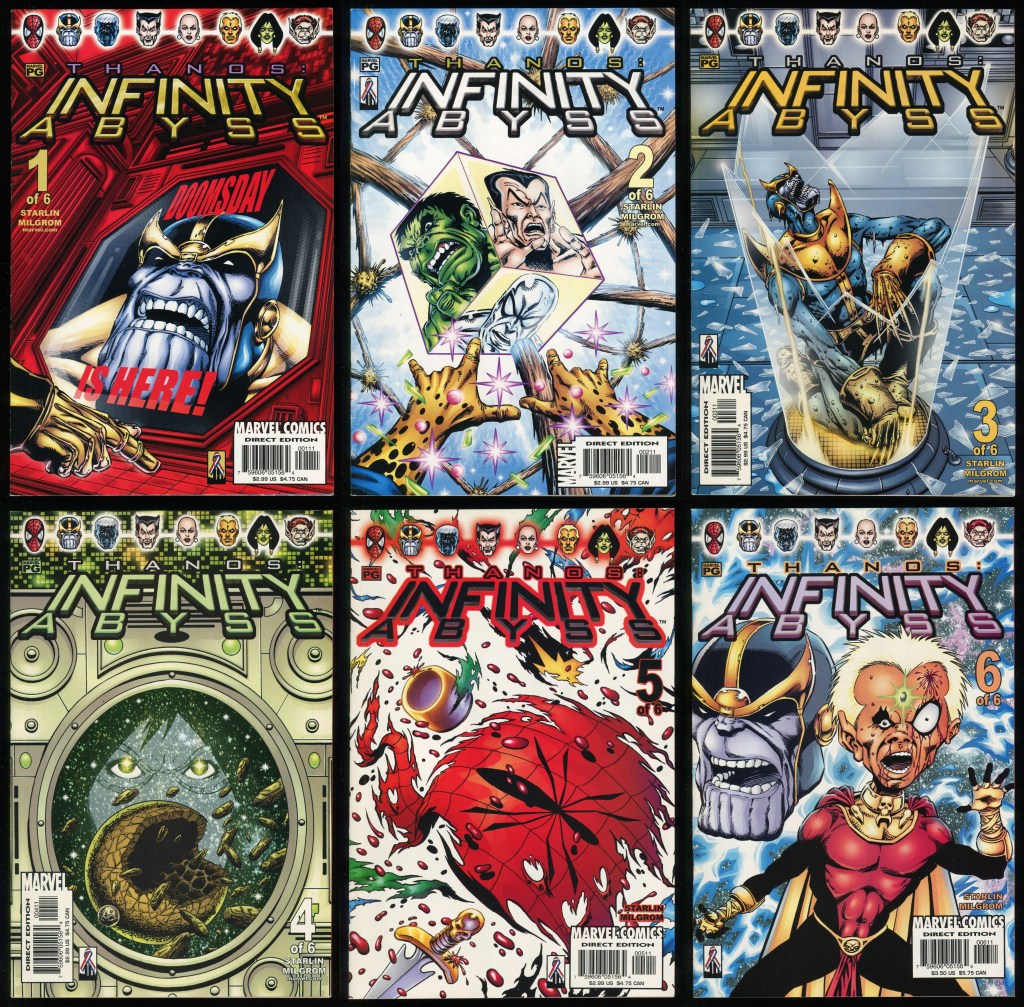
Infinity Abyss by Jim Starlin, 2002

That’s the problem with power-mad Titans like Thanos; you don’t have anybody to tell you, “Master, I think this is a very bad idea and I can’t support you.” Because you know what would usually follow: “AAAAAARRRGHHH!”

If there’s any complaint, it’s that we have to contend with yet another of Jim Starlin’s cosmic ninnies manipulating our lives, who never lifts a finger to intervene one way or the other. We also have a Warlock much preferable to the one given in his 1999 miniseries, one who’s finally able to appreciate and return Gamora’s affections, a lady he’s known through several incarnations.

From the first page our old friend Adam Warlock has been given to madness. The next five issues are spent charting how he got to that point. We might as well call this another regeneration, ala Doctor Who, since he keeps crawling into his cocoon and coming back to life. Before anything else, the mad Titan warlord, Thanos, almost dies in the hatching of a black hole. Now that’s one hell of a way to open the series. Starlin seems to have a fondness for motif, though he bends the laws of physics for the purposes of the plot.
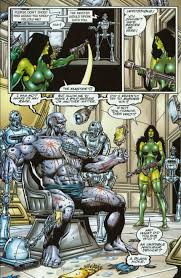
His old friend Pip the Troll discovers Adam’s cocoon stuck in an intergalactic insane asylum. This is delivered to Thanos, who is forced to recruit the psychic Moondragon to probe Adam’s sleeping consciousness. By the end of the first issue we know at least that this is not the true Thanos, but four of his illegitimate clones, guiding the Universe towards oblivion. But who is the mysterious mystic bookending these stories?

The villains, all variations of Thanos, are a blend of android, clone and mystical dopplegangers, whatever the hell that means. And we haven’t met the fifth child, the Omega, a being gifted with the genetics of Galactus, which even the mad Titan admits was “a severe lapse of judgement”. But like all bad projects, once he got started it was a challenge he couldn’t resist.

Infinity Abyss was a limited series written and pencilled by Starlin and published by Marvel Comics on a bi-monthly basis, from August to October 2002, and was the last series I had read featuring Adam Warlock to date. Adam Warlock follows us throughout the series, a bleeding head in the margins providing the necessary narration. He’s back to the butch look he had when he was only known as Him.

Ever since the Infinity Gauntlet and the follow-up series, The Infinity Watch, every comic book Starlin did in the 90’s had to have an ‘Infinity’ Something tagged onto it. Jim Starlin pulls together a stellar cast, a near-reunion of the Infinity Watch, consisting of the usual suspects: Dr. Strange, Gamora the adaptive daughter of Thanos, Moondragon  the daughter of Drax the Destroyer,  plus Genis, the son of Mar-vell who became the second Captain Marvel, and…Spider-Man?
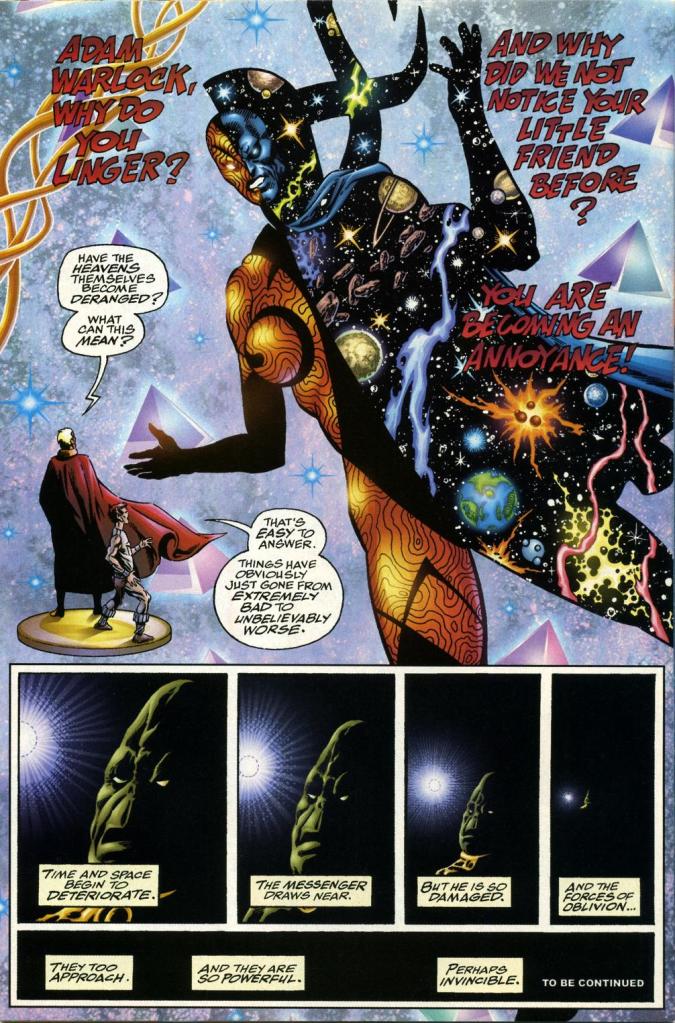
The story introduces us to yet another abstract being, Atlez, a nice enough fellow. At least he doesn’t seem hellbent on meddling/ screwing with ordinary people’s lives. He just does his job securing reality, but I think we’ve had enough of these jokers f—ing with the cosmos already. My god, there’s Eon, the Stranger, Chaos and Order, the Tribunal, Eternity and Infinity—AAAUUGH! Just how many more of these interdimensional busybodies are we going to have to contend with?

The time has come for Atlez to surrender his throne to a new flesh and blood abstract. This is a role carried on by representatives of various races since the age of dinosaurs on Earth. Atlez called to Adam two years ago with the knowledge meant to be imparted to his successor, Atleza. However the information was too much, resulting in Adam’s confinement in his cocoon in an asylum for two years. It was also Atlez’s efforts to find “alternate means of salvation” that also accidently revived Thanos’ errant incarnations, who are only good at bringing about universal oblivion.

The heir is Atleza, a cosmically precocious human child who is just adorable, and more articulate than the average two-year-old. Other events in the Marvel Universe have been delayed by Atlez’s heir, and if the child is not brought forward immediately, our reality will cease to be.
Adam narrates this tale as he assembles the usual cast of heroes. Thanos’ failed genetic experiments, titled the Thanosi, are based on Marvel’s mightiest figures; X is modelled on Professor Xavier of the X-Men; Armour, on Iron Man; Mystic on Dr. Strange; Warrior on the Gladiator; and Omega on Galactus. You thought ONE Thanos was bad? Try FIVE.

In defending little Atleza in a tag team battle with Dr. Strange and Adams on one side, and the Warrior and Mystic on the other, Adam is forced to steal Warrior’s soul. Therein lies the cause of what brought Adam to the brink of madness—which requires another pep talk towards the finale from Thanos to snap him out of it: “Adam, you are deluding yourself into self-destruction! THINK!…What copy has the power and clarity of the original? None! So your struggle against Warrior’s insanity is one you can win! For his spirit is but transferred data and not true personality!…Muster your will and you can triumph over his shallow convictions! For they are nothing compared to my own much darker depths!”

“Darker? How much darker?” Adam asks.

“Trust me, you do not want to know! Now GO!”

The final colossal battle is ultimately only a diversion; in the end Omega is left on an unstable planet where Thanos’ entire battle fleet blows him to the oblivion he craves. All in all for a universal Armageddon series this was a enjoyably compact adventure with a thankfully limited cast of characters, leading to a satisfactory conclusion. We can rest easy knowing reality is safe in the hands of little Atleza. In the end she has Adam and Gamora to guide her toward maturity. In the final panels we see Atleza spinning atoms, while Adam is finally able to share the affection he’s owed to Gamora.
Golden Messiah for the ’90’s

Warlock 1-4 (Vol. 2) 1998 Tom Lyle script & pencils

All characters & art, @ Marvel Comics

I usually expect more of this character, this series. I suppose you can’t expect Jim Starlin to script all of Adam Warlock’s adventures, but the depth of characterization, the strange worlds he’d encountered on his watch is sorely missed here.

I suppose my greatest disappointment with this miniseries was with Adam himself; he was always a calm man, rational yet passionate, plagued by the consequences of his actions and the harm this brought to his allies. Here Adam is on an emotional roller-coaster since recovering his Soul Gem [again]. At times he’s his old rational self, at others a screaming memmie that would be perfectly at home in any ’90’s comic. Saddling Adam Warlock with a temper tantrum syndrome somehow renders him…ordinary. A quirk that could apply to this miniseries in particular.

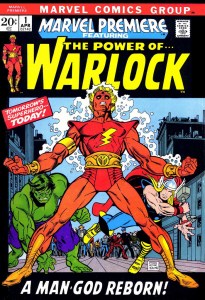
Bringing me to Plot Failure #1. It has been re-iterated time and again that Adam Warlock would die without the Soul Gem. But if past experience is anything to go on, that thing gets popped off his brow with alarming regularity. Recall that the High Evolutionary just handed it to Adam in Marvel Premiere # 1 in 1972, which raises the question of where HE got his frisky paws on it. [That business where a sacrifice is required to acquire the Stone, by the way, insofar as I know is purely an adaptation for the movies.]

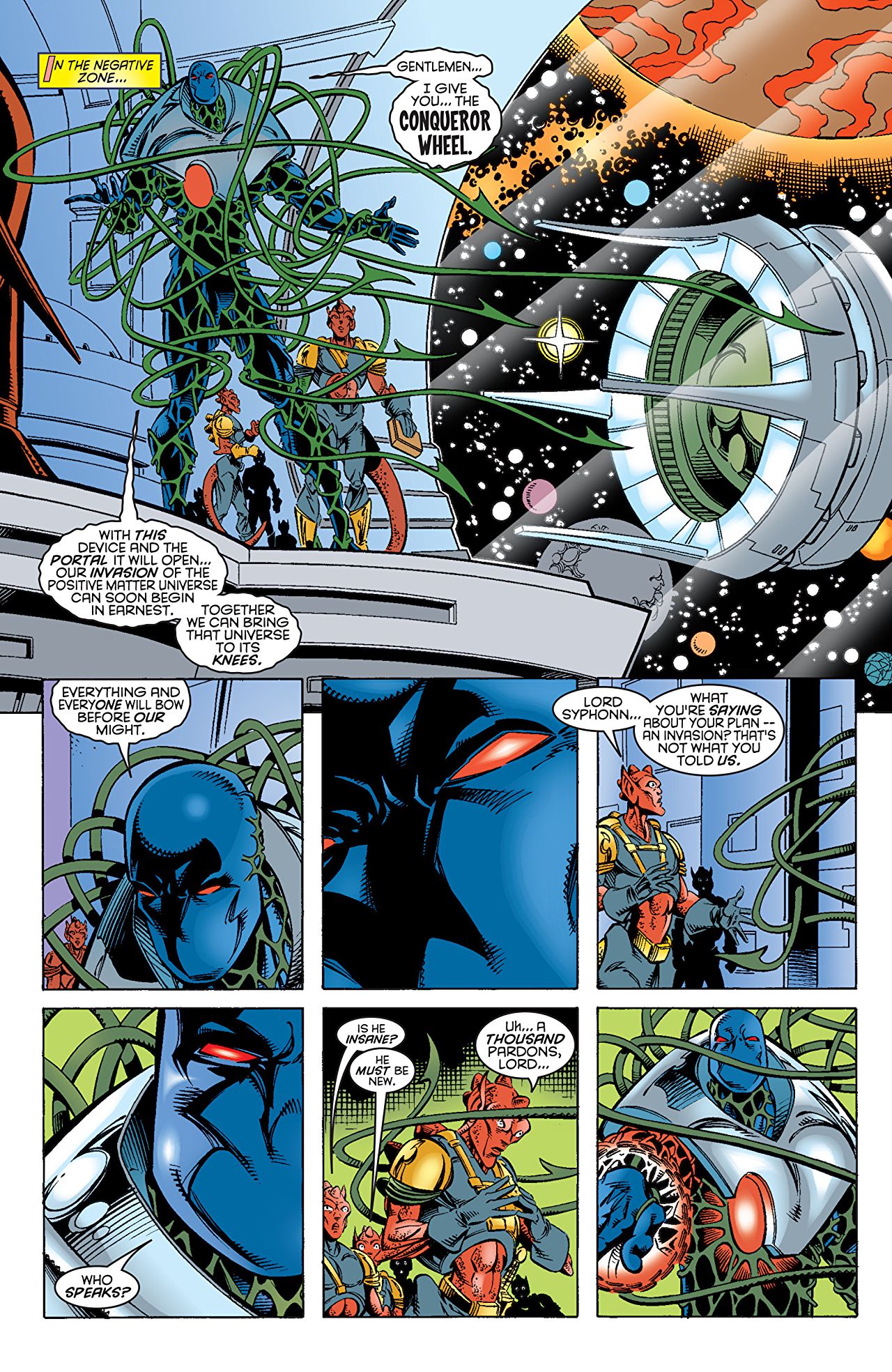
Warlock 1998 syphonn #3The villain for the day is Syphonn, another overlord from the anti-matter universe of the Negative Zone. He is a being gifted with an impractical tentacly suit, whose motives…yeah well, we never get to hear his backstory, so we have to take it at his word that he has a good reason for wanting to destroy the positive universe–our universe. There’s no rhythm or reason for his actions. He’s a bit like Maxwell Smart’s Siegfried: “It’s like this, Mr. Smart. There are goot guys unt there are bad guys, unt I am a bad guy.” Indeed he is a being so all powerful, so full of awe-inspiring mojo…that we never hear from him again.
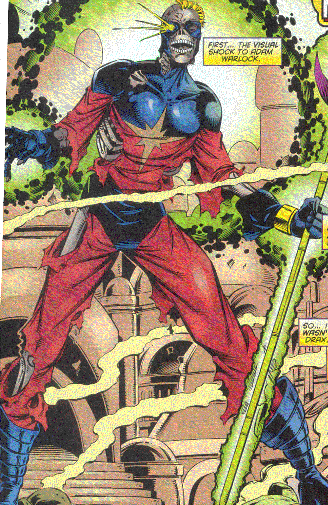

His overly elaborate plan is to raise the dead body of Captain Marvel so that he may bring his Nega-bands to Drax the Destroyer. Drax’s living body will then be a conduit to open a portal from our universe to the Negative Zone. The energies released in the destruction of our cosmos would funnel to something called a Conqueror’s Wheel, which theoretically would be used to turn Syphonn into a god.

Warlock 1998 1 dead CM syphonnw4

For reasons unknown this involves Mar-Vell’s corpse committing five murders across the galaxy, including that of Mar-Vell’s grieving widow Elysius at his gravesite on Titan. Each murder leaves a distinct calling card, a staff adorned with a craved head of Drax. Which brings us to the 2nd Plot Lapse: surely a plan like this would best succeed if the guilty parties did not go out of their way to attract attention to themselves–not to mention the vengeful wrath of not one but TWO protagonists, Adam Warlock and Mar-Vell’s grieving son Genis-Vell.

This also leads me to question Adam’s state of mind. He knows Drax; he called him to bear the Power Stone in the Infinity Watch. After all their dealings together, you would think he could take a moment to consider whether Drax was the object of an elaborate frame-up, instead of rushing to judgment like a damn fool human.

Familiar faces abound. Pip the Troll at least is practically writer-proof; it’s very hard to get his character wrong. Drax the Destroyer is along as well, first as the falsely accused and then as a tool. The son of deceased Kree warrior Mar-Vell, Genis, is not ready to step up as the new Captain Marvel. At this point he’s still a whiney ’90’s brat.

Gamora has very little to do here besides kick random thugs and intergalactic policemen’s fannies, and to pine over her unrequited love for Adam. To Gamora’s question, “Why did you even ask us along to “help”?”, Adam brusquely replies, “I’ve wondered that many times recently myself!” Traditional Negative Zone baddies Blastaar and Annihilus barely rise above the level of cyphers. All they contribute to the master plan is to bluster and get their asses handed to them by Drax and Genis.

Warlock 1998 4 endgame

Syphonn undoes his own scheme first by unintentionally blasting his own Conqueror’s Wheel; and second by foolishly engaging Adam after he goads Syphonn into using the Soul Gem against him, a plan that backfires predictably. If the moral of this series was that anger is self-destructive and counterproductive to one’s own ends, it demonstrated that point admirably. If the intention was to showcase the outlandish adventures of a cosmic entity from beyond the stars, this was a lackluster showing.

http://marvelite.prohosting.com/surfer/reviews/warlock1.html


A lifelong resident of the Pacific Northwest, Michael Robbins has been the author and a contributor to six books. BUTTERFLY & SERPENT, the first book in a series, was published in 2012. Mike takes pride in being part of the American labor force for over 40 years. In his prose he strives for unity, not division; humor over prejudice; and heart over heartlessness. His art page can be found at Deviantart.com

His latest book, FATHERS AND DAUGHTERS, is available at amazon.com.

f & d cover

Mike’s Amazon page:

Golden Messiah: Adam Warlock Phase One

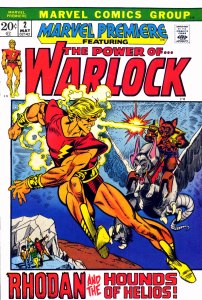
B-Marvel Pre. 1 cover  B-Marvel_Premiere 2

I encountered Adam Warlock through the usual venues, i.e. reading comic books after my brothers were done with them. I was too young to have any set parameters; my mind was wide open to the possibilities. The cynicism that characterized the rest of the 1970s wouldn’t set in for another three years.

Apparently I was more taken with Warlock and the original Captain Marvel [Marvel Comics version, not Shazam!] than most readers, considering that he couldn’t seem to hold a comic down. I’d read Warlock’s debut story in a Fantastic Four reprint magazine a couple years after his book ended abruptly in 1973. Back then he was a product of genetic experimentation known only as Him

A-Fantastic Four 66

I caught the first two issues of that plotline, which brings up another pet peeve of mine–I couldn’t stop missing the FINAL issue in a comic book’s multi-part arc. I reach the cliffhanger, and somehow the following month, I always missed the final part. If I wanted to know how a story arc wrapped, I’d have to gather that from the recap they helpfully provided in the following issue. Either that or I’d have to wait YEARS to track that comic book down at a used book-store.

MarvelPremiere14

What I’ll call Phase One of Adam Warlock’s comic book life was an allegorical retelling of the legend of the Son of God, where the newly christened Adam was cast as the golden-skinned  action-hero Jesus who steps forward to rid a new world, a Counter-Earth of its fallen angel, the Man-Beast and his horde of New Men, beast-men really. The role of the Father was taken by the High Evolutionary, once a man like us but elevated by scientific means unto godhood.

Don’t worry, I have no intention of proselytizing anyone. The Jesus-Father connections are more tenuous than at first appears. If I may, I always saw Jesus as self-assured and unwavering in his purpose, whereas Adam Warlock has always been uncertain of his role and plagued by guilt over the deaths brought to his followers over his crusade.

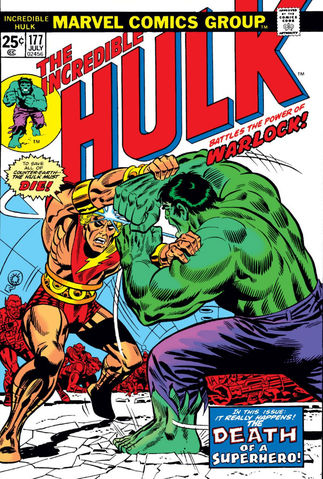
Reading Warlock comics was often an exercise in frustration since he never seemed to wrap his own storyline up in his own magazine! We were left dangling at the end of Issue #8 when Adam and Astrella Carpenter confronted the Man-Beast revealed as the President in the White House. That chapter would have to be taken up a year later in the Hulk comics, which I was reading religiously [ironically enough] at that time.

C-Hulk 177C-hulk178

I see now as an adult that it should have been no surprise the Man-Beast took the form of U.S. President Rex Carpenter, a charismatic Kennedyesque figure who persuaded millions to follow him down his dark path. That resurrects a chilling thought, from a lecture I attended by Dune author Frank Herbert. He warned us that Kennedy was the most dangerous President of the 20th Century because we were willing to do anything he asked. It’s likely JFK would have pulled us out of Vietnam had he lived. But people in this country have blindly followed lesser men into Middle Eastern debacles, and let’s not forget our more recent paranoid delusions over immigration, fears fanned by an even less informed mind.

I was too young to appreciate the script’s Savior underpinnings, nor was I too fond of the late Gil Kane’s art style, either. I was used to the blockbuster panels by Jack Kirby. I’m able to appreciate Kane’s naturalistic style; his heroes were muscular without being musclebound. And when the stone actually melts under Warlock’s hand beams, it’s like they are really oozing life. And God, the expressions! He was a master at capturing anger, heartbreak and the awe in each character’s face.

Gil_Kane Artist Gil Kane, 1926-2000

The Savior parallels would be most pronounced in the three-part arc in the pages of the Incredible Hulk in 1974. This would close Phase One of Adam’s life. There is the Last Supper scene, where Hulk is cast as both Judas and Peter. A public trial would follow, and then came that heart-rending crucifixion and Adam’s cry to the High Evolutionary, “Why have you abandoned me?”

hulk 177 cruci

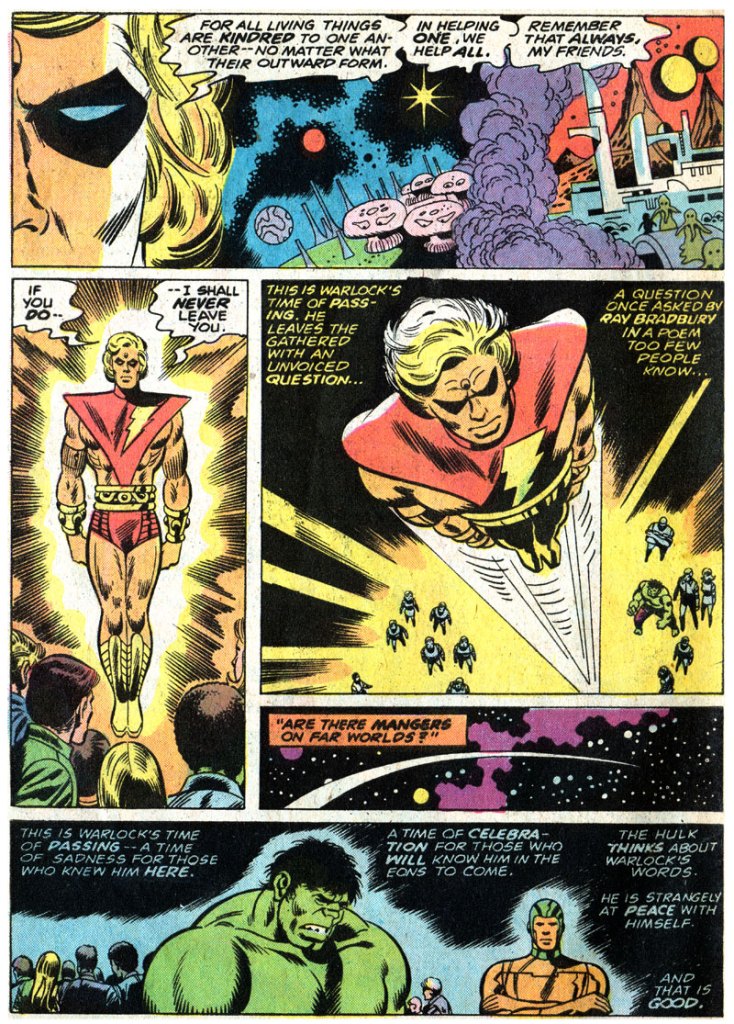
We depart briefly from the Biblical narrative when Hulk leads a revolt to indeed overthrow the evil kingdom on Counter-Earth. It only takes two days for Adam Warlock to be resurrected, and to banish the Man-Beast after he devolves him back to his wolf form. In a final Biblical allusion, Adam ascends into space with a final quote from Ray Bradbury: “Are there mangers on far worlds?” This has a profound effect on a sad Hulk, but not to worry. By the very next issue he’d be back to his raging self again.

hulk178_pg32