
Ironically in the fall of 1989 I had gone to a Doctor Who Day at Book King in Federal Way, Washington. Back when I was single, Book King had these get togethers for fans every weekend, and I attended as often as I could. Everyone was seated in this little room in the back of the bookstore, except instead of Doctor Who, the group was sharing a couple of episodes from the new season of TNG. This time around the show came out of the gate running and didn’t stop for the next three seasons.
One of the episodes they screened was “The Survivors”, which showed the embrace of bold ideas to go along with the always excellent f/x. They kept the plot twist close to the sleeve, positing a mystery: how did this lone elderly couple survive a planetary bombardment that eradicated all other life? Counselor Troi meanwhile was slowly driven mad by the incessant music of a tiny music box she had never heard before. In fact, no one had survived, including the wife of the older man—in reality a godlike being who in a moment of grief wiped out the invaders throughout the universe. For one of the few times in Trek history, this was a deity with a conscience who relieved the suffering he’d inflicted on Troi. Picard could do nothing but let him go to recreate the woman he loved, and to just leave him alone. And that’s one of the first episodes. It keeps going.
Season Three of the Original Series suffered from subpar writing, some of the worst of any Trek series. Gene Roddenberry had been bumped to executive producer, while Fred Freiberger became the new line producer. NBC had changed TOS’ time slot to 10 pm—on Fridays, a death slot for any series. Worst of all, the show had lost the sense of humor it was known for. By contrast, by its third season TNG had hit its stride. At least in my hometown, TNG was given a time slot of 7 pm on Saturday nights, and it never moved from that spot.

On September 25, 1989, the worm had turned. Rather than being The Original Series’ poor second cousin, in many ways The Next Generation surpassed it. Star Trek V had been a disappointment that summer. It was one of two movies I’d seen in one day in July of ’89. I’d had a very bad day; all I’ll say is that my brother and I had a falling out which ended with me stomping outside and smashing my windshield—with my bare fist. But enough of that for now.
The revolving door of scriptwriters that had plagued TNG’s first season, and the rewrites imposed by Gene Roddenberry were past. Briefly, Michael Piller was promoted to head of the writing staff, which brought a much-needed stability to the script process. Rick Berman became the chief of day-to-day operations. New costume designer Bob Blackman oversaw a redesign of outfits into real regimental uniforms a space service might issue, though not necessarily any more comfortable for the actors. Hence the birth of what fans refer to as ‘the Picard Maneuver’, where Patrick Stewart pulls his tunic down every time he has to stand up.
Blackman also rendered a one-piece version for the woman, which meant no more legs! A new title segment began this season showing an incoming montage from the Milky Way, instead of the departure angle used in the first two seasons. Best of all, Gates McFadden was back for good as Dr. Beverly Crusher.
This year we encountered aliens who really seemed …ALIEN. Tin Man. The Sheliak. A Douwd. What was also new was that the Enterprise-D encountered more people who were absolutely unreasonable; who were so locked into their own positions, they wouldn’t even consider the facts presented to them, even when said facts will endanger their lives. “The Ensigns of Command”, “The High Ground”, “The Wounded” and “Transfigurations” come to mind. The writing is sharper, the dialogue less formal and more natural; that was reflected in the return of Star Trek’s sense of humor. The crew often were not just put to the test, they were frequently put into life-threatening situations.
Every season has had its timey-wimey excursions (“We’ll Always Have Paris” and “Time Squared”, for example) where Time is out of sync. “Yesterday’s Enterprise” is a real mindwarp, bleeding seamlessly into a dark version of our universe, where the Federation is on the verge of collapse from a war with the Klingons. And no one is aware of what’s happened, except for Guinan. Even she can’t explain why, she only knows THIS-IS-WRONG! This is the one and only time we see the Enterprise-C, and the consequences of its falling through a time warp in the midst of battle would be catastrophic. Because this is an alternate timeline, they were able to bring back Tasha Yar, at least one version of her, and give her an ending with some dignity. The ramifications of this version’s death would roil through our timeline for seasons to come. Believe me, there is death and destruction enough here to satisfy the most die-hard pew-pew fan.
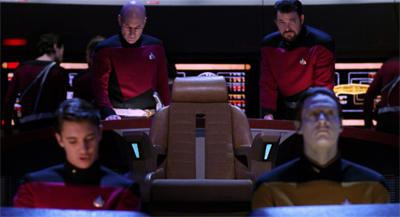

I’m embarrassed to re-read my old diary entries from this time. I seemed very petty and childish then. In 1990 I made it to two conventions, Rustycon 007 in January, and my third Norwescon, no. 12 in April 1990. My friends said I was a virgin when I came to my first sci-fi convention. Four cons in I guess I still was, considering they pinned a condom on the back of my stage pass. I was serving as a volunteer this time, though to be honest I remember very little of that. Rustycon had some good highlights. My friends were all there: Michael Scanlon, Chris and J. Steven York, and Jack and Fran Beslanwitch. The difference between the Sheraton where Norwescon was held and the Radisson, where we had Rustycon was the ambient noise level. There wasn’t a continuous drone of voices at the Radisson, only people’s quiet whispers. For a socially awkward person like me, that’s grand.

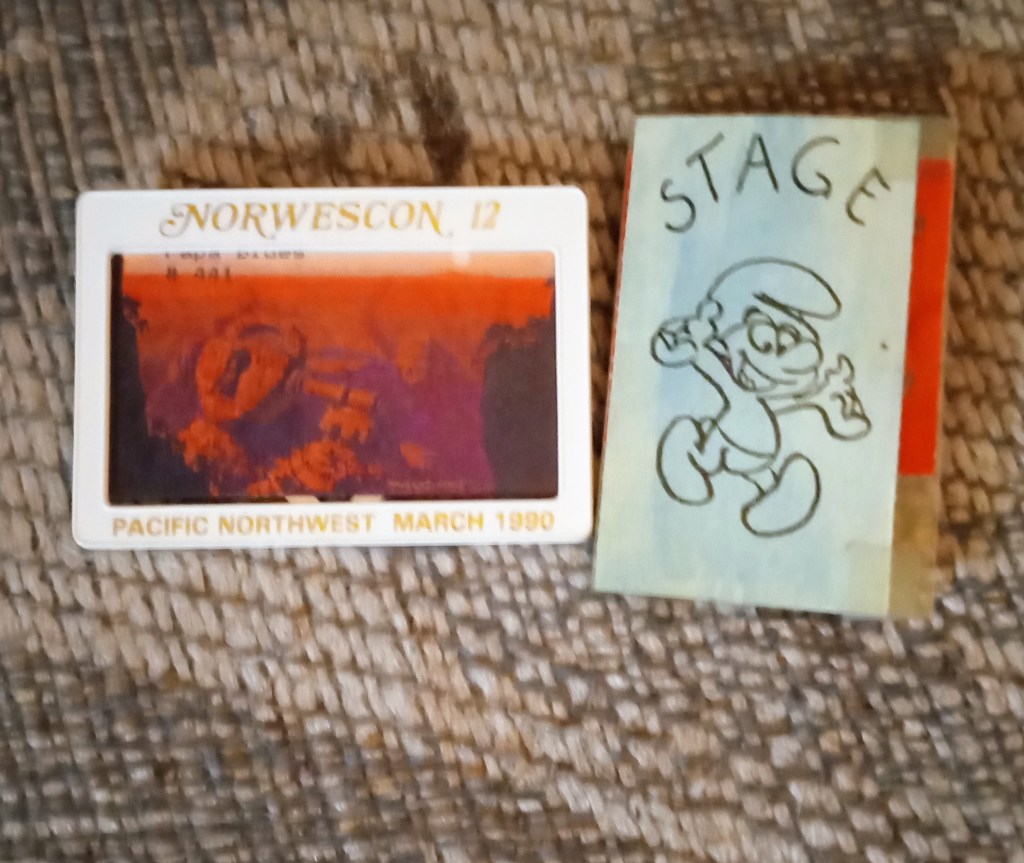

Apparently I’d gone to the dance, according to my diary, though odds are I sat in the back. Socially I was like Reginald Barclay. Mark Skullard had put together a fun panel on old Science Fiction radio programs. The lines in those shows were so melodramatic, the plots so preposterous even in the first couple of minutes we couldn’t help laughing. Here’s a shoutout to George Smith, who somehow showed up at nearly every panel I went to.
I met Rebecca Neason at this con, God rest her, at the Victorian SF/ Steampunk panel. She was a very sweet, social lady who kept getting tagged for panels when no one else would show up to empanel them. She was working on her first TNG novel, Guise of the Mind, which would be published in 1993. She and Donna Barr hosted a panel on Mythical Creatures. Apparently only the three of us were attending. Donna Barr has a very black sense of humor; she had me and Rebecca in near hysterics.
Curiously I don’t remember any TNG parodies at this year’s convention. Boy, at LAST year’s con we had a doozy, “Star Trek: Another Regeneration”. This was a taped radio program put together by two British chaps and sent over to Canada’s “The Ether Show”. (I hadn’t mentioned this in my last blog because I hadn’t found my diaries from that time period before.}
I squat on the floor of Room 1906 along with everyone who wasn’t seated on the bed. This had to be the best part of Norwescon 11 for me; this was a hilarious parody of “Farpoint”. Example: Riker has gone to the holodeck to fetch Data. The computer warned him this would be inadvisable, Commander Data was in the Atlantic Ocean simulation. Riker responds, “I don’t care, just let me in!” So it does, and “WHOOOSH!” The saucer section has also accidentally been separated from the ship, so Riker jams the two pieces together. “Make it fit!” he says, sooo, “SHRIIIEEEK!” until Data nonchalantly reports, “Reconnection complete, sir.”
The most badass character for season 3 has to be Jean Luc Picard. Diplomacy becomes a weapon in “The Ensigns of Command”, where he uses the same treaty the Sheliak have been beating him over the head with against them. “You enjoyed that,” Riker says, to which Picard retorts, “Damn right.” “Who Watches the Watchers?” is the story where the Prime Directive is not simply bent, it’s twisted out of shape. It’s the one where Picard is mistaken for a god. He takes an arrow to the shoulder, willingly, to prove his mortality.
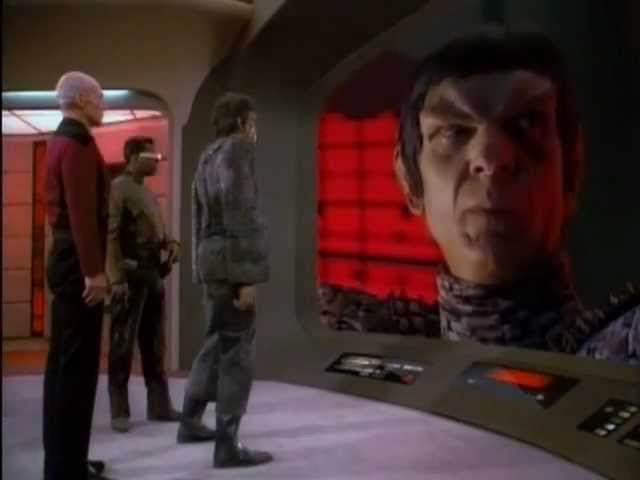
He’s also cunning when he wants to be. While investigating a possible Romulan base in the Neutral Zone on the word of a high-ranking defector, the Enterprise-D finds herself surrounded by three Romulan warbirds. With a word to Worf, the tables turn after three Klingon warbirds decloak on the warbirds’ flanks. “Shall we die together?” Picard challenges. When the Argosian Prime Minister Nayrok finally asks for help after rebuffing Picard for the entire episode, Picard cites the Prime Directive and just leaves (“The Hunted”).
Picard’s role as Patriarch of the Enterprise-D has never been more clearly defined than in “The Bonding”, which reminds us there are children on board, and their lives are just as fragile when a loved one dies. As he reminds Jeremy Aster, “no one on the Enterprise is alone”. To save Jeremy from an alien who wants to take him away to live on the planet, Picard calls together all the crew members who understand loss all too well. For Wesley Crusher this is a brutal reminder of his father’s death, and he admits for the first time that he was angry at Picard for surviving. I know that feeling; that was the moment that Wesley became a real person to me.
The Patriarchal role suits him when Data takes the ultimate step to becoming human, by creating his own child, Lal (“The Offspring”). In another first, this is the first episode in Trek history to be directed by a cast member, in this case Jonathan Frakes. When another asshole admiral wants to take Lal away to study, he responds, “There are times, sir, when men of good conscience cannot blindly follow orders. You acknowledge their sentience, but you ignore their personal liberties and freedom. Order a man to hand his child over to the state? Not while I am his captain.” Having had a child ripped from my family, I feel for them, and I love Picard for taking that stand.
By now his crew is so tight that with only a look, the bridge crew knows exactly what to do after aliens intrude on the bridge (“Allegiance”). Patrick Stewart’s hunger for more actions scenes bears fruit in both “Captain’s Holiday” and “The High Ground”, where he actually punches a terrorist on the bridge of the Enterprise. He becomes Worf’s cha’Dich, a ritual defender, when Kurn is attacked and injured in “Sins of the Father”. No, Picard is taking no shit this time around.
Worf may have been the cast member who experienced the most growth. Dare I say it, I think he became an actual character. I’ll explain. It was established in the first two seasons that he was a warrior, well versed in the ways of Klingons, a heritage he takes exceptional pride in. Beyond that, excepting two episodes, his role was not given the depth it deserved. In a sense he was a caricature much like Frank Burns in M.A.S.H. By its 5th season Frank had pretty much become a petty narrow-minded bigot, an overzealous ‘patriot’ with little to no depth.
So it was with Worf. He had been portrayed as a proud warrior, who frequently got his ass whupped by a stronger opponent. This season he became flesh and blood. Like Frank Burns, Worf is also burdened with prejudice–against Romulans, in this case. Given the chance to save a dying Romulan by giving a blood transfusion, Worf stubbornly refuses (“The Enemy”). To be fair, his prejudice is reciprocated by the Romulan as he dies. In “The Bonding”, out of guilt for an unavoidable tragedy, Worf attempts to bond with the orphaned Jeremy Aster. “Deja Q” proves he’s still king of the one-liners; when Q insists he’s human and shouts what do I have to do to convince you people, Worf replies, “Die.” In “Transfigurations” he plays the role of Lazarus raised from the dead by space Jesus.
With “Sins of the Father”, Worf’s story becomes epic. Treachery within the Klingon High Council brings a challenge Worf must answer to clear his father’s name. But the truth can’t come out; the traitor who betrayed the Klingons to the Romulans has friends on the High Council, which would lead to civil unrest. Only Worf’s discommendation temporarily prevents a Klingon civil war. We’re introduced not only to his brother Kurn but to the family of Duras, a name we’d come to despise in every Trek series to come.

The Ferengi make three appearances, primarily as irritants, moving closer to the comedic foils they’d master in DS9. No longer treated as a ‘major military threat’ to the Federation, they resort to deceit, and poison to narrow the field of bidders in “The Price”. If there’s any justice, a couple of those Ferengi are lost in the Delta Quadrant until their return in ST: Voyager. Michael Grodenchik debuts as Sovak, a pushy trader who deserves the punch in the face Picard delivers. (He would eventually play Quark’s dim brother Rom on DS9). “Menage A Troi” is a case of unrequited lust on the part of a demented Damon, although it finally gives Majel Barrett the opportunity to shine as the eternally flirty Lwaxana Troi. Ethan Philips makes his Trek debut there as Dr. Farek; we’d know him better in a later role, as Neelix on Voyager.
“Hollow Pursuits” introduces us to Reginald Barclay. Like him, I’m socially awkward, though I couldn’t articulate that in 1989. Reg is the guy who sits in the back of the room at parties, trying to blend in while seated next to a potted plant. That’s me. Maybe his escape into Holodiction is something else we have in common; don’t all us writers do that, though not in an actual physical expression? When the series originally came out on VHS, they were released as single episodes. The only tapes I collected were “The Royale” (season 2), “The Offspring” and “Hollow Pursuits”.

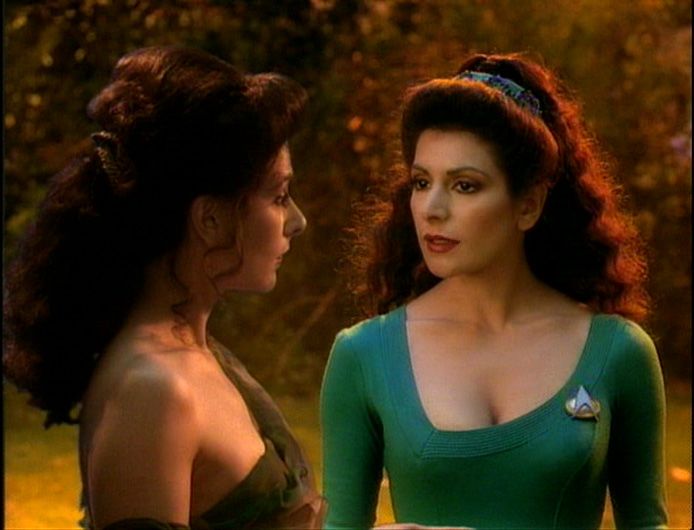
Reg was a challenge for Geordi to overcome his disdain and encourage Reg to put his mind to work in ‘the real world’. Troi also tries to guide him, up to the point that she meets the Goddess of Empathy. Then it’s “muzzle it!” The first time I saw this episode was at Jack & Fran’s house in Renton for a Writer’s Cramp meeting. We’re at the point where Picard himself accidentally calls Reg “Broccoli”. Data is saying, “Metathesis is the most common of pronunciation errors, sir, the reversal of vowels. ‘Boc’ to ‘Broc’—” At this point, Picard just glares, and as Data suddenly bends over a console, Fran said, “shut up, Data.” And that is usually the first response everybody gives when viewing that scene: “shut up, Data!”
Somehow I missed “Sarek” when it was originally broadcast. I didn’t find out about it until years later, after the series had ended. It was cool that they brought Mark Lenard back to the role, weaving another connection to the Original Series.
To close the season, they began a new tradition with the cliffhanger to end all cliffhangers, and honestly, I don’t think TNG ever came up with a better one. This led one fan to scream at Piller from his car, “You ruined my summer!” “The Best of Both Worlds” begins with a disturbing graphic. Riker’s away team beams down to a colony in distress, supposedly in the middle of downtown, where all that greets us is a crater.
Twin plotlines parallel each other. The Borg are coming, and we are nowhere near prepared for them. Meanwhile Commander Riker questions his priorities as he turns down yet another command, and Picard has to call him on the carpet for it. The issue would be ludicrous in any real-world military service; Piller’s script addresses that here. Riker is a man grown comfortable, loyal, and apparently will settle for nothing less than the Enterprise. Although this was not how he wanted it. He also faces a foil in Commander Shelby, a cocky young woman whose ambition is only exceeded by her impetuousness. And she pointedly tells Riker, “You’re in my way.”
This is only the second time we’ve encountered the Borg, who remain a great unknown, hostile in purpose even while they’re devoid of intent. It is not spoilers now to declare this as the most distressing cliffhanger in Trek history, perhaps one of the greatest in television history. Picard steps forward on board the Borg cube as Locutus, his voice lifeless as he states, “Your life as it has been is over. From this time forward, you will service…us.” The camera pans around to Riker, who says, “Mr. Worf…fire.”

And then— ‘To Be Continued’??? ARRRRRGHHHH! In June 1990 we were all going, “What—WHAT?” That would be the longest summer for all Trek fans everywhere. In this one season this crew had become beloved, a part of the family, and we didn’t know if they were going to be blown apart or not. Will Picard survive—COULD he? This would be the nail-biter dogging us for the longest summer ever.
 Papablues Scrapbook