
I’ve gotta admit, I didn’t catch every episode of season 2 during its original broadcast. I’d pretty much kept up with every episode of the first season at least once, such was my loyalty to Star Trek. My viewing history for the sophomore season was much more spotty. I’d watch two or three stories in a row, skip one or two. For instance, the first story I sat down for was “Where Silence Has Lease”, a significantly darker, unnerving outing than virtually anything in the previous season. I missed both the season opener, “The Child”, and its closer, “Shades of Grey”. The last story I saw would be “Peak Performance”, the penultimate episode.

I can’t explain; it’s been 35 years. Perhaps I’d lost some interest after the disappointment of season 1. My Saturdays in 1988-89 were tied up in get-togethers with my writing friends, who were giving me much needed instruction. More to the point, I was beginning to put in the research necessary to make my scribblings worthwhile; to be honest, at this point, it stank. I had less time to binge TV. At age 24 I hadn’t really lived at this point. Hell, I’d never fallen in love, yet.
Changes were afoot at TNG. Because of an ongoing Writer’s Strike in 1988, the season was delayed; the first episode wouldn’t be syndicated until November 21st of that year. I had no idea what tensions were going on behind the scenes. The cast had settled comfortably into their roles; the writing had improved considerably. We were still saddled with stories that were not up to snuff (“The Royale”, “Up the Long Ladder”); some that just left us scratching our heads (“Where Silence Has Lease”, “Time Squared”); and at least one that was pulled out of their fannies (“Shades of Grey”). Also, the music scores still tended toward the bombastic.
Looking back a little older, a little more jaded, I can declare that at this point TNG was still guided by a 1960’s naivete of Gene Roddenberry. To wit, humanity had matured into an enlightened species. By definition the governing body of the franchise, The Federation, would also be guided by enlightened principles. Of course, even in The Original Series (TOS) there were hints that Paradise had its worms. They had their share of crazy starship captains and a bureaucracy unwilling to face up to unsavory situations that needed to be addressed.
Elements we’ve come to be familiar with in later years made their first appearances, often in the opening scenes of an episode. Worf’s calisthenics program debuted this year (“Where Silence Has Lease”) as does the officers’ nightly poker game (“The Measure of a Man”). And the Ferengi, that most deadly threat to the Federation in season 1, had been relegated to one appearance this season, and then only in the last 15 minutes of “Peak Performance”, the second to last episode of the season.
As an established series, TNG began to attract a lot of celebrity guest stars, and a few future stars. Joe Piscapo appeared as the Comic in “The Outrageous Okona”; Entertainment Tonight cohost John Tesh was disguised as one of the Klingons inflicting pain sticks on Worf in “The Icarus Factor”, while drummer Mick Fleetwood was even more recognizable as a fish-faced alien in “Manhunt”. One of Teri Hatcher’s early roles was as a transporter chief in “The Outrageous Okona”
There was also The BEARD. Despite what Q would say a year from now, I thought it suited Riker. It made him more distinguished yet somehow still likeable. I was comfortable with it from the start. It can’t help enhancing his irrepressible grin. After a full season of rotating engineers, Picard promoted inhouse from the available personnel, making Geordi LaForge the Chief Engineer for the rest of the series.

Ten Forward appeared in the opener, but that wasn’t the most interesting development. That fell to the casting of the bartender Guinan, a long time Trek fan known as Whoopi Goldberg. This wasn’t a role she needed to take. By 1988 Whoopi already had seven films under her belt, including her breakout role in The Color Purple (1985), which earned her anOscar nomination for Best Actress. This was something she wanted, that she was inspired to by original Trek actress Nichelle Nichols. Though her cameos were small, she acted as that impish elf dispensing wise sayings that the crew needed at any given time.


Unfortunately the worst change was in the medical field. It seems certain people on the production staff didn’t like how Gates McFadden’s character, Dr. Crusher, was being developed. Worse, they managed to convince Gene Roddenberry of that. All I knew was that Dr. Crusher was gone, and you don’t realize how much you appreciate someone until they’re gone. Crusher was traded in for Dr. Kate Pulaski, a Dr. McCoy retread who couldn’t—or wouldn’t—get Data’s name right. In fact, she seemed to have a problem appreciating that Data was a valuable crewman and an individual who required no justification. The fact that she was played by TOS veteran Diana Muldaur (“Return to Tomorrow”, “Is There in Truth No Beauty?”) didn’t help anyone warm up to her.

Curiously, the one thing Muldaur and Whoopi shared in common was that they were not listed in the main cast, not even as guest stars, but solely designated with a ‘Special Guest Appearance’ after the opening teaser.
THE CAST
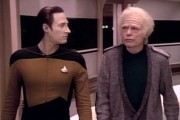
This season’s scripts were very Data-centric, with five focused exclusively on our favorite android (“Elementary, Dear Data”, “The Outrageous Okona”, “The Schizoid Man”, “The Measure of a Man” and “Pen Pals”). He grew in his study of humanity and endured the slights of Dr. Pulaski with dignity. He retained his childlike nature while mentoring under Picard. Often he has the central role to play in the resolution of a conflict. Data (Brent Spiner) attended the birth of Troi’s son Ian (“The Child”), explored the nature of humor (“Okona”), assisted Picard in deciphering the Iconian language (“Contagion”); gambled the away team out of the casino and out of a badly written novel (“The Royale”); and experienced doubt in his abilities for the first time (“Peak Performance”).
If any crewman comes close to the number of episodes in focus, it’s William T. Riker (Jonathan Frakes). Beard aside, here is a man who welcomes a challenge, whether it’s volunteering for an officer exchange program with the Klingons (“A Matter of Honor”) or bringing a broken-down wreck up to spec to challenge the Enterprise-D in a war game (“Peak Performance”). He faced every obstacle with zeal, ingenuity, and a great big grin. Not all challenges are so easy. Regulations compelled him to participate in a hearing that might cost Data his life (“The Measure of a Man”). For the second time Riker is offered his own command, and the man offering it is his estranged father, which in typical male fashion must be settled in a martial arts contest (“The Icarus Factor”). We also discover he’s a cook, albeit not very good one (though you could never tell Worf that). Could explain how he wolfs down gakk.
Patrick Stewart as Picard had pretty much become the captain we’d come to know and love for the rest of the series. He could be steady, firm, and hews closer to his principles, particularly the Prime Directive than James T. Kirk. We’re starting to get a little more background. For instance, in “Contagion” Picard indulges in his interest in stellar archaeology; while on a shuttle flight he divulges the incident from his misspent youth that forced him to have an artificial heart (“Samaritan Snare”).He even demonstrates a sardonic sense of humor (“The Outrageous Okona”).
Wesley Crusher (Wil Wheaton) grew into adolescence without the support of his mother, under the collective mentoring of the TNG crew. He wasn’t quite the annoying know-it-all we came to despise the previous year. He deals with this separation, with the help of Guinan (“The Child”). He also suffers his first crush in “The Dauphin”, where we the viewer are treated to the first montage of a crew member seeking the advice of every member of the bridge crew, with often humorous results. After endangering the ship so much in season 1, in “Pen Pals” Wesley is given the responsibility of actually saving a planet.
His father-son relationship with Picard deepens as the captain loosens up on an extended shuttle ride, relating an episode of his reckless youth that led to his impalement on a Nausican knife, necessitating an artificial heart that needs replacing (“Samaritan Snare”). For the first time the senseless of death smacks Wes right to his face with the destruction of the starship Yamamoto (“Contagion”) and the deathly aged crew of the Lantree (“Unnatural Selection”).
Worf’s (Michael Dorn) appearance evolved into a fuller mane and the addition of his baldric sash. He’s still inflexible and unbending in his application of Klingon tradition. He’s now permanent security chief, and still king of the one-liners (to wit– “Comfortable chair”, from “The Emissary”). Or how about this exchange with Wesley in “The Dauphin” about Klingon mating rituals: “Men do not roar. Women roar. Then they hurl heavy objects. And claw at you.”
“What does the man do?” Wesley asks.
Worf replies: “He reads love poetry. (beat) He ducks a lot.”
This season we also get to further explore Klingon culture, as in the aforementioned “A Matter of Honor”. Worf tutors Commander Riker, who takes his lessons to heart, first by asserting his authority over a junior Klingon officer (by kicking his ass) and then assuming command of the ship to save the Enterprise. Riker’s plotline in “The Icarus Factor” was almost undermined by the subplot where Worf is out of sorts, almost out of joint, because it’s the anniversary of his rite of ascension. Fortunately Wesley finds out and the crew prepares a proper simulation on the holodeck…complete with pain sticks.
Two problems crop up for Worf in “The Emissary”. First, there is the main issue of a Klingon sleeper ship on an intercept course for several Federation colonies. A more personal problem is the emissary herself, K’Ehleyr, an old love of Worf’s who’s not ready to commit to marriage, especially once Worf jumps ahead and announces they’re one anyway. In later episodes, they will both have to deal with the consequences of their mating.
Finally, Troi got out of that frumpy jumpsuit she was confined in for the previous voyage. Her new jumpsuit was more flattering and form-fitting, one she’d wear for the next five seasons. Also out was the bun and in with a freer floating ‘do. The season’s opening story, “The Child”, was given to Troi, who runs with the material. This story, a script recycled from the abandoned Phase II series from the late 70’s, was adopted when the writers strike clawed into TNG’s production time. While Worf’s first thought is to terminate the child and Riker demands to know who was the father, Troi feels the first stirrings of life in her belly and announces, “I’m keeping this child.” And the lioness has spoken.
THE EPISODES
Again, I won’t be going over every episode…well, any more than I already have. This is a personal rather than a critical remembrance. These will just be highlights.
The first episode I screened for season 2 was in fact the second episode, “Where Silence Has Lease”, and …ohh-kaaay. That was disturbing. It could have passed as an original series Outer Limits story. The ship faces an amorphous alien antagonist running bizarre, unethical experiments without the slightest concern for his lab subjects—us. The next couple of weeks slipped in the opposite direction. First, in “Elementary, Dear Data”, Dr. Pulaski challenges Data to solve a real mystery in the Sherlock Holmes style. Geordi’s poor choice of words gives him a worthy opponent all right, a holographic version of Professor Moriarty, with all the 23rd century knowledge of the Enterprise. “The Outrageous Okona” was a bit of a comedy of errors; part Han Solo, part Capulets vs. Montagues.
“Unnatural Selection” tread similar ground to the original series episode “The Deadly Years”, though the repercussions for the ‘children’ of the Darwin lab will be more consequential and uncertain. “Loud As a Whisper” dealt sensitively with disability, even having insight enough to cast a deaf man, Howie Seago, in the guest starring role of ambassador Riva. “Time Squared” has no monsters, no alien antagonists: in the words of David Tennant’s Doctor, it’s pretty much wibbly wobbly timey-wimey.
“Contagion” was probably the most honest Trek story as far as our dependence on computers goes; and how screwed we’ll be if they fall apart. One hidden gem, for myself, was that the co-author (with Beth Woods) was none other than Steve Gerber. That name probably means nothing to many of you younglings, but I knew him from my comic books, the creator of Man-Thing and Howard the Duck. One a horror series, the other a satire of the 70’s. Here he’s at his most inventive, introducing the Iconians, ‘demons of air and light’. It’s both a race to beat the Romulans, and personal for Picard after the Yamamoto explodes in front of his eyes, taking another old friend. It’s also an excuse for him to take a more active role in the story, to exercise captain’s prerogative and lead the away mission himself, as only he has the archaeological knowledge to pursue this mission.
Now, “The Royale”. My family has loved this episode since we first watched it on a standalone VHS. My wife waits through the entire first season just for this repeat. Putting that aside…it’s best not to question it too much, just enjoy the funny bits. The crew beam aboard a fragment of a 21st century Earth craft. Beaming down to the planet, Riker, Data and Worf find themselves in a recreation of a second-rate novel, as well as a dead astronaut. Picard decides that the answers to the puzzle lie in the novel itself, which he sits down to read. It begins: “It was a dark and stormy night. (Sigh) Not a promising beginning.”
Troi volunteers, “It may get better.” (It doesn’t.)
In fairness to my beloved, this episode’s effects don’t hold up well. It’s no secret that the away team is standing on a dark soundstage with a blurry F/X ‘cloud’ fuzzing above them. This story was also dated only a couple years later when the unsolvable mathematical equation by Fermat mentioned in this story, was in fact deciphered by Princeton professor Andrew Wiles in 1993.
In “Pen Pals” , Data befriends a young alien girl on a planet on the verge of destruction. In so doing he not only becomes a ‘pen pal’ but a surrogate brother. Data also demonstrates a depth and caring I don’t think he recognized in himself. “Manhunt” is basically Lwaxana Troi on steroids. “Up the Long Ladder” couldn’t decide what story it wanted to be. Somehow the writers tried to wedge two stories into one script. We have a humorous story with space Irish on one colony, and on another colony is a sterile, scientifically advanced society. By sterile I mean ‘sterile’; every one in the second colony is (surprise!) a clone. What we have is a mess, touching on issues like resettlement, privacy, ethics. So Picard’s brilliant solution: let’s mash ‘em both together and hope it all works out.
“Shades of Grey”, the season’s closer, was Classic Trek’s first and only clip show. If it’s not the worst, at least it is the laziest written script in TNG’s history. We’re now left with two.
“The Measure of a Man” is our first certifiable classic of the TNG era. Data is confronted by the fact that as an android, in the eyes of Starfleet he has no rights. He doesn’t even have the right to resign his commission to prevent his dismantling so that cyberneticist Bruce Maddox can study him. Picard is having none of that and demands a hearing from Captain Phillipa Louvois, the same person who conducted his court-martial nine years before for losing the Stargazer.

Picard was almost beaten by his first officer’s presentation. Riker is morally beaten because he did his job too well, a job forced on him by regulations. It’s only through Guinan’s sly insights that Picard sees the real danger, which apparently came to pass in season 1 of ST: Picard. On the stand, Maddox’s lofty ideas are exposed as fantasy, implying the creation of a race of androids without agency, a prelude to slavery. Then Picard renders a classic speech in his closing argument. In part:
“Your honor, Starfleet was founded to seek out new life. Well, there it sits, waiting. You wanted a chance to make law. Well, here it is. Make it a good one.” At the beginning of her ruling Louvois refers to Data as ‘it’. Halfway through it she’s calling Data ‘he’. Though its early on in the series, Data had already demonstrated he was more than the sum of his parts. He also has the grace to invite a despondent Riker to the victory celebration.
Finally…until the story we’re about to cover, TNG did not have an enemy. As a force to be reckoned with, the Ferengi were a miserable failure. The Klingons and Romulans were formidable opponents, but the former were our allies in the 24th century. As for the latter, well, they’re just as deceitful and haughty as ever, but they’re still old school—or should I say ‘old series’. In “Q Who”, that rascally omnipotent entity Q committed the most evil act in all his appearances. He introduces us to the Borg.

The Borg were everything Gene Roddenberry would NOT identify as human. They are not evil; that would imply intention to inflict harm. They’re as incapable of feeling as a virus. Cybernetic monsters were not new to science fiction series. Prior to this, Doctor Who got 20 years of mileage out of the Cybermen, not to mention the Cylons from the original Battlestar Galactica. This was different. This was a dark page in the bright future Gene had painted for the previous 20 years.
Q (John De Lancie) had returned to the Enterprise-D, having been expelled from the Continuum, doubtless for his failure to intimidate humanity. After Picard insists humanity was ready for ANY challenge it might face ‘out there’, Q had a fit. With a snap of his fingers Q tosses the Enterprise thousands of light years into the heart of the Delta Quadrant. The first hints of Guinan’s past are given; she knows of the Borg, because they destroyed her people a hundred years ago. Very soon all of Picard’s ingenuity and diplomacy were rendered useless.


All the while Q pops in and out of the action, defining the Borg bit by bit, taking a sadistic delight in Picard’s growing discomfort. “You can’t outrun them, you can’t destroy them. If you damage them, the essence of what they are remains…They regenerate and keep coming…Eventually you will weaken…Your reserves will be gone…They are relentless.”
It is to his credit this one time that Picard asks this small minded omnipotent bastard to save his ship. This Q does. No apologies, no regrets for the lives lost, or for the fact that this one act has overturned the natural order by introducing a Force (there’s no other word for them) we were absolutely not prepared to face.
I have gone on without saying a lot about this episode, I know. I don’t need to explain the details for hardcore Trekkers. For those of you new to Star Trek, well, hopefully I haven’t dropped too many spoilers.
This would be the last season of any Star Trek series where Gene Roddenberry would be in the producer’s chair. Change has always been an essential part of Trek, but a lot of us didn’t feel TNG was essential viewing at the time. What we saw in the coming season was more than change, it was like a soft reboot. That will be another blog.






 Papablues Scrapbook