Rubber Soul as it should be

Rubber_Soul

I’ve just realized why Rubber Soul was never one of my favorite Beatles albums growing up. I had no way of knowing better of course; did any of us know in the fall of 1965? You see the problem was, we were getting the Americanized version.

A sign of a great work of art is its openness to more than one interpretation. In his blog Psychobabble, Mike Segretto gave the impression  that certain alterations were an improvement on the original British LP; that these substitutions were more in line with the folk-rock stylings of the majority of the set. On that count, I respectfully disagree. The rock numbers [“Drive My Car” & “Nowhere Man”] I feel balanced out the introspection of “Norwegian Wood” & “In My Life”. There is very little question that the British album was the better of the two versions.

Granted the classics were all in their proper places—“Norwegian Wood (This Bird Has Flown)”, “Michelle”, “In My Life”, even “The Word”. The point is, I grew up listening to what was provided by Capitol Records. Capitol was the American distributor for EMI-Parlophone Records in the U.S. And they butchered Rubber Soul.

rubber soul UK back

The back cover of the UK release, at least the remastered CD from 2009 

rubber soul US Capitol back

Running order of the Capitol Records release

The first sin they committed was to strip four songs from the original LP, ie “Drive My Car”, “Nowhere Man”, “What Goes On” & “If I Needed Someone”. This was standard practice for Capitol: take a few songs off one Beatles album and collect as many as possible into a ‘new’ album. Something New [July 1964] may be the most egregious example of such mash-ups, and I’m saying this as someone who does in fact prefer some of the American LPs over their British counterparts.

Here’s what rubs me; two of those songs were among the strongest tracks the Fabs had done in this period; and they substituted two of the weaker tracks from the British Help! LP. If I may digress, Capitol got a lot of mileage out of that record. Over the following two  years they managed to spread those six Side-2 songs over three different albums. Most of us who grew up in the ‘60’s didn’t realize how badly we’d been gipped until the official British albums saw their first CD release in 1987. That was the year we in America finally received Rubber Soul in its full glory, as God [or the Fab Four anyway] intended.

The UK version opened with a strong lead-in, ‘Drive My Car”; the Capitol album had the temerity to replace that with the significantly weaker number, “I’ve Just Seen a Face”. Worst of all, “Nowhere Man” was also taken off the Capitol release. I never knew it was supposed to be on Rubber Soul until I listened to that damn CD for the first time–in 1998! George Harrison had originally been allotted two numbers, “Think For Yourself” & “If I Needed Someone”. I don’t know why I’m so taken with the latter number; that riff just seemed to hook me. It’s mostly the guitar. These are both decent songs, but at a time when George was just beginning to flex his songwriting muscles, Capitol cut his contributions by half.

Adding insult to injury, the one song allotted to Ringo Starr, ‘What Goes On”, the first instance in which he actually received any songwriting credit, was swapped with “It’s Only Love’, a song even John Lennon said was abysmal. Which meant Ringo got NO vocal numbers at all on our side of the Atlantic. In fact, in 1965 Ringo would appear on two, count ‘em, two tracks for U.S. release. One was “Act Naturally”, the B-side of the “Yesterday” single. “Boys” [from The Early Beatles, March ‘65] was part & parcel of the re-re-release of the Beatles’ first Parlophone album Please Please Me–from 1963.

That leaves fully half of the album dominated by Lennon compositions—on either side of the Atlantic—“Norwegian Wood”, “Nowhere Man”, “The Word”, “What Goes On”, “Girl”, “In My Life” & “Run For Your Life”. John Lennon songs tended to dominate Beatles albums up to this point. Rubber Soul would actually be the last time this was the case until the White Album sessions three years later—honestly, mostly on account of John’s growing, admitted laziness.

The four tracks that were stripped from the Capitol album would eventually conglomerate in July 1966 on the Yesterday and Today set, along with the final two orphans from Help!, Side 2, plus three more recent cuts stolen from the upcoming Revolver. And that would be the last time such butchery would be committed against a Beatles long-play.

–“It’s Only Love” was mine. I always thought it was a lousy song. The lyrics were abysmal. I always hated that song.

-John Lennon to David Sheff, The Playboy Interviews with John Lennon & Yoko Ono, @ 1981 Playboy Press

https://psychobabble200.blogspot.com/2014/08/turn-left-at-greenland-part-8-rubber.html

Breakfast of Champions-Review

breakfast of champs

I was expecting more. The follow-up to Kurt Vonnegut’s breakout novel Slaughterhouse 5 reads more like a Target Doctor Who novel from the 70’s-80’s, by which I mean it’s an easy read. IF of course a Doctor Who novel covered such topics as wide-open beavers and crazy used-car salesmen with bad chemicals. ‘Bad chemicals’ would be Vonnegut’s meme fir mental illness. I’ve heard some doctors refer to depression as an imbalance in the brain’s chemistry. I’m not sure if Vonnegut had been ahead of his time or simply being a smartass.

Curiously the author had also chosen to fill his book with his own simple illustrations, including ducks, ‘beavers’ and assholes. I had a feeling there’d be a lot of Fourth Walls breaking since the author, despite all the conventions of written storytelling, frequently takes the opportunity to personally intrude on the narrative. The plot revolves around the unhappy meeting of Kilgore Trout, a frequent cameo character in Vonnegut novels, and Dwayne Hoover, the crazy used care salesman in question. The mayhem takes place at the Midland City Festival of the Arts in 1972 in the American Midwest. He also drops in references to other past characters like Eliot Rosewater, the hero of God Bless You, Mr. Rosewater.

African Americans are not portrayed in a flattering way. I’m not comfortable with that or his frequent use of the ‘N’ Word. At first I thought it might be an attempt at making we the readers uncomfortable, in the same vein as Mel Brooks would in Blazing Saddles. If so it’s a rank failure. In Vonnegut’s hands it’s unnecessarily gratuitous.

This is probably not his best work but it has its amusements. We have the truck driver whose brother works in a factory making napalm for dropping on Vietnam. His truck is also dumping poison gas into the atmosphere and that the planet is turning into pavement so his truck can deliver 78,000 pounds of olives to Tulsa. Observing all this, the nameless driver says, “Seems like the only kind of job an American can get these days is committing suicide in some way.” Another cutaway remark is how one of the most expensive things a person could do in this country was for a guy to get sick. Some things never change….

In fact the relevance to current events never seems to end, as with the destruction of the countryside in West Virginia in the name and authority of the Rosewater Coal and Iron Company. Let’s have one last reference: “Trout couldn’t tell one politician from another one. They were all formlessly enthusiastic chimpanzees to him” [Chapter 10, page 88]. To be honest, I find this an insult to chimpanzees.

[Kurt Vonnegut, c. 1973 for the Playboy interview]

Kurt Vonnegut

The Beatles Last Live Show…kind of

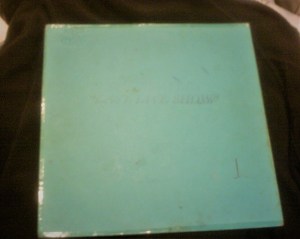
My mother bought me my first Beatles bootleg. She’d gone back east to New York City to visit my Aunt Poca and Aunt Mary. Among the gifts she came home with was a live LP with a plain blue cover entitled The Beatles Last Live Show. I don’t know if she was aware that this was an unofficial release, bootlegs being a relatively new concept in the bright spring or summer of 1972. I didn’t care either way; I was an 8-year-old indiscriminate Beatlemaniac.  I imagine at some point I’ll get an email correcting any details in this blog I mess up. Looking forward to it, Mom.

My beautiful picture  My beautiful picture

Please also note that, as an 8-year-old, I didn’t take very good care of this precious LP. The disc itself survived me, but I’m afraid I kind of defaced the cover trying to scribble what I thought the track listing was. Things to know before we go too far: this is definitively NOT the Beatles’ last live show. That was be performed a year later at Candlestick Park in San Francisco on August 29, 1966. Still the show I’ve got was impressive enough. The actual concert was taped for TV broadcast at New York’s Shea Stadium on August 15, 1965, before what was the largest audience anyone had performed to up to that time. Count ‘em, 55,600 screaming maniacs. The LP begins with the last track, “I’m Down’, and ends with the same. The bootleg would be taken from a recording of this TV broadcast. Now, as they say on Doctor Who, this is where it gets interesting.

beatles at shea paulbeatles-shea-stadium_01

The concert was broadcast twice on the BBC in 1966 and once in the USA on ABC-TV on January 1967. Unfortunately the audio was so atrocious that the Beatles’ manager Brian Epstein and personal assistant Tony Bramwell decided this needed some overdubs. So the band shuffled in on January 5, 1966 for shall we say some touch-up work at CTC Studios in London. Two songs, ‘She’s a Woman’ and ‘Act Naturally’ were not on the soundtrack; I’ll get back to the latter song in a bit. Although ‘Everybody’s Trying to Be My Baby’ also was not on the soundtrack, it did see release on Anthology 2 in 1996. Let’s go through this,  track by track.

–‘Twist and Shout’, the 1st number, was not even taken from the Shea concert but from the August 30 concert at the Hollywood Bowl, which would be officially released on the 1977 live Hollywood Bowl LP.

the-beatles-at-the-hollywood-bowl

–‘I Feel Fine’ is a new version recorded at CTS, January 1966 to make up for the poorly recorded original live track.

–‘Dizzy Miss Lizzy’ features an overdub of Paul’s bass parts as well as a new organ track by John

–‘Ticket to Ride appears as it was

–‘Can’t Buy Me Love’ also features a bass overdub by Paul

–‘Baby’s in Black’ received another bass overdub

–‘A Hard Day’s Night’ was untouched but still obscured by interview fragments by John, Paul, George and Brian Epstein.

–‘Act Naturally’ was probably the laziest ‘overdub’ as it’s neither a new version but simply the studio recording we all know with audience screams layered over it.

–‘Help!’ was a new version recorded at CTS , January 1966.

–‘I’m Down’ has overdubbed bass by Paul.

Please don’t take these observations too critically. I loved that LP, despite the above deficiencies which I wasn’t aware of as a kid. Admittedly I’m not the most discriminating Beatles listener and I’m grateful that my mother thought of me when she bought it.

Rock Hewn Churches of Ethiopia

http://www.ancient-origins.net/ancient-places-africa/rock-hewn-churches-lalibela-ethiopia-00154

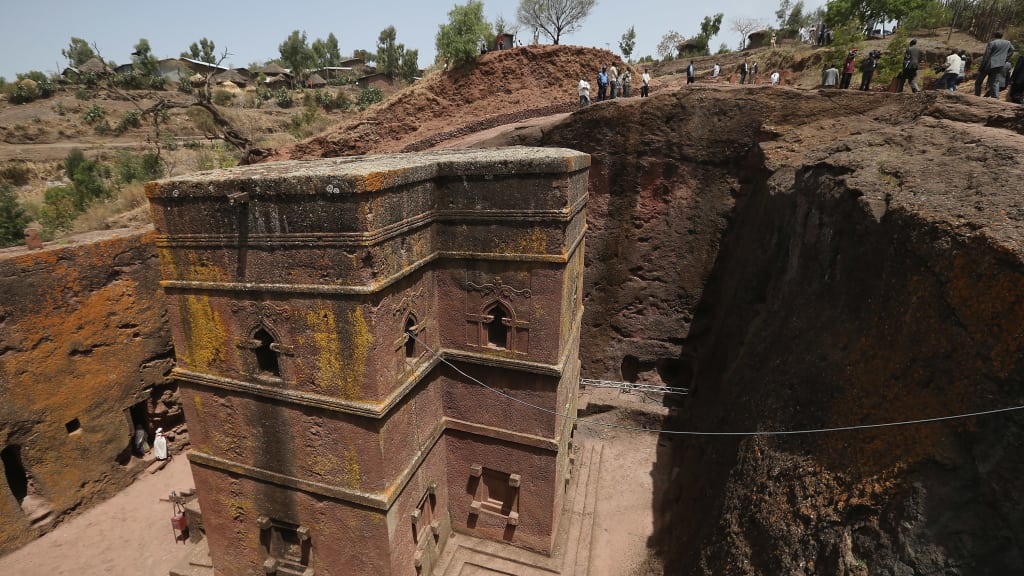
Ethiopia has seen its hard times in recent decades. However it remains the one land never to be conquered by foreigners. It also boasts magnificent rock-hewn churches, dating from the 13th Century. The name is apt; these holy sites had been literally carved from the hills of Ethiopia, centuries before the Renaissance began to turn back a thousand years of ignorance in Europe, before there was even a notion of such a place as ‘America’. LalibelaPilgrims_jpgrock-hewn-churches-of-lalibelahttp_cdn.cnn.comcnnnextdamassets130625155428-ethiopia-churches-lalibela-rocks-bete-giyorgis