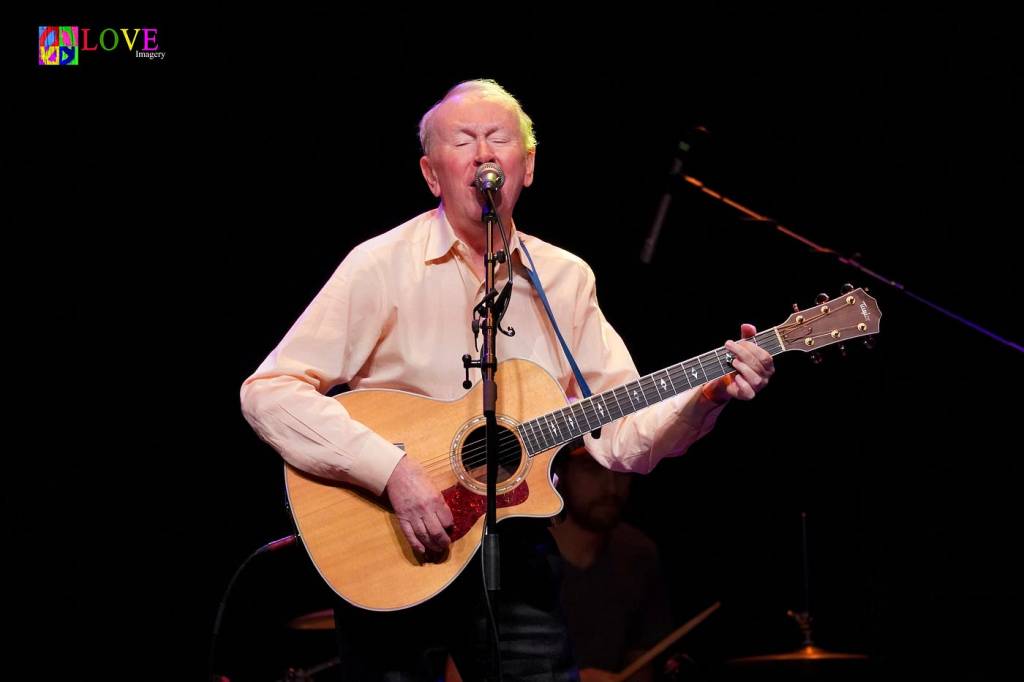
Amazing how times passes. Fifty years have gone since The Year of the Cat, the Bicentennial Year of these United States, a once in a lifetime event in the middle of a time of national trauma and doubt. The man behind that album, Al Stewart, is on his Farewell Tour, as perhaps he should since he’s going on 81 years old this coming September. So it was a happy surprise to receive his latest CD in the mail.
(Well, not so much; I ordered it online on purpose, but anyhow…)
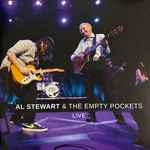
Al Stewart & The Empty Pockets Live was released through Stewart’s own label, Wallaby Trails Recordings in August 2024, a double-CD covering his 1970’s glory days. The Empty Pockets hail from Chicago and play a listener-friendly variety of rock reminiscent of the early 70’s. In 2008 your kids may have heard their music on Nickelodeon shows like iCarly, Zoey 101 and Drake & Josh. They’ve toured with many legendary artists, including Richie Furay of Buffalo Springfield, Gary Wright and Stewart, as well as recording with Simon Kirke of Bad Company.
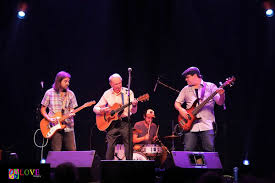
The Empty Pockets began touring with Stewart in 2022. This CD was recorded at concerts “across America”; it’d have been nice to know where and when, but I’m nitpicking. This is obviously not going to be a loud knockout concert experience like a KISS show, because that’s not how Al Stewart rolls. His music is the kind they don’t play on the radio anymore, a more thoughtful, intimate variety roiling with poetical lyrics and historical references.
It opens with “Sirens of Titan”, a song inspired by Kurt Vonnegut’s 1959 novel. The band seems to replicate the sound of the studio songs well enough. Stewart carries every tune with that familiar Scots voice, though it’s not as expressive as it used to be. That’s to be expected, since he’s not as young as he used to be. Between songs he engages in some light chatter, the first time to segue into “Antarctica”, from 1988’s Last Days of the Century LP.
Of the five studio CDs he recorded between 1993 to 2008, actually, here he performs only two selections, the aforementioned “Antarctica” on CD-1 and “Joe the Georgian” from 1995’s Between the Wars. The setlist leans heavily on his better known works Like 1975’s Modern Times (“Sirens of Titan”, “Carol” & “Modern Times”), 1978’s Time Passages (“The Palace of Versailles” and the title song), and especially The Year of the Cat; six of that album’s nine tunes are performed, strangely enough in the same running order as on the album.
After “Palace of Versailles”, Stewart invites Peter White, his co-writer on ‘Time Passages”, to join them on stage to play his nylon string guitar while Chase Huna blows saxophone; that part on “Time Passages” and “Year of the Cat” was originally performed by Phil Kenzie, one of rock’s great sax players. This is followed by a triple serving from Year of the Cat, first “On the Border”, “Midas Shadow” and then “Flying Sorcery”
The second CD opens with the oldest song in their set, “Soho (Needless to Say” from his 1974 release, Past, Present and Future, where keyboardist Erika Brett offers a haunting backing vocal. Then comes “Carol” and the longest song of the night, “Modern Times”, an 8-&-a-half minute opus that actually seems to breeze by. “Broadway Hotel” is next (again from the Cat LP), then “Joe the Georgian”, an acoustic song which has the kind of Spanish guitar playing my mother used to play when we were kids. The final two songs are ironically or not, also the last two on Cat, “One Stage Before” and appropriately enough, “Year of the Cat”, a romantic interlude with hints of Casablanca in the opening couplet.
This was an enjoyable listen for people like me who grew up with songwriters like Stewart and Dylan and others who could create movies with their words. I’d liked to have heard some other tunes of his as well; how would they have done “Song on the Radio”, “Midnight Rocks” or “Russians & Americans”? Well done, Al. I wish you a happy life. To the Empty Pockets, great job and may the future bring good prospects.
Al Stewart- guitar, vocals
The Empty Pockets: Josh Solomon—electric guitar, backing vocals
The way May Pang recalls things, “John and I were listening to playback. I was facing the door which suddenly opened and I mouthed to John, “it’s Paul and Linda.” John turned as if he had spoken to him that morning and said, “Hey Paul.” Paul asked, “Is the session over?” “Yeah but we’re about to jam. Want to join?’ And in that moment, five years of animosity and anger simply disappeared…Stevie Wonder came in from the studio next door. Linda joined in on organ. Mal Evans, the original roadie for the Beatles, and me, we grabbed the tambourines and the fun began.” (Narration excerpted from the 2022 film The Lost Weekend: A Love Story, some punctuation added.)
John began 1973 fighting U.S. immigration to stay in the U.S. while undergoing constant surveillance by the FBI, due to his political activism and promotion for peace. Under the pressure cooker of the times, John and Yoko Ono began to experience marital difficulties. He began recording Mind Games in June 1973; by August 1973 he and Yoko would be separated. It was Yoko who prompted May Pang, their personal assistant, to become John’s companion and lover for what turned into that time in L.A. known as the Lost Weekend.
John told journalist Larry Kane, “You know Larry, I may have been the happiest I’ve ever been…I loved this woman (Pang), I made some beautiful music and I got so fucked up with booze and shit and whatever.” May encouraged John to reach out to family and friends and arranged for his son Julian to visit him for the first time in two years. These would be the closest times Julian would share with his father, until Yoko drew him back.
It’d be unfair to say John was just screwing around for those 18 months. True, he was smashed and doped up, but at the same time he produced the Pussy Cats album for Harry Nilsson as well as two albums of his own (Walls and Bridges, recorded in June to August, 1974, and eventually, Rock ‘n’ Roll) that recaptured the magic of songwriting he lost while on his Peace mission in the early 70’s.
John began recording sessions for his next album, Rock ‘n’ Roll, before producer Phil Spector disappeared with the master tapes. To top everything off, on March 31, 1974, Spector got involved in a car accident that left him in a coma. By his own estimation John waited eight months for Spector to come back with the master tapes. In that time he hung out with Keith Moon, Ringo Starr and Harry Nilsson, which involved getting drunk a lot of the time. With nothing else to do, John decided, let’s do an album with Harry.
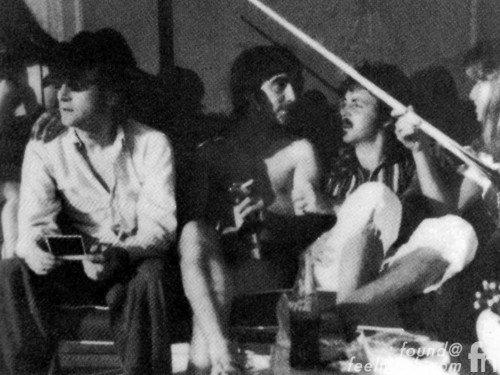
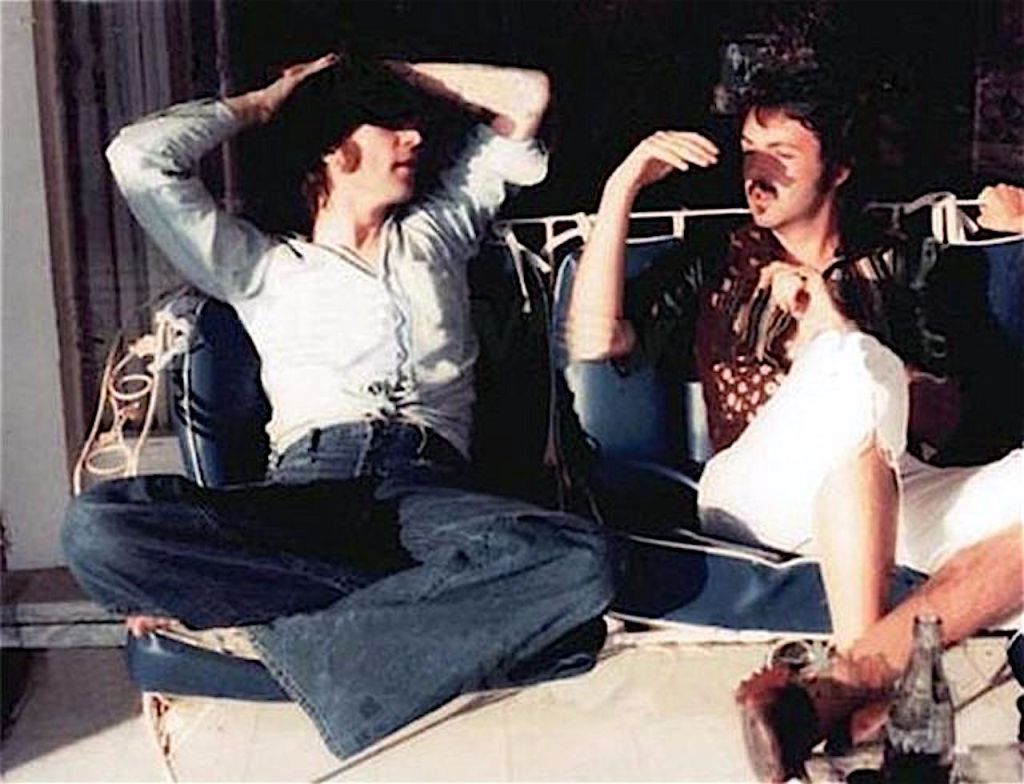
Paul and Linda McCartney dropped in on the first night that John was producing Pussy Cats with Harry at Burbank Studios on March 28, 1974. Paul sat behind Ringo’s drum kit (Ringo wasn’t present, though he has commented, “(he) always messes up my drums!”), and Linda behind the organ. They were joined by Nilsson, Stevie Wonder on electric piano, (he’d played with John at a few of his concerts, including the benefit concert in Madison Square Garden in 1972); guitarist Jesse Ed Davis, and saxophonist Bobby Keys both of whom had been contributing to Pussy Cats, and producer Ed Freeman on bass. Mal Evans was credited with ‘Tea’ and May Pang with ‘Sympathy’ (they actually played tambourine).
It was probably intended to be an impromptu jam session. What emerged was an incoherent mess with fragments of songs and the poorest recording of a jam session in Beatles history. Do you recall John’s first three albums like Two Virgins and The Wedding Album, those experimental avante-garde records he spun off with Yoko Ono in 1969? This was worse. Which was too bad, since this would be the last recording session with John Lennon and Paul McCartney playing together since the breakup of the Beatles in 1970, unfortunately. Even so, you know, it was all for fun.
This jam was first mentioned in 1975 in an interview with John, with more details following in May Pang’s 1983 book, Loving John. In a interview with ‘Whistling Bob’ Harris on the BBC2 music program The Old Grey Whistle Test, from March 11, 1975, John said, “I’ve worked with Ringo, I’ve worked with Ringo and George. I haven’t worked with Paul because we’ve had a more difficult time but now we’re really close, you know…I jammed with Paul. I did actually play with Paul. Yeah. We did a lot of stuff in L.A., but there were fifty other people playing too. They’re all just watching me and Paul.”
[The Last photos of John & Paul together, March 29, 1974, by May Pang]
Paul’s recollection of this jam went like this: “We were stoned. I don’t think there was anyone in that room who wasn’t stoned. For some ungodly reason, I decided to get on drums. It was just a party, you know. To use the word ‘disorganized’ is completely understating it. I might have made a feeble attempt to restore order—‘guys, you know, let’s think of a song, that would be a good idea’—but I can’t remember if I did or not.”
In a 1997 interview with Australian writer Sean Senett, Paul said, “(the) session was hazy…for a number of reasons.” Bobby Keys had been questioned a number of times about this session, but couldn’t recall any of it.
Track listing:
1-A Toot and a Snort (26 seconds)
2-Bluesy Jam Session (2:31)
3-Studio Talk (2;38)
4-Lucille (by Little Richard, 5:57)
5-Nightmares (2:37)
6 through 8-Stand By Me
9-Medley: Cupid/ Chain Gang (Sam Cooke)/ Take This Hammer (traditional railroad song)
On the first track, all of 26 seconds, John calls, “You wanna snort, Steve? A toot? It’s goin’ around.” That’s how it begins. ‘Snort’ refers to cocaine, the ubiquitous drug at the time, which is where we get the name of this bootleg.
Paul laid a scattershot, random drumbeat, or tries to; no wonder Ringo was pissed off with what he does to his kit. John improvised some words while the others tried to follow along: “I just gotta say it, Brooklyn Bridge, San Francisco Boot, Elementary Canal, Boston Strangler…it’s so wonderful to be waiting for my Green Card with thee…I would never doubt it, but I have to shout it, ‘Chicago, Chicago’, it’s a hell of a town, solo, play it man!” We’ve seen John spout these kind of nonsense lyrics before, in songs like “Come Together” and “I Am the Walrus”, or anything from his books like In His Own Write.
John asked if anyone knew a song they all knew: “It’s gotta be something done around Fifties, or no later than ’63, or we ain’t gonna know it.” Stevie laid down a bluesy refrain for “Lucille” and the others pick up on it, with John screaming the words accompanied by Paul.
“Lucille” may have been the most coherent song of the night. The band began with three instrumental choruses on sax, organ, guitar and bass in a middle-tempo blues style, before John came screaming in with Paul on harmony. This is the only tune where one can hear those old harmonies like on their old records. John turns in a couple of ragged guitar solos. Paul and John sing a middle eight a capella section, followed by another chorus.
“Nightmare” was probably supposed to be the 1961 Shadows instrumental “Midnight”, and it might have been, if this had been a professional session. As it was John ad-libbed some lines, adding “Someone give me an E and a snort.”
John had repeated troubles with his microphone and headphones on ‘Stand By Me’. While the band is trying to find its footing, John says, “OK, OK, let’s not get too serious, we’re not getting paid…we ain’t doing nothing but sitting here together…” Despite a strong start, the second try breaks down after the first verse; worse, John is still having trouble with his mic. “If you’re trying to get rid of me guitar, tell me…It’s gone all sort of dead in the earphones, you know? Dead! Dead!…”
“Hand up, who doesn’t know ‘Stand By Me’?…Just turn up the f—-n’ vocal mic on! McCartney’s doing his harmony on the drums! Stevie might get on it there if he’s got a mic!” They get a decent harmony going between John and Paul on the third go-round, until partway through the song, John’s vocal mic fails and we’re left with Paul’s voice, joined by Harry’s hoarse voice on the last refrain.
Stevie tried to salvage the moment, singing a couple of verses of “Cupid” by Sam Cooke with Paul; leading into “Working For the Chain Gang” (titled simply “Chain Gang” on the label), with Harry joining on vocals, at which point his mic started going bad, too. Paul leads a short version of the traditional song “Take This Hammer” as the tape fades out. That’s where this half-hour recording ended.
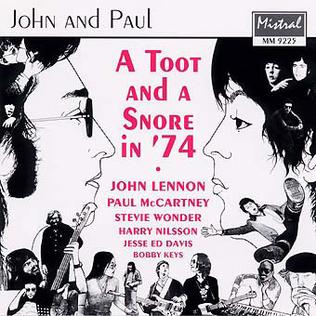
Bootleg Zone: John Lennon & Paul McCartney- A Toot and a Snort in 74
Availability: For obvious reasons, there has never been an official release of this session, despite its historic importance as the last time John and Paul played music together. That hasn’t stopped the bootleggers; a CD was issued, unofficially, by Mistral Music, from Luxembourg, in 1992.
This album was sitting prominently on a bookshelf at our county library when were living in University Place, Washington in 1979. The cover grabbed me; art is more impactful when its spread over a 12-inch surface and not squashed onto a five inch CD case. I took it home in a paper bag. Back then I walked everywhere, even to school.
My memory is that I loved that album; maybe I loved some tracks more than others. I wasn’t too familiar with Jackson Browne. I blame FM radio. The only song I’d ever heard from him was back in our house in Fircrest, “Doctor My Eyes”, back in 1972—six years before! I hear “The Pretender” on my store’s radio network NOWADAYS, but most AM-FM stations only played the hits. Critics may have loved him, but most of us (myself at least) were oblivious. After 1979 and checking out that LP, I was more aware of Browne and paying attention more when his songs hit the airwaves.
This LP was recorded on the road, either in concert or into hotel rooms, backstage in at least one case (“Nothing but Time”) on a bus in New Jersey on the way to another gig. Basically it was a travelogue of musicians, by musicians, about life on the road. “Running on Empty”, “The Load-Out” & “Stay” were recorded live at Meriweather Post Pavillion in Columbia, Maryland. “You Love the Thunder” was performed at Garden State Arts Center in Holmdel, New Jersey, while “Love Needs a Heart” was taped in Universal City, California.
Some songs were meant to stick out. The big hit getting airplay in the summer of ’78, along with the music from Grease, was “The Load-Out”, which segued into a cover of Maurice Williams & the Zodiac’s “Stay”. “Stay” was the A-side of a double sided single, backed on vocals by Rosemary Butler and David Lindley on falsetto in the second verse. (To be fair, the Zodiac’s version was short at 1 minute, 36 seconds long).
Other tunes I no longer appreciate on principle, such as “Cocaine”, recorded in a hotel room at a Holiday Inn in Illinois. Having seen the damage drugs had done to my family in the ‘70’s, I’m finding myself of the permissiveness, and also sad for all the artists buried by their addictions.
Some songs I understand better, now that I’m older, especially the title song. No that I’m a musician, but I can relate. The verses make sense in a general way, like this one:
I look around for the friends that I sued to turn to to pull me through/
There has been a lot of negative pre-release videos critical of Captain America Brave New World on YouTube for months. I haven’t viewed any of them. The consensus seemed to be of impending disaster, literally; oh, this is the end of the MCU, whatever. You’ve probably seen the taglines. If you have, forgit ‘em. This is a really good movie.
I don’t know military life from personal experience. The military has some weird ass standards about not inducting kids with diabetes who might have a low blood sugar incident on the field. Funny, that. But I have grandparents who served with distinction in the Second World War. My dad and his brother Wayne both volunteered and served as radio operators in Alaska during the Korean War. I have two brothers who served in the 1970s, and a niece who defused bombs in Iraq. So, yeah, you could say I’m a relative of veterans. (If I’ve left anyone in the family out, it wasn’t intentional. Sorry.)
The is the first film Anthony Mackie has had to carry the film on his own, at least within the MCU, and that he does. Sam Wilson is a soldier who understands loyalty and duty, and respects the chain of command, even when his president is a man he has no reason to trust. He can carry himself in battle without the shield or flight gear, and certainly without any super soldier serum. But if he has to do things the hard way to clear a good man’s name, even over his president’s stubborn will, that’s what he’s going to do. And that’s America, too.
Danny Ramirez joins the cast as Joaquin Torres, Sam’s sidekick and Falcon-in-training, a role reprised from the Falcon & the Winter Soldier mini-series. I haven’t seen that series so all I have to go on is what I see in the movie. From what I see he’s got a lot of heart, but he’s going to need a lot of mentoring. He seems to have a healthy bond in that regard with Sam Wilson.
Harrison Ford is an excellent choice to step into the role of General Thaddeus Ross, formerly played by the late William Hurt. Hurt brought gravitas and a certain smugness to the role, but he never projected the disdain or rage that should’ve been percolating beneath the surface. With Ford it’s all out there, the temper just ready to explode. His Ross has no time for fools, no patience for anyone who dares to second guess him. Doesn’t sound familiar at all, does it?
At the same time Ford is able to express regret at his failure to connect with his daughter, and that’s as far as I’ll go in the Spoiler Department. At the same time, it’s unfair to represent Ross as a foil for our current president. The scriptwriters were wise enough not to fill Ross’ mouth with the kind of word salads for which Donald Trump is famous.
The plot basically circles around Ross’ legacy, a treaty he’s pulling together which involves a Celestial relic full of adamantium. This motherload is supposed to be harvested for the benefit of all mankind, all that BS, which can be read as mostly for whichever world power who claims it first. This leads to a pitched aerial battle Sam and Joaquin have to defuse with one of our closest allies, and…. nope, that’s all. Go see the movie. This ties in with a legacy hero Cap from the Korean War era, Isaiah Bradley (Carl Lumbly), who’d spent 30 years in prison as a reward for his service, thanks to men like Ross.
As with most MCU films there are callbacks to previous projects, like 2008’s The Incredible Hulk especially, The Falcon & The Winter Soldier and Eternals, both from 2021. That being said, it’s refreshing to have at least one movie that’s not bogged down in Multiverse BS. I appreciated being able to follow the action without having to mentally backtrack every thread.
The most disturbing choice for me would be casting Shira Haas, a former IDF soldier as Mossad agent Ruth Bat-Seraph. At a time when her nation is committing genocide, I don’t know what possessed Kevin Faige to commit such a negative creative decision. Her character is exactly the kind of person I’d expect Ross to hire for his personal security. However, there are any number of capable female back-up characters from the Cap comics that could’ve been scripted in. including this character is morally indefensible and may sink an otherwise excellent film at the box office.