
On August 30, 1972, John Lennon delivered his biggest concert performances in Madison Square Garden in a benefit for needy children. It would be a last moment of glory before the Nixon administration piled on him. The concerts were intended to raise money for Staten Island’s Willowbrook State School for children with intellectual disabilities, a place where horrifying conditions of overcrowding, neglect and abuse were brought to light in an expose by Geraldo Rivera earlier that year. He came all the way to San Francisco to meet John and Yoko to convince them to perform.
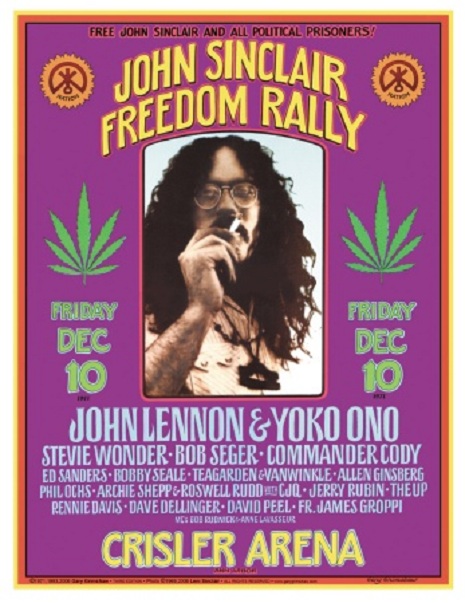
The Plastic Ono Band was no stranger to benefits, having done the 1969 UNICEF benefit at the Lyceum Ballroom with George Harrison, as well as the John Sinclair rally and the Apollo benefit for the families of the Attica Prison inmates in 1971. These would be John’s only full-length concerts as a solo artist, apart from his appearance at the Toronto Rock and Roll Revival in September 1969. The proceeds would go to establish new accommodations for the residents of the Willowbrook institution.
For this concert he recruited Elephant’s Memory, a New York group, as his backup band. According to their bassist, Gary Van Scyoc, the band met the Lennons in September 1971, recording a live set for a Long Island radio station. That tape wound up with Jerry Rubin, who passed it on to John, and for all we know Yoko still has her hands on it. Elephant’s Memory would be their backing band for Sometime In New York City as well as Yoko’s solo album Approximately Infinite Universe (released January 1973).
As Rolling Stone’s Jann Wiener described it, “John and Yoko permitted themselves to be exploited in this way because they were trying to clean up their act, to impress the immigration authorities that they were good citizens.”
Paul McCartney came close to performing a set but bowed out due to concerns about how Allen Klein would handle the proceeds. That would be a legitimate concern; George Harriosn was livid at how Klein had mishandled the money raised from the Concert for Bangladesh only a year earlier.
Sha Na Na, Roberta Flack and Stevie Wonder were also at the show, but John Lennon was the headliner. For once Yoko actually SANG, instead of just screaming, but don’t worry. She put in her share of wails. John did both an afternoon matinee and an evening show. The evening performance is believed to have been the better show. According to a New York Times review, “Some of the rough edges of the afternoon performance were smoothed off for the evening show. Interchanges between the Lennons and Elephant’s Memory began to jell, aided in no small measure by Jim Keltner’s drumming.” (“Lennons’ Elan Infuses ‘One to One’ Garden Concert” by Don Heckman, August 3, 1972).
Sha Na Na Playlist: “Yakety Yak”—“Tears On My Pillow”—“Tell Laura I Love Her”—“Rock & Roll is Here To Stay”—“Rama Lama Ding Dong”
I remember watching Sha Na Na with my Dad in 1977, between divorces to his second wife. One of the joys of that show was the endless pranks they played on their celebrity guests. They were a 1950’s revival group popular in the ‘70’s. I didn’t know they’d sung at Woodstock in 1969, right before Jimi Hendrix closed the festival at 7:30 Monday morning, August 18. They were also one of the highlights of Grease (1978); I believe they were allotted a whole side of the 2-record soundtrack. Two of the songs they performed that day, “Tears On My Pillow” and “Rock and Roll is Here to Stay” would be done during the dance scene in Grease.
There was an aura of innocence to their music, the illusion that all’s right with the world. That’s probably why 1950’s nostalgia was so big in the 70’s; it’s what our country needed after spiraling into a national malaise after Vietnam and Watergate. During “Tell Laura I Love Her”, the audience banged tambourines with the band. I hope John appreciated their energetic performance; this was the music that shaped him, this early rock ‘n’ roll magic.
Roberta Flack’s Playlist: “Reverend Lee”—“Somewhere”
Roberta Flack did not appear at the afternoon show. I wish I could have found some video or audio tracks from this concert, but no such luck. Nevertheless, she was a star in her own right. In Don Heckman’s article he states the “black goddess of music proved that her hit song, “The First Time Ever I Saw Your Face” was not a one shot phenomenon. She came out and entranced the audience with a program that blended her sometimes unrecognized ability to play superb jazz with her well known gifts as a fine pop vocalist.”
Stevie Wonder’s Playlist: “For Once In My Life”—“If You Really Love Me”—“Superwoman”—“Heaven Help Us All”—“Superstition”—“Keep On Running”
Stevie Wonder was no stranger to the Garden. He’d spent most of 1972 supporting the Rolling Stones on their Exile on Main Street tour. He’d played four shows with the Stones by the end of July with his band, Wonderlove, which included young up-and-coming musicians such as Ray Parker Jr on rhythm guitar and Greg Phillinganes on keyboards. His appearance at this concert was part of Berry Gordy’s plan to expose him to a wider, more diverse audience.
He gave an energetic performance, albeit of the same songs he’d been playing all summer. But he brought the audience alive with a new song called “Superstition”, which turned out to be an even funkier version than what was soon to be committed to vinyl, with Trevor Lawrence blasting an even livelier sax solo. “Keep On Running” closed to the shriek of a police siren.
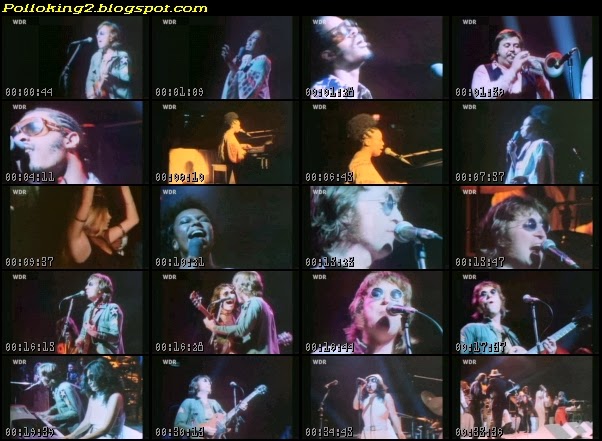
John and Yoko’s Playlist, afternoon matinee: Power to the People (excerpt)—New York City—It’s So Hard—Move On Fast (Yoko)—Woman is the N—– of the World—Sisters O Sisters (Yoko)—Well Well Well—Born in a Prison (Yoko)—Instant Karma (We All Shine On)—Mother—We’re All Water (Yoko)—Come Together—Imagine—Open Your Box (Yoko)—Cold Turkey–Don’t Worry Kyoko (Mummy’s Only Looking For Her Hand in the Snow) (Yoko)—Hound Dog
Evening playlist: Power to the People (excerpt) with introduction by Geraldo Rivera—New York City—It’s So Hard—Move On Fast—Woman is the N—– of the Word—Sisters O Sisters—Well Well Well—Instant Karma—Mother—We’re All Water—Born in a Prison—Come Together—Imagine—Open Your Box—Cold Turkey—Hound Dog—Law and Order (statement read by Yoko)—Give Peace a Chance (reggae version)
Five songs performed at these shows, especially Yoko’s, would be drawn from their Sometime in New York City album, released only two months before in June of 1972. Putting that aside, in the past four years John especially had recorded a small but impressive body of albums and singles to draw on. I write this in hindsight, as I was only eight years old at the time of these concerts. Shall we begin?
Over the screams of the audience comes the chant, “Power to the People”, after half a minute it burns into an electric performance of “New York City”. John came onstage in a green army jacket and blue tinted Granny glasses. No politics here, just a homage to John’s adoptive home that thoroughly outdid the studio version. He closed the evening show by shouting “What a bad-ass city!”
Then he growled through “It’s So Hard” and for all the complaints about the matinee being the weaker concert, I think John brought a lot of enthusiasm to his performance. After the drum roll closed the song, John called, “Welcome to the rehearsal.” Lest we forget the other half, Yoko shouted through a new song, “Move On Fast”, a fast paced number that John laid down a decent groove.
“This song is one of those songs of ours that got banned,” John joked, “something Yoko said to me in 1968, took me until 1970 to dig it.” On the count of “one-two-three-four”, the sax opens ‘Woman is the Nigger of the World”. Most people can’t read past the big N-word in the title, which was the point. The song is provocative—it’s SUPPOSED to be provocative! Sadly it’s words are just as relevant now as they were fifty years ago. After the last lyric, “We make her paint her face and dance,” John shouted “Dance—Dance—Dance!” like a wild man, just to emphasize the point.
“This song has the same message, it’s just put in a way she puts it,”, John said. Then Yoko shouted, “This is the time of change! Wake up now!”, jumping right into “Sisters O Sisters”. Yoko was really singing this time, or at least she was trying. John gave the solo a 1950’s rockabilly spin. At the end of the song John called out, “Thank you, sister! Reggae, baby, reggae! They do it in Jamaica and London, they’re gonna do it here one day.”
Next up was John’s “Well Well Well”, from his Plastic Ono Band album. John was not like Mick Jagger, dancing all over the stage; he could be carried away by the music and just rock in one spot. He slipped in a cute addendum: “She looked so beautiful I could eat her—I did!” His anguished screams were still not as distressing as Yoko’s. (He did that twice in the matinee show, once in the evening show.)

“Born in a Prison” was Yoko’s second of three songs of hers from Sometime in New York City. The poetry of this song is gorgeous; if it’d been sung by Joni Mitchell or Joan Baez, it would’ve been legendary. With Yoko singing, well, not so much. Still, “wood becomes a flute when it’s broken” remains a beautiful lyric. I’m not sure she and John harmonized very well. In fact, in the evening performance his voice sounded very strained; Yoko in contrast sung more relaxed. I hope they had water on stage when she started yelling “Let me out-Let me out!”, again and again over the saxophone. (And you’re only reading this: God help those people who were there enduring it!)
“Let us pray the choir comes in on time,” John said, hunched behind an organ for “Instant Karma”. This was the only time he actually performed this song live, as well as most of the rest of his tunes. For the evening show he quipped, “I’m just beginning to understand what this record was about,” bringing an extra bit of energy to his performance. After closing the song in the matinee, John remarked, “we’ll get it right next time.”
The spotlight that shone on John seemed to isolate him starkly behind the keyboard. “This number we’re gonna do now, everybody thought it was about my parents, but it’s about all parents, alive or half-dead.” In his review, Heckman wrote “Mother” was a “smashingly passionate song that drew a shouting, emphatic reaction from the young audience.” The delivery was as haunting as the studio recording, but John shredded the vocals far more powerfully in this concert. For the evening performance he embellished his comments from the afternoon by prefacing, “This is another song from one of the albums I made since I left the Rolling Stones!” I’m sure the audience appreciated that.
Yoko was back for “We’re All Water” The lyrics were slightly different from the album, although I always thought this line was hilarious: “There may not be much difference/ between Chairman Mao and Richard Nixon/if we strip them naked”, although she also compared Nixon to Hitler. And no, we’re not spared the shrieking that closes the number. Her screaming “What’s the difference!” actually seemed more defiant.
“Let’s go back to the past, just once, alright,” John said in the evening performance, “Something about a flat top, that’s all I know.” Elephant’s Memory joined him in a raw, almost spooky rendition of “Come Together”, stretching the song in ways I don’t think he could have with the Beatles. He confused some of the lyrics, which was par for the course for John; he often forgot the words to his own songs while performing with the Beatles. Approprietly enough, after the third chorus he sang, “Come together—right now—STOP THE WAR!” the audience roared their approval; at the time of this concert, young people were still serving and dying in Vietnam.
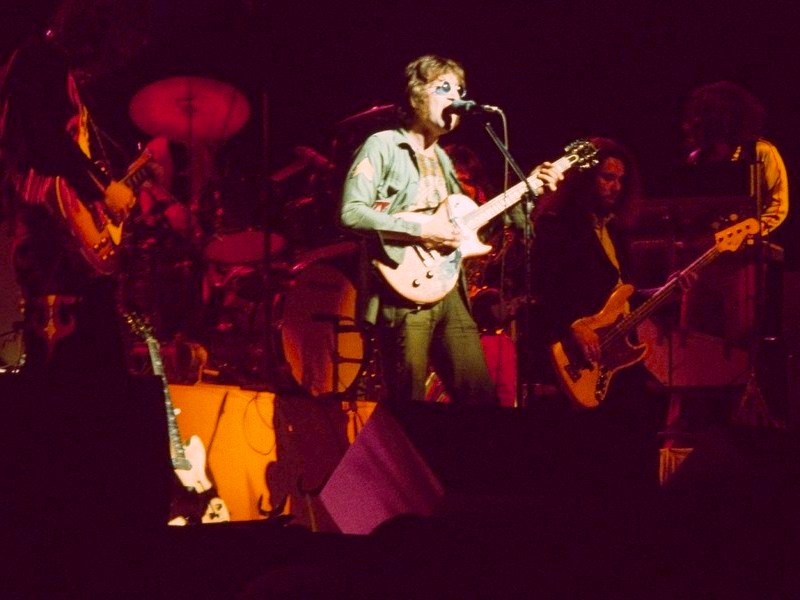
“This song is more about why we’re here, apart from rocking and that,” John opened the evening performance for “Imagine”. He never did a bad performance of this song. The keyboard offered a ringing quality, while he amended the final lyrics to “Brotherhood and sisterhood of man.”
“This is a song that was banned in America but I don’t see anything wrong with it actually”, Yoko said of the next song, “Open Your Box”.
“It’s so banned, we didn’t even notice ourselves,” John added. Lyrics such as “Open your box—open your legs” may have had something to do with that. At the evening concert Yoko commented, “I think they banned it because I’m a woman.” The drums and guitars laid down a thumping groove. That organ solo was also grand.
In the matinee, the following song stopped after a false start. “Start again! Stop-stop-stop!” John shouted. “Okay, we haven’t been in two weeks of hell of doing that for nothin’!” the evening show went smoother. John quipped, “This is something that happens to all of us, one way or the other.” No false starts for “Cold Turkey” this time, just one of the most intense vocal-guitar-sax assaults of all time. John’s shrieks may have been even more terrifying than on the single, and that scared the shit out of me in ’69.
This segued into “Don’t Worry Kyoko”, appropriately enough since it was the B-side of the “Cold Turkey” single. As painful as this was at Toronto or the Lyceum ballroom, in fairness she poured her mother’s anguish into the vocals. This performance was only four-and-a-half minutes long, as opposed to the 40 minutes she subjected attendees to at the Lyceum. And this was only for the afternoon concert.
For the last number of the matinee, John reached back into his rock and roll roots for an enthusiastic rendition of “Hound Dog”. For the evening performance, an otherwise perfect performance was spoiled by Yoko’s howling behind John. Love it when he shouts, “Elvis, I love you!” near the close.
“Hound Dog” had closed the afternoon concert. The evening show ended slightly differently. Following “Hound Dog”, as an encore, behind a driving groove Yoko reads a statement, “Law and Order” “by a well-known politician”. It might have described the turmoil of the early 1970’s—student unrest, fear of communists and the threat of Russia. The kicker was this statement was given by Hitler in 1931.
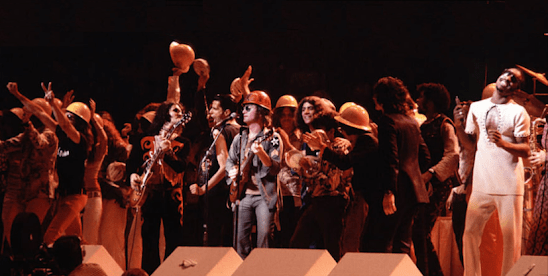
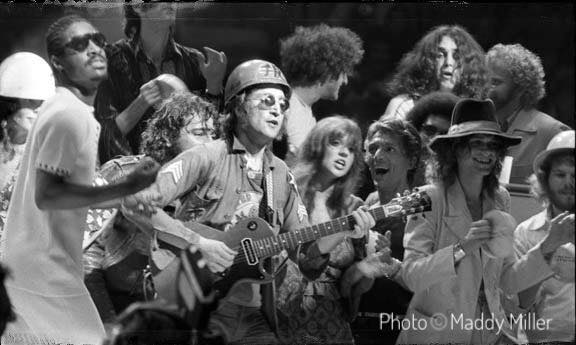
The Lennons were joined in the finale by Sha Na Na, Stevie Wonder, Roberta Flack, the cast of Godspell, Abbie Hoffman, Allen Ginsburg, Melanie Safka and others to sing a reggaefied version of “Give Peace a Chance”. Melanie was another Woodstock veteran, appearing on day one, (August 15, 1969), only three years prior. John and Yoko had invited Melanie to perform. She almost missed the show but made it to the stage in time for the finale. They did justice to the song, I’ll give them that. Stevie Wonder joins in at three minutes—but did it have to be 10 minutes long?
After the concerts, John and Yoko and all the other artists joined a celebratory party at the Tavern In The Green in Central Park. The concerts had raised over $1.5 million dollars for Willowbrook. John was hyped to do more live shows like this. Maybe he would have if he hadn’t got caught in an immigration battle with Nixon over the next couple of years.
Read More: Why John Lennon’s ‘Live in New York City’ LP Was So Frustrating | https://ultimateclassicrock.com/john-lennon-live-in-new-york-city-album/?utm_source=tsmclip&utm_medium=referral
Archive: Lennons’ Elan infuses One to One Garden Concert by Don Heckman, Aug. 31, 1972
https://b1027.com/flashback-john-lennons-only-solo-full-length-concert-video/
Sha Na Na live at Madison Square Garden August 1972
Stevie Wonder’s setlist
https://www.setlist.fm/setlist/stevie-wonder/1972/madison-square-garden-new-york-ny-23c57cd3.html
interview by Jeniffer Dodge with Melanie Safka
Stevie Wonder at Madison Square Garden August 1972
https://www.wolfgangs.com/music/stevie-wonder/audio/20052500-6809.html?tid=2974
Songs in the Key of Stevie blog
https://www.theatrewithin.org/songs-in-the-key-of-stevie
Albums that should exist blogspot
https://albumsthatshouldexist.blogspot.com/2023/06/john-lennon-and-various-artists-one-to.html
Soul Concerts wiki, August 30, 1972, Madison Square Garden
https://soul-concerts.fandom.com/wiki/August_30,_1972_Madison_Square_Garden,_New_York_City,_NY
Ultimate Classic Rock: Why John Lennon’s Live in NYC is so frustrating
https://ultimateclassicrock.com/john-lennon-live-in-new-york-city-album/
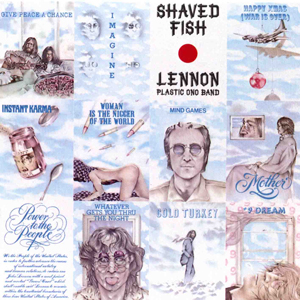
Available on: This is something of a mixed bag. In order, then. To my knowledge, none of the other artists have had an official release of their performances from the One to One concerts. An excerpt of “Give Peace a Chance” from the evening concert featuring Stevie Wonder, segued into the tail end of “Happy Xmas” on the 1975 compilation Shaved Fish.
Both concerts were professionally filmed. The recording supervisor for the shows was Phil Spector. A version with seven songs from the evening concert (“Come Together”, “Instant Karma”, “Sisters O Sisters”, “Cold Turkey”, “Hound Dog” and “Give Peace a Chance”, with “Imagine” played to scenes of the One to One fun day activities in Central Park that afternoon) was transmitted on ABC-TV in America, as a 53 minute special, on December 14, 1972. Yoko’s afternoon performance of “Move On Fast” received a rare one-off screening in England during the January 20, 1973 edition of BBC2’s late night show, The Old Grey Whistle.
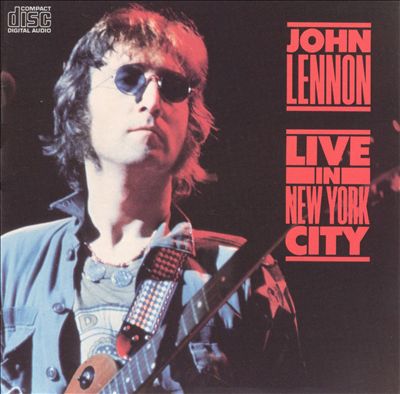
The 1986 posthumous album Live in New York City consisted primarily of songs from the afternoon set, with the exception of “Cold Turkey”, “Hound Dog” and an extremely truncated version of “Give Peace a Chance”, which were taken from the evening show. Even that involved some editing; the spoken intro for “Hound Dog” was taken from the afternoon show, while the performance was from the evening show. Yoko’s music was not included to make an exclusively John Lennon LP. A concert film of the same name was broadcast on Showtime in the same period, and released as a one-hour VHS, with different edits and the inclusion of some of Yoko’s songs.
Three songs from the evening show, along with Geraldo Rivera’s introduction, were included on the 1998 box set John Lennon Anthology: “Woman is the N—– of the World”, “It’s So Hard” and “Come Together”.
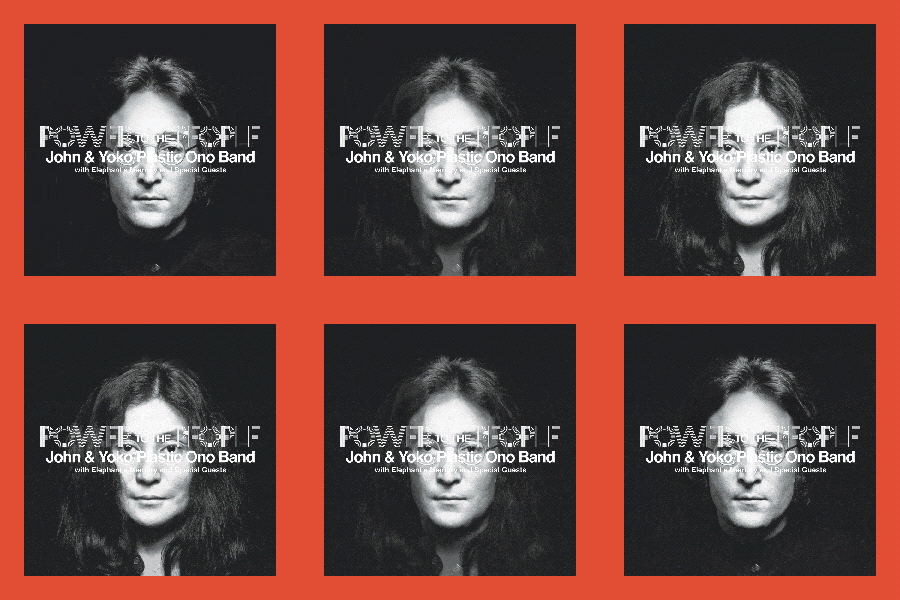
I’d like to say 2025’s Power to the People 9-CD box set finally released the entire concert on its first two CDs, except for some ungodly reason, Sean Lennon removed “Woman is the N—– of the World” (due to cultural sensitivity) as well as Yoko’s ‘Sisters O Sisters” (apparently for lack of space) from both the afternoon AND evening concerts. That’s essentially four songs deleted from the shows. We’ll see if he can get the job done right on the Blu-Ray of the concert, should Sean decide to remaster it properly.






 Papablues Scrapbook