On the Other Hand…

4144 south of sahara gatti   attilio-gatti

While some volumes are especially instructive, sometimes in my early researches into African culture and ecology, I may have sampled a few too many books that would give you an altogether wrong picture of the ‘Dark Continent.’

Let’s just start with that descriptive right here. The very expression ‘Darkest Continent’, ‘Darkest Africa’, whatever conjures up fearsome images of cannibals, savages, wild lions and snakes ready to fall on every convenient [preferably] blonde nubile maid. Perhaps it would help to know that Africa is not one big jungle from one end to the other. A variety of habitats, from savannah to desert to river ecosystems to fertile deltas to, yessss, swamplands, exist across the breadth of the land. At least three ecosystems are to be found in the nation of The Sudan alone. So there.

The books I started with unfortunately, were the kind written in the 40’s and 50’s, featuring the brave explorer with the requisite pith helmet on his brave white head. Attilio Gatti’s South of the Sahara from 1945 for example, or Cherry Lander’s My Kenya Acres (1957). I wonder if I should include Isak Dinesen’s Out of Africa on that list?

I found these in used books stores, and there’s a reason for that. They’re kind of like Jim Carrey’s 1995 comedy Ace Ventura: When Nature Calls, which was funny as hell. Until you step back and realize its portrayal of Africa, the real Africa, is hopelessly, terribly, horrifically out of date by at least 30 years. Sorry, there were no British or any other colonial officers running any African nation by 1995.

One wonders whether Africans were testing the credulity of these so-called white explorers. Case in point; in his 1996 book No Mercy, intrepid explorer Redmond O’Hanlon travels to the Congo in search of the legendary lost dinosaur Mokele-Mbembe at Lake Tele. Over dinner by a campfire Redmond asks one of his guides, “So, Doubla…why did Marcellin swear he saw the dinosaur?” “Don’t you know?” Doubla smiles. “It’s to bring idiots like you here. And make a lot of money.” (That said, it’s a pretty funny book with ‘slapstick, existential dread and brilliant digressions on everything from the sex life of the pygmy chimpanzee to the best method for killing a sorcerer’.)

no mercy redmond

The tendency of such books is to be condescending towards Africans, an Outsiders view not so different from Victorian times where each tribe was charming in and of itself, and yet, due to their lack of the civilizing influence of Christian values, these people always inevitably must be savages. That’s the mindset we have to get away from, one our President unfortunately snuffles every night.

I have tried to shake these colonial misconceptions. It’s taken years and it has not been easy. That conditioning is burned into our thoughts and minds with every safari rerun on late night TV, every Tarzan movie ever made and remade. Word of advice? Don’t believe Edgar Rice Burroughs. The man knew nothing of Africa.         tarzan-terrible-lion

I spent endless hours watching Tarzan movies at my mother’s house as a kid. Today I look back and think of them the way Richard Pryor did. Here’s what he said in Live on the Sunset Strip (1981): “Tarzan wouldn’t last a week in Africa. Either that or they’d think he was a crazy white man. ‘Where’s Tarzan?’ ‘You mean the crazy white man? He’s up the trees with the baboons!’

Richard_Pryor_Sunset_Strip_album

I have developed through painful experience a simple rule when it comes to these books: if it was published before 1970 it’s probably not accurate. especially when it comes to Africa. The further back in time you go, the less accurate the information will be and the more biased it becomes. Think of all the advances we’ve made in the last 50 years. Can you imagine writing a term paper on Mars, based on the knowledge we had before 1964? You’d be crowing about canals and laughed out of university!

If you’re open there is a treasure trove of African literature waiting to be discovered, and its really not that hard to find. There are historical and cultural treatises such as Jomo Kenyatta’s Facing Mount Kenya, memoirs both personal and historical. Novels galore from such talents as Chinua Achebe and Chimamanda Ngozi Adiche await your attention, just as two examples. There are stories of hope and despair, war and renewal. All this is waiting for you, if you only reach out your hand and grasp it.

Reflections: Facing Mount Kenya

51Q3I+SqzVL._SX293_BO1,204,203,200_

If you’re going to write about a place you’ve never been and people you’re not familiar with, if you want to bring truth to the tales you tell, it might be a good idea to listen to the voices of those who know and what they have to say.

This is the first book I encountered in my African studies written by a man of Africa. There’s a rich literary history most of us are quite unaware of, that is really not that hard to find. The problem is not enough of us are really looking and our schools are not going out of their way to expose our children to Afrocentric literature.

Facing Mount Kenya was something I stumbled on in a used book store in the 1980s. It was the author who caught my eye. Jomo Kenyatta, for all you younglings out there, is not just any Panafricanist; he’s like the father of his country, Kenya. I’m not going into his history at this time. It’s the book we’re concerned with here, which speaks of his pride of home and of his culture.

Published in 1938, this was essentially an anthropological study, from the inside, of Kenyatta’s Gikuyu people. It imparts their values and traditions, perhaps giving away more than he was really supposed to, and mayhaps that was the point, to explain his home and people to the Western world. And perhaps open some minds to the fact that they are more than the mindless savages all Africans are portrayed as in Tarzan novels, as well as too many adventure movies to come.

It may have also been too British in tone, a reflection of Kenyatta’s love for his Anglo home away from home. This is where my true African re-education began. Possibly some of my male characters in my writing are scewed to the lessons I learned from this book, and if so, well here’s where it began.

http://www.bookrags.com/studyguide-facing-mount-kenya-the-tribal-life/#gsc.tab=0


Butterfly & Serpent–thoughts

b-B & S Book Cover Image

We’re in the final stages of proofing and I’m looking forward to putting this baby to bed.

I never really intended this to be a trilogy at all. I hate trilogies; they’re as bad as cliffhangers, or major motion pictures of books that stretch ONE book into two–or three- pictures. Thank you very much, Harry Potter, for starting that trend. I thought this series would wind up at two books, at best.

Well, the first book, Butterfly & Serpent (above) was already clocking in at over 200 pages. Once I finished the first section of the follow-up volumes, I realized this section would be completely different from the rest of the material and would probably work best as a stand-alone.

Not to give away too much, but in Book 2, Fathers & Daughters, Youssou is forced to call on Jamai’s help when a new situation rises, and he has to confront his family’s pains of the past. Jamai will come forward as a stronger, more assertive personality.

For Book 3, because of their actions in the previous adventure Jamai & Youssou find themselves thrown into the wider world. Their relationship will be tested, with the usual troubles one can expect from two very young people.

Strolling the Shores of Lake Tana

That’s all for now. I’ll keep everybody up to date as things move along.

Guns for the Week

facebook-no one taking guns

Talk that compares Banning Knives vs. Banning Guns is spurious at best

A Knife is not a Weapon of Mass Destruction

One has to make an Effort to push the blade through Flesh, Muscle, Bone

Not to mention that nifty outfit you’re wearing

You’re only able to take out one person at a time

And you have to get Up Close & Personal

A Gun removes those limitations

A Gun is Stupid Easy

Depending on the range of your weapon, you never have to go near your target

You can spray a volley of bullets

Hundreds to a magazine

In a matter of seconds

And you never have to get your victim’s blood all over your nice flannel shirt

You would never have to make a Human Connection

To your murder victims at all

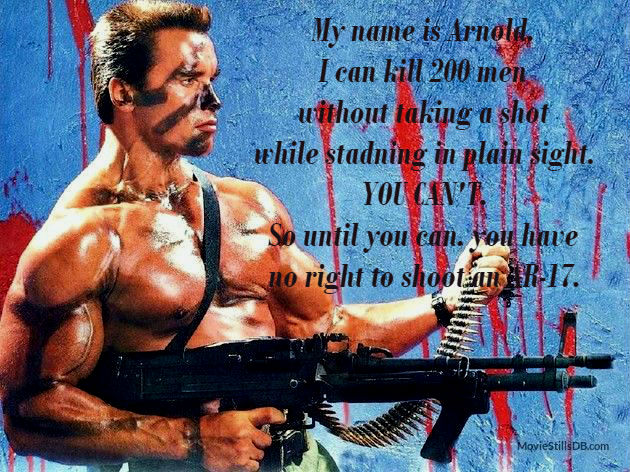
arnold-schwarzenegger-horror-movies


Now This/ Facebook May 19, 2018

Texas Lt. Governor Dan Patrick blames Santa Fe shooting on ‘too many exits’

If there has been only ONE entrance to their school, this guy would have had a clear shot to pick people off one by one, or shoot them all in a straight line.
Sorry, when is the last time you’ve been to a school, guy? Of course there’s multiple doors! You have 11,000 students going to different classrooms, in different rooms or portables on campus, which they have to get to within a five-minute time period.

Here’s a thought, and I’m just bein’ silly here…BAN ALL THE F—ING GUNS FORM CAMPUS! No gun zone! Gee! Ain’t that simple?

Snapshot 1 (8-4-2013 6-50 AM) Guns


Retweeted Indivisible Guide (@IndivisibleTeam):

We’ve said #enough. We’ve said thoughts and prayers are not enough. We can’t watch the inaction in Congress go by unexcused. We can’t lose more to senseless gun violence. It’s time to #VoteThemOut.

Go to https://t.co/LDYRmnF4ut and commit to change who represents us.https://t.co/MAL9qlwrVn

Butterfly & Serpent–coming soon

We’re making progress towards a June publication date. The edit is coming along & I’m pretty close to done. Val Dumond is working with me on a new improved edit. I have to confess to several moments of embarrassment as I realized, a lot of these errors sneaked through into the original print. Thankfully those are being corrected. Given the sales on the first printing, this will pretty much be just like starting over. Cheers.

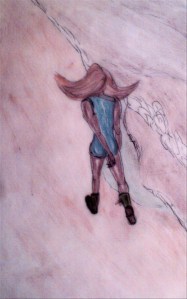
below: In Her Dreams (Jamai & Sydelle)

http://www.mike3839.deviantart.com

In Her Dreams 1 closeup- (1)