This album was sitting prominently on a bookshelf at our county library when were living in University Place, Washington in 1979. The cover grabbed me; art is more impactful when its spread over a 12-inch surface and not squashed onto a five inch CD case. I took it home in a paper bag. Back then I walked everywhere, even to school.
My memory is that I loved that album; maybe I loved some tracks more than others. I wasn’t too familiar with Jackson Browne. I blame FM radio. The only song I’d ever heard from him was back in our house in Fircrest, “Doctor My Eyes”, back in 1972—six years before! I hear “The Pretender” on my store’s radio network NOWADAYS, but most AM-FM stations only played the hits. Critics may have loved him, but most of us (myself at least) were oblivious. After 1979 and checking out that LP, I was more aware of Browne and paying attention more when his songs hit the airwaves.
This LP was recorded on the road, either in concert or into hotel rooms, backstage in at least one case (“Nothing but Time”) on a bus in New Jersey on the way to another gig. Basically it was a travelogue of musicians, by musicians, about life on the road. “Running on Empty”, “The Load-Out” & “Stay” were recorded live at Meriweather Post Pavillion in Columbia, Maryland. “You Love the Thunder” was performed at Garden State Arts Center in Holmdel, New Jersey, while “Love Needs a Heart” was taped in Universal City, California.
Some songs were meant to stick out. The big hit getting airplay in the summer of ’78, along with the music from Grease, was “The Load-Out”, which segued into a cover of Maurice Williams & the Zodiac’s “Stay”. “Stay” was the A-side of a double sided single, backed on vocals by Rosemary Butler and David Lindley on falsetto in the second verse. (To be fair, the Zodiac’s version was short at 1 minute, 36 seconds long).
Other tunes I no longer appreciate on principle, such as “Cocaine”, recorded in a hotel room at a Holiday Inn in Illinois. Having seen the damage drugs had done to my family in the ‘70’s, I’m finding myself of the permissiveness, and also sad for all the artists buried by their addictions.
Some songs I understand better, now that I’m older, especially the title song. No that I’m a musician, but I can relate. The verses make sense in a general way, like this one:
I look around for the friends that I sued to turn to to pull me through/
I found this in one of those cut-out bins at a local drug store in 1979; that must have been 45 plus years ago. I don’t know why it was in a cut-out bin, it was an extraordinary album. It was my first experience with Blue Oyster Cult. Apparently, the best way to listen to this band is in a live setting. It’s actually their second live LP, after 1975’s On Your Feet or On Your Knees. This record’s only sin is that at 38 minutes, it’s too damn short.
The classic line-up is here—Buck Dharma on guitars, Eric Bloom on vocals & stun guitar (whatever the hell that is), Allen Lanier on keyboards, Joe Bouchard on bass, and his older brother Albert Bouchard on drums. Four of the numbers are from their most recent albums (‘R.U. Ready to Rock’ and ‘Godzilla’ from Spectres (1977), and ‘E.T.I. (Extra Terrestrial Intelligence’ and ‘(Don’t Fear) the Reaper’ from Agents of Fortune (1976)). Only one song originates from their early albums (‘Astronomy’, from Secret Treaties (1974), but then they’d only released five albums at this point. The last two numbers are cover tunes.
The cover reaches out and grabs you. The Grim Reaper rides a black horse over a desert landscape. T.R. Shorr (ie, Todd Shorr) painted it based on a concept by Hillary Vermont and Marty Pekar, with Andrea Klein for the sleeve design. This album recalls the times in the 1970’s when Metal gave the impression of obscure meanings in mystic lyrics.
This was recorded at different venues, for instance at the Fox Theatre, Atlanta, Georgia (‘R.U. Ready to Rock’ & ‘Kick Out the Jams’); the Columbus Municipal Auditorium in Columbus, Georgia (‘E.T.I.’ & ‘Astronomy’), both in April, 1978; New Castle City Hall in the UK, June 1, 1978 (‘Godzilla’ & ‘We Gotta Get Out of This Place’). ‘(Don’t Fear) the Reaper’ was recorded live at Barton Coliseum, Little Rock, Arkansas on April 9, 1978.
The show launches off with a kick-ass rendition of ‘R.U. Ready to Rock’ and never lets up on the momentum. Donald “Buck Dharma” Roesner cranks out some masterful solos without a trace of the self-indulgence Led Zeppelin was known for. Not one song overstays its welcome. I didn’t know MC5 growing up, but I think BOC took their version of ‘Kick Out the Jams’ and made it their own.
I first heard ‘Godzilla’ on one of those late-night rock concert shows they had in the 70s, Night Flight maybe, with a Godzilla head bobbing in the background. I couldn’t believe somebody had actually done a song about him. I’ve always been a Godzilla fan, having watched a lot of admittedly dubbed movies on Saturday afternoon reruns. That song captures the grandeur and sheer terror, the force of nature that is Godzilla.
Everybody knows (Don’t Fear) the Reaper’; it’s the only BOC song they’ll play on the radio these days. This performance from Arkansas is more energetic than what we heard on vinyl. Eric Bloom channels Eric Burdon’s vocals on the closer, “We Gotta Get Out of This Place”, and it’s just possible BOC exceeds the Animals on this tune. I know there’s an expanded version on CD somewhere out there, but this LP remains a treasured favorite. You need to try it sometime.
There has been a lot of negative pre-release videos critical of Captain America Brave New World on YouTube for months. I haven’t viewed any of them. The consensus seemed to be of impending disaster, literally; oh, this is the end of the MCU, whatever. You’ve probably seen the taglines. If you have, forgit ‘em. This is a really good movie.
I don’t know military life from personal experience. The military has some weird ass standards about not inducting kids with diabetes who might have a low blood sugar incident on the field. Funny, that. But I have grandparents who served with distinction in the Second World War. My dad and his brother Wayne both volunteered and served as radio operators in Alaska during the Korean War. I have two brothers who served in the 1970s, and a niece who defused bombs in Iraq. So, yeah, you could say I’m a relative of veterans. (If I’ve left anyone in the family out, it wasn’t intentional. Sorry.)
The is the first film Anthony Mackie has had to carry the film on his own, at least within the MCU, and that he does. Sam Wilson is a soldier who understands loyalty and duty, and respects the chain of command, even when his president is a man he has no reason to trust. He can carry himself in battle without the shield or flight gear, and certainly without any super soldier serum. But if he has to do things the hard way to clear a good man’s name, even over his president’s stubborn will, that’s what he’s going to do. And that’s America, too.
Danny Ramirez joins the cast as Joaquin Torres, Sam’s sidekick and Falcon-in-training, a role reprised from the Falcon & the Winter Soldier mini-series. I haven’t seen that series so all I have to go on is what I see in the movie. From what I see he’s got a lot of heart, but he’s going to need a lot of mentoring. He seems to have a healthy bond in that regard with Sam Wilson.
Harrison Ford is an excellent choice to step into the role of General Thaddeus Ross, formerly played by the late William Hurt. Hurt brought gravitas and a certain smugness to the role, but he never projected the disdain or rage that should’ve been percolating beneath the surface. With Ford it’s all out there, the temper just ready to explode. His Ross has no time for fools, no patience for anyone who dares to second guess him. Doesn’t sound familiar at all, does it?
At the same time Ford is able to express regret at his failure to connect with his daughter, and that’s as far as I’ll go in the Spoiler Department. At the same time, it’s unfair to represent Ross as a foil for our current president. The scriptwriters were wise enough not to fill Ross’ mouth with the kind of word salads for which Donald Trump is famous.
The plot basically circles around Ross’ legacy, a treaty he’s pulling together which involves a Celestial relic full of adamantium. This motherload is supposed to be harvested for the benefit of all mankind, all that BS, which can be read as mostly for whichever world power who claims it first. This leads to a pitched aerial battle Sam and Joaquin have to defuse with one of our closest allies, and…. nope, that’s all. Go see the movie. This ties in with a legacy hero Cap from the Korean War era, Isaiah Bradley (Carl Lumbly), who’d spent 30 years in prison as a reward for his service, thanks to men like Ross.
As with most MCU films there are callbacks to previous projects, like 2008’s The Incredible Hulk especially, The Falcon & The Winter Soldier and Eternals, both from 2021. That being said, it’s refreshing to have at least one movie that’s not bogged down in Multiverse BS. I appreciated being able to follow the action without having to mentally backtrack every thread.
The most disturbing choice for me would be casting Shira Haas, a former IDF soldier as Mossad agent Ruth Bat-Seraph. At a time when her nation is committing genocide, I don’t know what possessed Kevin Faige to commit such a negative creative decision. Her character is exactly the kind of person I’d expect Ross to hire for his personal security. However, there are any number of capable female back-up characters from the Cap comics that could’ve been scripted in. including this character is morally indefensible and may sink an otherwise excellent film at the box office.
Live albums can be fickle things. Usually, they’re intended as throwaway gifts to keep a band’s fans interested. Sometimes an album fails to capture the excitement of a live performance. Some just fall flat. 1985’s Arena by Duran Duran is one example, which edited out pretty much all of the audience reactions—which is half of why we buy a live record in the first place!
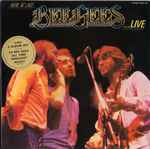
Sometimes, very rarely, a live album can be a game changer. Neil Diamond’s Hot August Night certainly qualifies in that area. Not to mention Frampton Comes Alive, which turned a relatively unknown guitarist named Peter Frampton into a rock god. While not a game changer, Here At Last…Bee Gees…Live was an immensely enjoyable two-record set.
Confession session: I hadn’t heard ANY of the Bee Gees 1960’s hits before this record was handed down to me. How could I, I was five years old in 1969. In the late 1960’s I was focused on the Beatles, and ONLY the Beatles. My earliest awareness of any musical world beyond the Fab Four was Neil Diamond’s single “Sweet Caroline”. To say I’d slept through the 1960’s would be an understatement.
My first awareness of the Bee Gees—brothers Barry, Robin and Maurice Gibb– was their 1970 single “Lonely Days”. That was one of only two songs that had an impact for them in the early 70’s. My brother David bought “Lonely Days”, while I fell for the second one, “How Can You Mend a Broken Heart”, which came out a year later. The fact that they’d had eight hit singles in America before that kind of passed by me. It would be years before they remade themselves as ‘the Kings of Disco’; at least that’s what the media called them.
Shockingly, I still have that album. I had a purge in 1998. It was a very bad year. Basically, my wife and I were separated, temporarily. I was moving out of our apartment and back in with my dad. And I was thinking, why am I carrying all this shit around with me? I didn’t listen to half of it. I pruned my record collection down to a select few, and evidently this was one of them. It’d been passed down to me by David, and I’m glad he did. That’s what we’d do, pass our old records and comic books down to the next sibling. As the youngest I was the frequent recipient of these goodies.
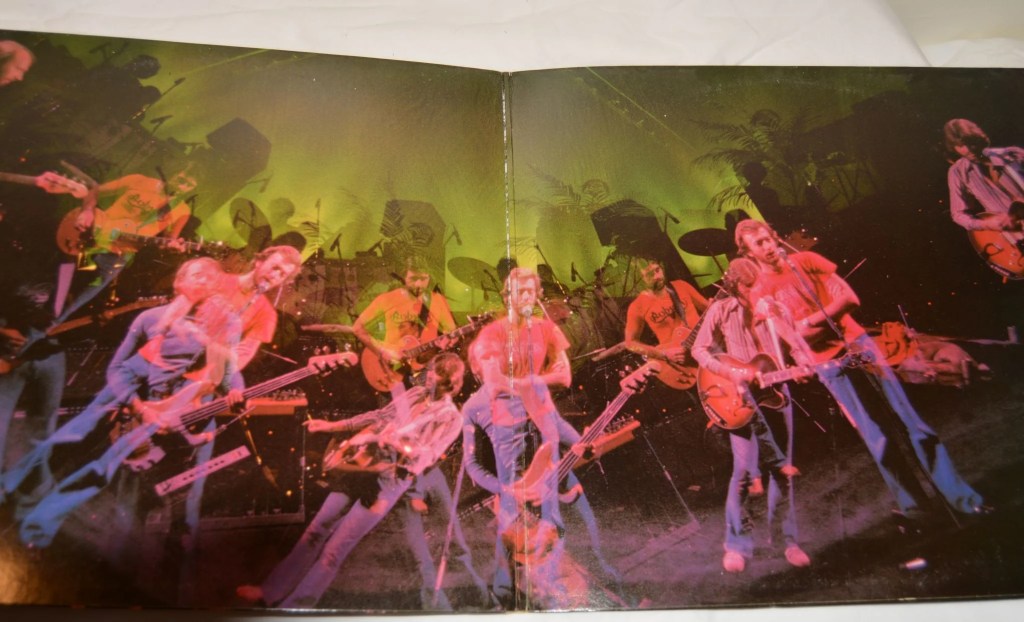
This performance was recorded December 20, 1976, at the Forum in Los Angeles, California, the last concert on their 1976 tour to promote their latest LP, Children of the World. It was a guidebook to who they were as a band, before Saturday Night Fever broke in the fall of 1977. After that they were inescapable, what with their own songs dominating the charts, along with their youngest brother Andy Gibb becoming a pop star in his own right and half the planet covering their songs. You had to be there to know just how big they’d become.
People don’t always realize the Gibb brothers didn’t just write love songs or songs to dance to. A lot of their tunes were absolute heartbreakers. Because those songs were marginally successful, that was the pattern they followed in their early 1970’s LPs. “My World”, “Words”, “Love So Right”, and even “Lonely Days”, if you want to stretch a point, are examples of these.
Very little of these early 70’s material would be found here, probably because it wasn’t the Bee Gees’ better selling periods. Besides the two mentioned singles, only “Run To Me” and “Down The Road” were carried over from that period. After a brief split in 1968 and their reunion in 1970, the boys spent that period trying to find a new direction. Not until they embraced their funky side on Main Course would success come.
I’m afraid I’ve been spoiled. Since this album was the first place where I’d heard most of their early work, I find I prefer the live versions. Live performance was the perfect venue to showcase their strengths, in particular their harmonies and songwriting. Their older songs especially benefited from a live setting, being presented by an older, more seasoned band updating their 1960s sound for a 1970s audience. The horn section was a definite boost, especially on songs like “I Gotta Get A Message To You” and “To Love Somebody”. The audience interaction was always enthusiastic. This may also be the only time I’ve seen Robin a with mustache and beard; I don’t know when he grew that; on the road perhaps.
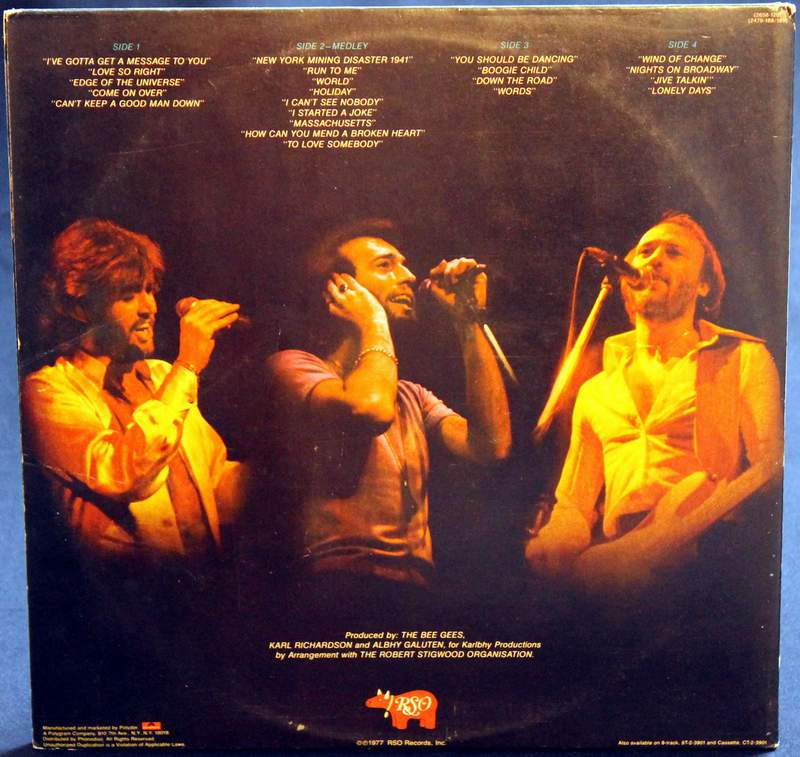
The show opens with a flourish of horns on “I Gotta Get A Message To You”, and this is the version I prefer. The audience is whistling throughout the performance. Robin and Barry share vocals; Robin taking the first and third verses, and Barry the second. This leads into their most recent heartbreaker, “Love So Right” another example of their gorgeous harmonies.
On “Edge of the Universe” Barry and Ronin’s voices harmonize gorgeously together, followed by “Come On Over”, where Robin is at his most vulnerable. It’s performed in a distinctly country style; it’d been a hit for Olivia Newton-John earlier that same year. Even a lesser-known song such as “Can’t Keep a Good Man Down” moves at a faster tempo, gifted with a killer funky solo three minutes in.
Barry opens the second side of the LP. “We’d like to enter into a medley of some of our older material.” They usually performed such a medley in the middle of their concerts in the 1970s, leading off with their first hit from 1967, “New York Mining Disaster 1941”. This may have been their only 60’s song I was familiar with. It was a haunting song in its original studio version. The acoustic version presented here is even more stark, just the three brothers harmonizing over guitars with a horn as a backdrop.
“Run To Me” and “World” combined seamlessly into one tune. Robin’s voice always had a vulnerable quality ideal to these songs, and he carries most of the tunes in this medley. Indeed, “Holiday”, “I Can’t See Nobody”, “I Started a Joke” and “Massachusetts” blend into each other without a hitch. Cheers rise at the beginning of every verse of “How Do You Mend a Broken Heart”.
“You Should Be Dancing” gets an extended treatment on Side 3, at 9 minutes 22 seconds, the longest track on the LP. The single version and “Jive Talkin’” were additions to the initial release of Saturday Night Fever soundtrack. (Subsequent pressings would substitute this live performance, but the CD reissue would restore the original version.) Barry’s falsetto was still a new thing at this point, and it’s put to fine use here. The middle section settles down into a driving drum beat backed by guitar and horns that must’ve got the audience on the floor. It closes with a bongo drum solo and a last flourish.
The very next tune was one of their weaker disco songs, “Boogie Child”. “Down The Road” from their 1974 album Mr. Natural was energized in this live version, with a much more aggressive vocal delivery. This performance would be pressed as the B-side to their phenomenally successful SNF single “Night Fever” two years later.
Just as a sidebar: I was there in the 70s. I remember the depression gripping America then; we’d just lost in Vietnam, with Watergate, the Arab oil embargo and rampant inflation piled on top of everything else. Some people despised disco, especially partisans of rock music. My view is, after all the troubles we’d endured in the 1970’s, disco was exactly what we needed at that moment to overcome our national malaise.
The fourth and final side presents three tracks from Main Course. “Winds of Change” gets a funky upgrade, leading off with the entire horn section. The song details a man bowed but not broken. “Sometimes a man breaks down, down, down, down, down/ and the good things he’s searching for/ are crushed into the ground”, the message being to not give in, to “feel the winds of change.”
This leads into “Nights on Broadway”, the powerful opening track on Main Course. This tops the original version. This may be the greatest example of shared vocals with Barry and Robin trading lyrics with Maurice adding his falsetto on the chorus. This leads into “Jive Talkin’”, and from there the piano leads into “Lonely Days”, building to a glorious finish. Barry closes with “Thank you! Merry Christmas and good night!”
It’s kind of sad to realize Barry is the only Gibb brother still alive. After the phenomenal success of Saturday Night Fever, apparently their manager Robert Stigwood thought it’d be a great idea to do a motion picture adaptation of the Beatles’ Sgt Pepper’s Lonely Hearts Club Band, with the Bee Gees as the band and Peter Frampton as Billy Shears. Well, to paraphrase Epstein from Welcome Back, Kotter, “I’ve heard of people bombing, but that was a nuclear explosion!”
That’s okay, their follow-up album Spirits Having Flown was a smash. However, in the backlash against all things disco, their 1981 LP Living Eyes ended their chart success. Their next album wouldn’t be recorded for another eight years, by which time their loyal fans had gotten over their discophobia and the Bee Gees regained their well-earned respectability. Which I’d never lost.
Ironically in the fall of 1989 I had gone to a Doctor Who Day at Book King in Federal Way, Washington. Back when I was single, Book King had these get togethers for fans every weekend, and I attended as often as I could. Everyone was seated in this little room in the back of the bookstore, except instead of Doctor Who, the group was sharing a couple of episodes from the new season of TNG. This time around the show came out of the gate running and didn’t stop for the next three seasons.
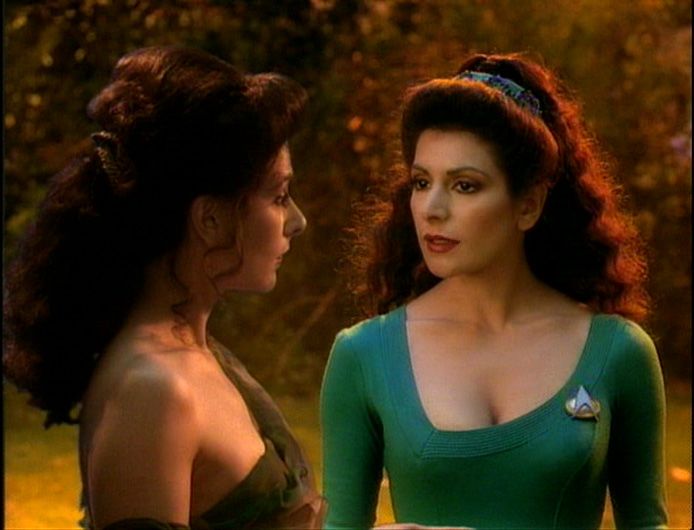
One of the episodes they screened was “The Survivors”, which showed the embrace of bold ideas to go along with the always excellent f/x. They kept the plot twist close to the sleeve, positing a mystery: how did this lone elderly couple survive a planetary bombardment that eradicated all other life? Counselor Troi meanwhile was slowly driven mad by the incessant music of a tiny music box she had never heard before. In fact, no one had survived, including the wife of the older man—in reality a godlike being who in a moment of grief wiped out the invaders throughout the universe. For one of the few times in Trek history, this was a deity with a conscience who relieved the suffering he’d inflicted on Troi. Picard could do nothing but let him go to recreate the woman he loved, and to just leave him alone. And that’s one of the first episodes. It keeps going.
Season Three of the Original Series suffered from subpar writing, some of the worst of any Trek series. Gene Roddenberry had been bumped to executive producer, while Fred Freiberger became the new line producer. NBC had changed TOS’ time slot to 10 pm—on Fridays, a death slot for any series. Worst of all, the show had lost the sense of humor it was known for. By contrast, by its third season TNG had hit its stride. At least in my hometown, TNG was given a time slot of 7 pm on Saturday nights, and it never moved from that spot.
On September 25, 1989, the worm had turned. Rather than being The Original Series’ poor second cousin, in many ways The Next Generation surpassed it. Star Trek V had been a disappointment that summer. It was one of two movies I’d seen in one day in July of ’89. I’d had a very bad day; all I’ll say is that my brother and I had a falling out which ended with me stomping outside and smashing my windshield—with my bare fist. But enough of that for now.
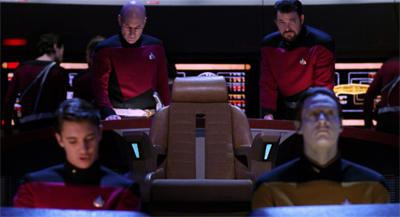
The revolving door of scriptwriters that had plagued TNG’s first season, and the rewrites imposed by Gene Roddenberry were past. Briefly, Michael Piller was promoted to head of the writing staff, which brought a much-needed stability to the script process. Rick Berman became the chief of day-to-day operations. New costume designer Bob Blackman oversaw a redesign of outfits into real regimental uniforms a space service might issue, though not necessarily any more comfortable for the actors. Hence the birth of what fans refer to as ‘the Picard Maneuver’, where Patrick Stewart pulls his tunic down every time he has to stand up.
Blackman also rendered a one-piece version for the woman, which meant no more legs! A new title segment began this season showing an incoming montage from the Milky Way, instead of the departure angle used in the first two seasons. Best of all, Gates McFadden was back for good as Dr. Beverly Crusher.
This year we encountered aliens who really seemed …ALIEN. Tin Man. The Sheliak. A Douwd. What was also new was that the Enterprise-D encountered more people who were absolutely unreasonable; who were so locked into their own positions, they wouldn’t even consider the facts presented to them, even when said facts will endanger their lives. “The Ensigns of Command”, “The High Ground”, “The Wounded” and “Transfigurations” come to mind. The writing is sharper, the dialogue less formal and more natural; that was reflected in the return of Star Trek’s sense of humor. The crew often were not just put to the test, they were frequently put into life-threatening situations.
Every season has had its timey-wimey excursions (“We’ll Always Have Paris” and “Time Squared”, for example) where Time is out of sync. “Yesterday’s Enterprise” is a real mindwarp, bleeding seamlessly into a dark version of our universe, where the Federation is on the verge of collapse from a war with the Klingons. And no one is aware of what’s happened, except for Guinan. Even she can’t explain why, she only knows THIS-IS-WRONG! This is the one and only time we see the Enterprise-C, and the consequences of its falling through a time warp in the midst of battle would be catastrophic. Because this is an alternate timeline, they were able to bring back Tasha Yar, at least one version of her, and give her an ending with some dignity. The ramifications of this version’s death would roil through our timeline for seasons to come. Believe me, there is death and destruction enough here to satisfy the most die-hard pew-pew fan.
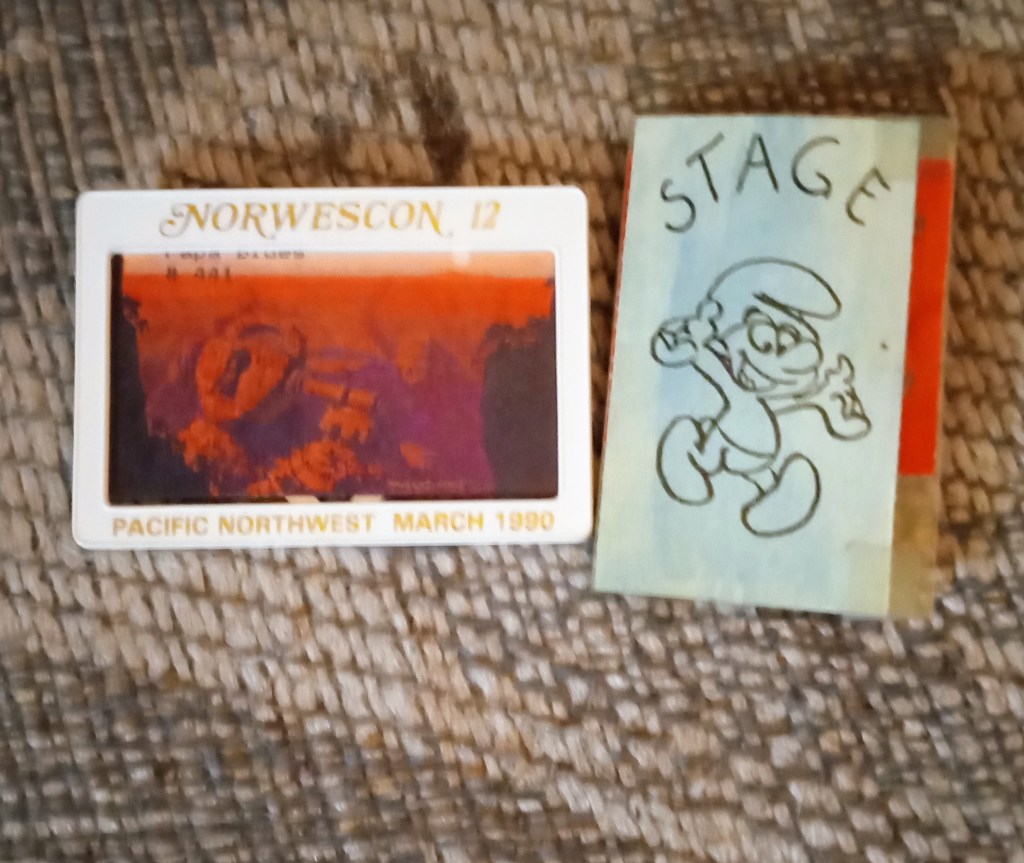
I’m embarrassed to re-read my old diary entries from this time. I seemed very petty and childish then. In 1990 I made it to two conventions, Rustycon 007 in January, and my third Norwescon, no. 12 in April 1990. My friends said I was a virgin when I came to my first sci-fi convention. Four cons in I guess I still was, considering they pinned a condom on the back of my stage pass. I was serving as a volunteer this time, though to be honest I remember very little of that. Rustycon had some good highlights. My friends were all there: Michael Scanlon, Chris and J. Steven York, and Jack and Fran Beslanwitch. The difference between the Sheraton where Norwescon was held and the Radisson, where we had Rustycon was the ambient noise level. There wasn’t a continuous drone of voices at the Radisson, only people’s quiet whispers. For a socially awkward person like me, that’s grand.
Apparently I’d gone to the dance, according to my diary, though odds are I sat in the back. Socially I was like Reginald Barclay. Mark Skullard had put together a fun panel on old Science Fiction radio programs. The lines in those shows were so melodramatic, the plots so preposterous even in the first couple of minutes we couldn’t help laughing. Here’s a shoutout to George Smith, who somehow showed up at nearly every panel I went to.
I met Rebecca Neason at this con, God rest her, at the Victorian SF/ Steampunk panel. She was a very sweet, social lady who kept getting tagged for panels when no one else would show up to empanel them. She was working on her first TNG novel, Guise of the Mind, which would be published in 1993. She and Donna Barr hosted a panel on Mythical Creatures. Apparently only the three of us were attending. Donna Barr has a very black sense of humor; she had me and Rebecca in near hysterics.
Curiously I don’t remember any TNG parodies at this year’s convention. Boy, at LAST year’s con we had a doozy, “Star Trek: Another Regeneration”. This was a taped radio program put together by two British chaps and sent over to Canada’s “The Ether Show”. (I hadn’t mentioned this in my last blog because I hadn’t found my diaries from that time period before.}
I squat on the floor of Room 1906 along with everyone who wasn’t seated on the bed. This had to be the best part of Norwescon 11 for me; this was a hilarious parody of “Farpoint”. Example: Riker has gone to the holodeck to fetch Data. The computer warned him this would be inadvisable, Commander Data was in the Atlantic Ocean simulation. Riker responds, “I don’t care, just let me in!” So it does, and “WHOOOSH!” The saucer section has also accidentally been separated from the ship, so Riker jams the two pieces together. “Make it fit!” he says, sooo, “SHRIIIEEEK!” until Data nonchalantly reports, “Reconnection complete, sir.”
The most badass character for season 3 has to be Jean Luc Picard. Diplomacy becomes a weapon in “The Ensigns of Command”, where he uses the same treaty the Sheliak have been beating him over the head with against them. “You enjoyed that,” Riker says, to which Picard retorts, “Damn right.” “Who Watches the Watchers?” is the story where the Prime Directive is not simply bent, it’s twisted out of shape. It’s the one where Picard is mistaken for a god. He takes an arrow to the shoulder, willingly, to prove his mortality.
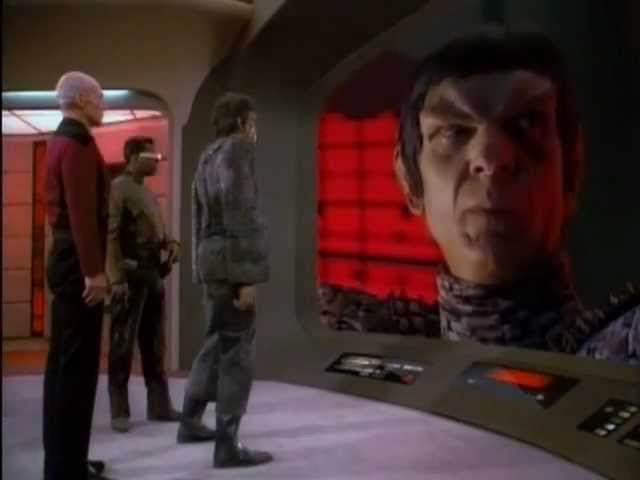
He’s also cunning when he wants to be. While investigating a possible Romulan base in the Neutral Zone on the word of a high-ranking defector, the Enterprise-D finds herself surrounded by three Romulan warbirds. With a word to Worf, the tables turn after three Klingon warbirds decloak on the warbirds’ flanks. “Shall we die together?” Picard challenges. When the Argosian Prime Minister Nayrok finally asks for help after rebuffing Picard for the entire episode, Picard cites the Prime Directive and just leaves (“The Hunted”).
Picard’s role as Patriarch of the Enterprise-D has never been more clearly defined than in “The Bonding”, which reminds us there are children on board, and their lives are just as fragile when a loved one dies. As he reminds Jeremy Aster, “no one on the Enterprise is alone”. To save Jeremy from an alien who wants to take him away to live on the planet, Picard calls together all the crew members who understand loss all too well. For Wesley Crusher this is a brutal reminder of his father’s death, and he admits for the first time that he was angry at Picard for surviving. I know that feeling; that was the moment that Wesley became a real person to me.
The Patriarchal role suits him when Data takes the ultimate step to becoming human, by creating his own child, Lal (“The Offspring”). In another first, this is the first episode in Trek history to be directed by a cast member, in this case Jonathan Frakes. When another asshole admiral wants to take Lal away to study, he responds, “There are times, sir, when men of good conscience cannot blindly follow orders. You acknowledge their sentience, but you ignore their personal liberties and freedom. Order a man to hand his child over to the state? Not while I am his captain.” Having had a child ripped from my family, I feel for them, and I love Picard for taking that stand.
By now his crew is so tight that with only a look, the bridge crew knows exactly what to do after aliens intrude on the bridge (“Allegiance”). Patrick Stewart’s hunger for more actions scenes bears fruit in both “Captain’s Holiday” and “The High Ground”, where he actually punches a terrorist on the bridge of the Enterprise. He becomes Worf’s cha’Dich, a ritual defender, when Kurn is attacked and injured in “Sins of the Father”. No, Picard is taking no shit this time around.
Worf may have been the cast member who experienced the most growth. Dare I say it, I think he became an actual character. I’ll explain. It was established in the first two seasons that he was a warrior, well versed in the ways of Klingons, a heritage he takes exceptional pride in. Beyond that, excepting two episodes, his role was not given the depth it deserved. In a sense he was a caricature much like Frank Burns in M.A.S.H. By its 5th season Frank had pretty much become a petty narrow-minded bigot, an overzealous ‘patriot’ with little to no depth.
So it was with Worf. He had been portrayed as a proud warrior, who frequently got his ass whupped by a stronger opponent. This season he became flesh and blood. Like Frank Burns, Worf is also burdened with prejudice–against Romulans, in this case. Given the chance to save a dying Romulan by giving a blood transfusion, Worf stubbornly refuses (“The Enemy”). To be fair, his prejudice is reciprocated by the Romulan as he dies. In “The Bonding”, out of guilt for an unavoidable tragedy, Worf attempts to bond with the orphaned Jeremy Aster. “Deja Q” proves he’s still king of the one-liners; when Q insists he’s human and shouts what do I have to do to convince you people, Worf replies, “Die.” In “Transfigurations” he plays the role of Lazarus raised from the dead by space Jesus.
With “Sins of the Father”, Worf’s story becomes epic. Treachery within the Klingon High Council brings a challenge Worf must answer to clear his father’s name. But the truth can’t come out; the traitor who betrayed the Klingons to the Romulans has friends on the High Council, which would lead to civil unrest. Only Worf’s discommendation temporarily prevents a Klingon civil war. We’re introduced not only to his brother Kurn but to the family of Duras, a name we’d come to despise in every Trek series to come.
The Ferengi make three appearances, primarily as irritants, moving closer to the comedic foils they’d master in DS9. No longer treated as a ‘major military threat’ to the Federation, they resort to deceit, and poison to narrow the field of bidders in “The Price”. If there’s any justice, a couple of those Ferengi are lost in the Delta Quadrant until their return in ST: Voyager. Michael Grodenchik debuts as Sovak, a pushy trader who deserves the punch in the face Picard delivers. (He would eventually play Quark’s dim brother Rom on DS9). “Menage A Troi” is a case of unrequited lust on the part of a demented Damon, although it finally gives Majel Barrett the opportunity to shine as the eternally flirty Lwaxana Troi. Ethan Philips makes his Trek debut there as Dr. Farek; we’d know him better in a later role, as Neelix on Voyager.
“Hollow Pursuits” introduces us to Reginald Barclay. Like him, I’m socially awkward, though I couldn’t articulate that in 1989. Reg is the guy who sits in the back of the room at parties, trying to blend in while seated next to a potted plant. That’s me. Maybe his escape into Holodiction is something else we have in common; don’t all us writers do that, though not in an actual physical expression? When the series originally came out on VHS, they were released as single episodes. The only tapes I collected were “The Royale” (season 2), “The Offspring” and “Hollow Pursuits”.
Reg was a challenge for Geordi to overcome his disdain and encourage Reg to put his mind to work in ‘the real world’. Troi also tries to guide him, up to the point that she meets the Goddess of Empathy. Then it’s “muzzle it!” The first time I saw this episode was at Jack & Fran’s house in Renton for a Writer’s Cramp meeting. We’re at the point where Picard himself accidentally calls Reg “Broccoli”. Data is saying, “Metathesis is the most common of pronunciation errors, sir, the reversal of vowels. ‘Boc’ to ‘Broc’—” At this point, Picard just glares, and as Data suddenly bends over a console, Fran said, “shut up, Data.” And that is usually the first response everybody gives when viewing that scene: “shut up, Data!”
Somehow I missed “Sarek” when it was originally broadcast. I didn’t find out about it until years later, after the series had ended. It was cool that they brought Mark Lenard back to the role, weaving another connection to the Original Series.
To close the season, they began a new tradition with the cliffhanger to end all cliffhangers, and honestly, I don’t think TNG ever came up with a better one. This led one fan to scream at Piller from his car, “You ruined my summer!” “The Best of Both Worlds” begins with a disturbing graphic. Riker’s away team beams down to a colony in distress, supposedly in the middle of downtown, where all that greets us is a crater.
Twin plotlines parallel each other. The Borg are coming, and we are nowhere near prepared for them. Meanwhile Commander Riker questions his priorities as he turns down yet another command, and Picard has to call him on the carpet for it. The issue would be ludicrous in any real-world military service; Piller’s script addresses that here. Riker is a man grown comfortable, loyal, and apparently will settle for nothing less than the Enterprise. Although this was not how he wanted it. He also faces a foil in Commander Shelby, a cocky young woman whose ambition is only exceeded by her impetuousness. And she pointedly tells Riker, “You’re in my way.”
This is only the second time we’ve encountered the Borg, who remain a great unknown, hostile in purpose even while they’re devoid of intent. It is not spoilers now to declare this as the most distressing cliffhanger in Trek history, perhaps one of the greatest in television history. Picard steps forward on board the Borg cube as Locutus, his voice lifeless as he states, “Your life as it has been is over. From this time forward, you will service…us.” The camera pans around to Riker, who says, “Mr. Worf…fire.”
And then— ‘To Be Continued’??? ARRRRRGHHHH! In June 1990 we were all going, “What—WHAT?” That would be the longest summer for all Trek fans everywhere. In this one season this crew had become beloved, a part of the family, and we didn’t know if they were going to be blown apart or not. Will Picard survive—COULD he? This would be the nail-biter dogging us for the longest summer ever.
I’m a little disappointed here. I was led to believe there was some pornography involved, and I’ll be damned if I can find ANY pornographic material AT ALL!!!
Truth be told, I had two reasons to read Mr. Johnson’s excellent book. One, he’s a fellow author and I’m going to support him. Two, I was told by some jackass in Florida, the guv or some flake, that I wasn’t allowed to. So I said, pfff, that so? Try an’ stop me, Desantutts.
I think the reason AllBoysAren’tBlue is on conservatives’ hit list is that it’s truthful. That’s probably the same reason HuckleberryFinn, TheGrapesofWrath, TheDiaryofAnneFrank and so many more have been banned and are being banned this very second. A good book is truthful and shines an unpleasant light on the reality of our society. Though to be honest, AllBoysAren’tBlue is not unpleasant reading at all. Far from it.
This is a memoir for young adults; it’s probably too mature for preschoolers, but that’s not the point here. It’s about a young black man growing up, finding his queerness but frequently having to suppress himself. The author is not alone. The prevalent theme in his story is family. Back in the 1970’s my brothers used to say if someone messed with someone in our family, we could get about a hundred people together to settle this. We had a lot of more of us then; I don’t know if that’s true now.
George Johnson has always had the support of his family; brothers, cousins, parents. And especially his Nanny, his grandma, that older person every family relies on; the one who takes you to flea markets, teaches you stuff, encourages you in everything you do, and is always proud of you, no matter what. That’s what family is for, to tease you, rough-house, to fight with and to fight for you
There are a couple of cuss words, not to excess. I can get more profanity from a StarTrek movie. A couple of chapters made me uncomfortable, maybe because these were private things you don’t ordinarily share with the world. You’ll find out, if you have the courage to read it. My discomfort is not the point. What matters is representation, and I believe George Johnson has done a hellava job.
One might ask, once you’re done Googling the given title, why the HELL would we be interested in a book published 72 years ago. That was before the Red Scare of the 1950s, before fears of nuclear war overtook all future versions of Armageddon. There is wisdom in old works, perhaps more than can be found in contemporary books. I found for myself this is a more timely text than was seemingly possible.
The back cover of the 1976 edition I read describes this as ‘a novel about a tomorrow that could happen today’. After the events of 2020 it seems very close to home. Our protagonist, Isherwood Williams, spends some time in a cabin in the woods recovering from a rattlesnake bite. He comes back to a city that appears deserted. Scattered newspapers, what’s left of them, tell of a ‘new and unknown disease of unparalleled rapidity of speed, and fatality’. Unlike in 2020, in the novel there was a concerted and competent government response, although this pathogen still wiped out the better part of the population of the late great United States.
I saw a lot of myself in Ish. He was well read, and probably more mechanically inclined than I. Basically he’s a good person trying to make sense of an impossible situation. At first he was all right with solitude, he could do without loads of people and their problems for a while. Peace and quiet were nice, and he was free to do what he wanted. Some inhibitions had to be broken, such as when Ish had to start breaking into stores to get canned goods, just for his own needs, now without fear of prosecution. Given that all means of mass production were essentially gone, canned goods were all that city people had to live on.
But no one can live alone forever. That’s how Ish was adopted first by a homeless dog, Princess, which lead him to Em, his future wife and the woman who would become this novel’s Mother of the community they gather together in an old California suburb. . As the first, original Mother, Em becomes the heart of what they call the Tribe, probably the most intuitive person and the one everyone defers to in matters.
This community Ish gathers, this Tribe, is comfortable, too much so perhaps. Even when a crisis arrives, when the reservoirs have dried up and no more water is to be had from their taps, it is very hard to stir the people to make an effort even to dig a well.
I can see this–I believe it. For a novel written seven decades ago, it has a clarity and insight. These are average people with average goals, without much ambition to rebuild civilization as they knew it. Ish’s efforts to educate the children of their small Tribe come to no avail, until he settles on more basic–and potentially fun skills, such as bows and arrows. And of course there is the Hammer, which Ish has carried with him from the beginning. This becomes an unconscious symbol of power, a tool as well as a faithful companion that Ish has to pass on in the end.
I would highly recommend Earth Abides. There is more truth, more humanity there than a lot of the propaganda we’ve indulged in for the past several years.
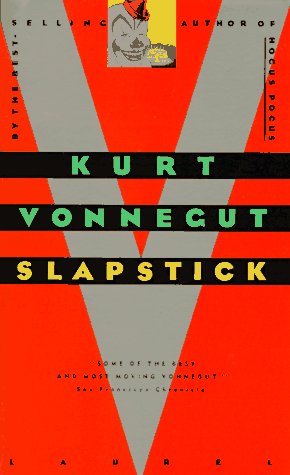
I haven’t read a book quite this fast in a long while, and I was barely trying. Published in our fair nation’s Bicentennial year, we have the story of twins separated by their judgmental parents, and a granddaughter the brother twin comes to care for. Family is the core virtue of this satire, even to the point of ludicrousness. Don’t expect it to be an endorsement of what we laughably call ‘family values’. Our protagonist is essentially a modern Neanderthal who with the help of his sister Eliza becomes by turns a genius, an idiot, a pediatrician, the last President of the United States and the King of Manhattan after a flu and the Green Death destroys civilization as we know it.
A means is also discovered to contact the Afterlife which turns out to be as boring as nails, so much so that it’s referred to as a ‘Turkey Shoot’. The biggest religion at the end of the world is the Church of Jesus Christ the Kidnapped. The insinuation that the Chinese are shrinking in stature may have been written in jest but by today’s standards or any other, it might be considered racist. The style is breezy and pure Vonnegut, sparing in detail and broadly farciful with even the most tragic of events. A step up from Breakfast of Champions.
Well, I am used to the rootlessness that goes with my profession. But I would like people to be able to stay in one community for a lifetime, to travel away from it to see the world, but always to come home again,…Until recent times, you know, human beings usually had a permanent community of relatives. They had dozens of homes to go to. So when a married couple had a fight, one or the other could go to a house three doors down and stay with a close relative until he was feeling tender again. Or if a kid was so fed up with his parents that he couldn’t stand it, he could march over his uncle’s for a while. And this is no longer possible. Each family is locked into its little box. The neighbors aren’t relatives. There aren’t other houses where people can go and be cared for.
The harvest of Beatlemania of 1964 continued with their third Capitol album in a seventh-month period, Something New, a title which wasn’t that true at all. To summarize, The Beatles’ Second Album had only been released on April 10. The United Artists’ version of A Hard Day’s Night (US) was an abridged version of the original Parlophone (UK) LP. However, the US LP preceded the better UK version by two weeks (release dates, June 26 for United Artists vs. July 10 for Parlophone).
U.S. v., A Hard Day’s Night (1964)
and the original Parlophone release
With me so far? It gets better. Something New followed the UK Hard Day’s Night by ten days and less than a month after the US LP. If this album has any weakness, it’s the lack of a strong lead single. On the other hand, apart from “Slow Down’ and “Matchbox”, it is notably lacking in the cover songs that would fill their LPs up through Beatles For Sale, or Beatles VI, depending on which continent you were born on.
Anal details: eight of its eleven tracks had already appeared on the original A Hard Day’s Night; five of those songs had already appeared the month before on the United Artists’ album. It would be the third album release for “I’ll Cry Instead”, which we never even got to hear in the movie! Side One closes with two songs from the British Long Tall Sally EP. I’ll get to the song that closes in a bit. “A Hard Day’s Night”, “I Should Have Known Better” and “Can’t Buy Me Love” had already appeared on both/either Hard Day’s Night LPs. The only remaining orphans from the Parlophone album were “You Cant Do That”, which had already appear on The Beatles’ Second Album in April; and “I’ll Be Back”, relegated to Beatles ’65, soon to be released in December 1964.
Also of note, on the trivial side, in addition to being released in Mono, it was the only early Beatles album where all tracks were in true stereo. Alternate versions of “Any Time at All”, “I’ll Cry Instead”, “When I Get Home”, “If I Fell” and “And I Love Her” appear in the Mono mix. Parlophone released Something New to US Armed Forces bases in Europe; today those copies are appropriately great collector’s items. The German stereo version on the Odeon label has a reprocessed stereo version of “Komm, Gib Mir Deine Hand” and an extended version of “And I Love Her” that repeats the closing riff six times instead of the familiar four. This mix appears on the US version of the now-defunct LP Rarities (1980). In 2004 the album was released on CD as part of the box set The Capitol Years, Volume I.
All fine, but how does it sound??? Despite being A Hard Day’s Night Redux, it’s actually a pretty listenable album. “I’ll Cry Instead” gets it off to a rocking start; “Things We Said Today” was a reflection on Paul’s relationship with actress Jane Asher. “If I Fell” and “And I Love Her” were two of John and Paul’s most tender love songs; given their relative youth, it’s surprising how much depth and maturity they could fit into two and a half minutes each.
The final track, “Komm, Gib Mir Deine Hand”, was a German language recording of “I Want to Hold Your Hand”. It wasn’t something they really wanted to do, and in the end they had to be dragged to the studio in Paris to get the job done. It wasn’t unknown for American artists in the ’60’s to record foreign-language versions of their biggest hits. The Temptations for example did the Beatles one better by recording “My Girl” not only in German but in Italian as well.
For “Komm…”, the band used the original instrumental track, then recorded eleven vocal takes, overdubbing handclaps later. And that’s all Capitol had to offer until November with the release of The Beatles’ Story, a two-LP spoken-word press release until Beatles ’65 arrived in December, with “I Feel Fine” rounding out the year.
Mikes’ latest book, FATHERS AND DAUGHTERS, is available at amazon.com. Mike’s Amazon page:
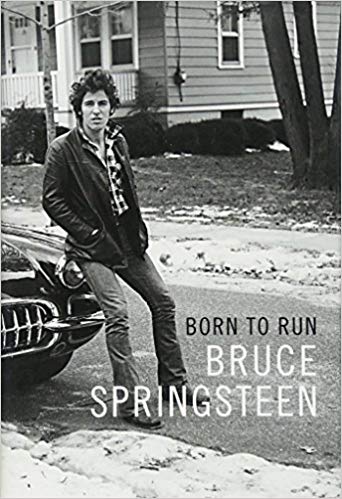
I like that Bruce doesn’t just talk about the records and chart positions. You get into the process, the thrill of seeing Elvis on TV for the first time, the arrival of the Beatles and the Motown sound. You get to know the man and the people he performs with, their gifts and foibles and all the reasons he loves them.
He spent his childhood walking in egg shells around his father Doug, a man always on edge, seemingly disappointed in how life did NOT turn out for him, disapproving of his children. He was Bruce’s foe as well as his hero, and he grew up never knowing when the fuse would be lit.
Ten years of groundwork went into his apprenticeship in New Jersey. Behind his songs was the lingering dread that was only relieved on stage. It wasn’t until the 1980s that Bruce was diagnosed with depression, something I never knew about, that most of us didn’t know, and it was then, before his biggest hit Born In the USA, that he began treatment and got the help he needed. It took a lot of courage to express that part of himself, a never-ending specter that rises up and must be endured. This he has done with medication and the support of his loved one. It’s a long read but worthwhile, on a level with or even surpassing Bob Dylan’s Chronicles. Highly recommended.













 U.S. v., A Hard Day’s Night (1964)
 and the original Parlophone release
 Papablues Scrapbook