Doctor Who Series 11: A Perspective

I think I’ve heard just about enough of this. Ever since Jodie Whitaker was announced as the 13th Doctor, we have heard from the disgruntled male class how wrong this was, that the Doctor was MALE and always should be. Guess they all forget that the idea was first introduced in the 4th Doctor story “The Hand of Fear”. The change,  if you will has been hinted at, even anticipated by fans every time a regeneration was due. And now that is has happened, we have those same males swearing this is the worst Doctor Who ever, that this marks the END of Doctor Who.

I’ve finally had the opportunity to view the entire 11th series on DVD, including the New Year’s special ‘Resolution’. And my verdict? Calm down, you dimwits.

Point one: WORST Doctor Who ever? You people never watched Classic Who, have you? Where do I begin…? How about ‘The Twin Dilemma’? ‘Time and the Rani’? ‘The Power of Kroll’? Okay, ‘Robot’ had dicey f/x but at least there was some heart in it, and it was Tom Baker’s debut so his energy managed to carry it through.

DW power of kroll

@ BBC still for ‘The Power of Kroll’

No, I think we can settle on Series 22 as the rock bottom of DW. The writers failed Colin Baker, they relied too much on torture and violence as valid story telling elements, and god! That patchwork coat still burns my eyes!

dw_-_sixth_doctor_5773

Don’t look on this as a criticism of Colin Baker. Truth is he was my first Doctor, which is always going to leave some warm fuzzies–even though my first viewing of DW on PBS was Episode 4 of the Trial of a Time Lord season. Getting back to Jodie Whitaker. What to say about her first outing as the Doctor…

One of the failings of series 11 was something we’d all gotten used to, an overarching plotline leading to a season-ending all-in showdown. Where was the Cosmic Menace with Delusions of Grandeur threatening all reality/the universe entire/Earth in general, whatever? I think we could all have used more scripts of epic proportions. And DAMN Doctor Who for making me care about f—in’ giant spiders! Why would you do that, Chibnell? ‘Kay, so much for the negative.

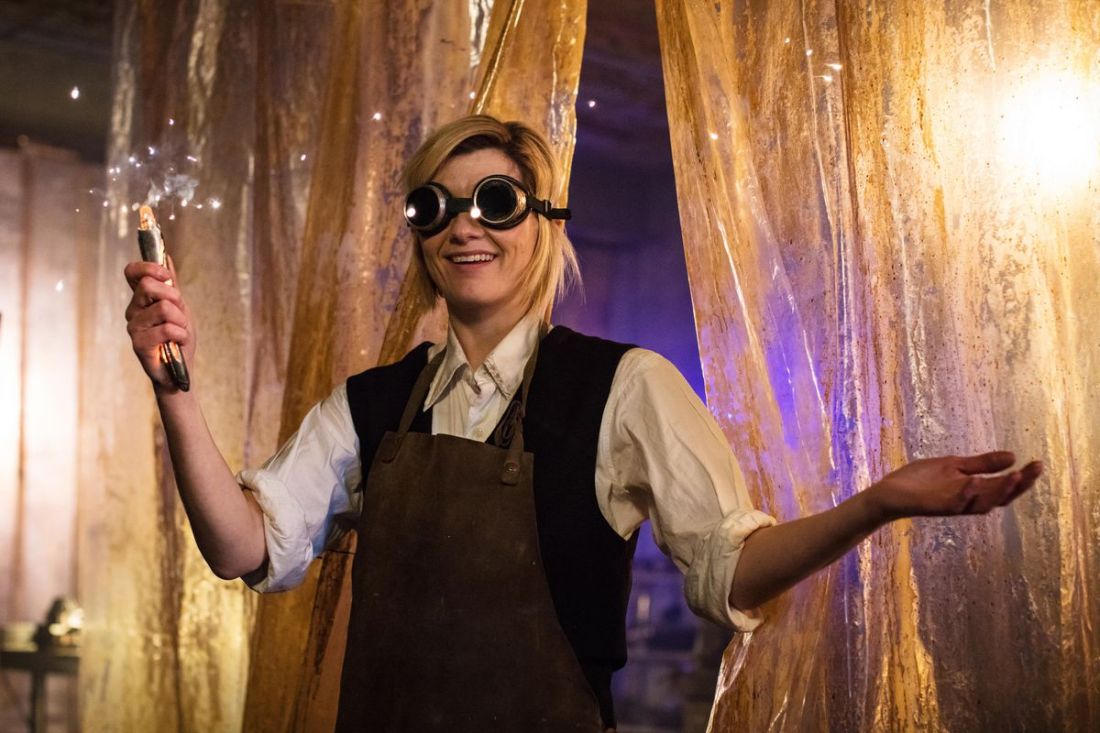
‘The Woman Who Fell to Earth’ served as a decent introductory story for 13 (I’m just going to call her that for now). Like so many before him, Tim Shaw–is it ok to call him that?–mistakes regeneration for incapacity. This Doctor is firing on all cylinders, scraping traps out of available materials and assembling a new sonic out of spare parts. Think ‘The Christmas Invasion’–‘The Eleventh Hour’–‘Deep Breath’. We haven’t had a regeneration story yet that was a turkey, and we don’t have one now. The Doctor is never more dangerous than when their neurons are going batshit.
jodie whitaker making sonic Ep_1_4.0

We did have gold amidst the dross. ‘Rosa’, ‘The Witchfinders’ are among the best New Who has to offer. ‘Demons of the Punjab’, oh lord, that was a heartbreaker! And make no mistake, 13 is the Doctor. The sanctity of life is still paramount, perhaps too much so; we’ll see what Time and Experience does to modify 13’s perspective and attitude.

DW-S11E06-Wedding

I know there are some people who will never be convinced this series is not pure shit, and honestly they’re not worth our time. Science fiction is about open perspectives and challenging ideas, NOT calcified notions of ‘THIS IS HOW DOCTOR WHO IS SUPPOSED TO BE AND NOTHING ELSE!’ I got this with Matt Smith and Peter Capaldi, not to mention Colin Baker, Sylvester McCoy ad nauseum. There are some die-hards who think anything done since the 2005 return of DW was god-awful.

Okay, I’ll give you this. Jodie Whitaker’s first series as 13 was lacking in the Epic department. But its not the end of DW. It’s a different team’s take on a classic hero…heroine, whatever. We have two or three more series to judge her era on its merits or demerits. And I got exactly what I wanted when 13 first met a Dalek, she left it gobsmacked with clever patter, and she gave it as much mercy as it deserved–which is none at all. Will future Whovians look back favorably on 13? Sorry, friends, only Time and distance will tell us that.

jodie whitaker resolution 03-dr-who.w700.h700


Mikes’ latest book, FATHERS AND DAUGHTERS, is available at amazon.com.

Mike’s Amazon page:
f & d cover

https://www.amazon.com/Mr.-Michael-Robbins/e/B00CMHSMYA


Book review: Apollo 8

apollo 8 cover

Apollo 8: the thrilling story of the first mission to the Moon by Jeffrey Kluger, author with Jim Lovell of Apollo 13 @ 2017 Henry Holt & co.

This was a mission of firsts which by no means was a sure thing. It may not be exaggerating to say this was the mission that saved the Moon Landing, the hurried preparations notwithstanding. Apollo 8 was the first manned mission to leave the Earth’s gravity field and surrender to another’s; the first manned mission to orbit another world; the first burn during a communications blackout on its first pass around the dark side of the Moon, to establish lunar orbit. That orbit would be the first time the eyes of man viewed the dark side of the Moon from close proximity. Then there was the burn to escape lunar orbit and re-entry into Earth’s atmosphere, all of which held the potential for disaster. Despite the fatigue that was inevitable on a six-day flight in a small, sometimes temperamental craft, with virtually the eyes of the world on these three men, the first trip to the Moon was an unqualified success.

apollo 8 crew

Though all three astronauts–Commander Frank Borman, Jim Lovell and rookie Bill Anders, along with their wives have their share, the focus is more on Borman, his service in the Air Force and his struggle to join the budding astronaut corps. For author Kluger it’s also a chance to revisit an old friend, Jim Lovell on his earlier career for his record-setting missions for Gemini. And for a last first, these gentlemen were the first to eyewitness the Earth rising over another world, and Bill Ander’s majestic photo has been immortalized ever since as ‘Earthrise’.

45th-Anniversary-of-Apollo-8-Earthrise

It is also a story of the tragedy of Apollo 1 and the disorderly craft that killed Gus Grissom, Roger Chaffee and Ed White on the ground. Apollo 8 was a bold, on-the-fly idea that ultimately saved the Moon landing, and I want to thank Kluger and all those brave men who helped bring back the wonder of the Moon shots, before cynicism and division became the norm and divided our country.


Mikes’ latest book, FATHERS AND DAUGHTERS, is available at amazon.com.

f & d cover

Mike’s Amazon page:

https://www.amazon.com/Mr.-Michael-Robbins/e/B00CMHSMYA

Beatles ’64—what a year!

To say 1964 was a fruitful year for the Beatles, as well as a bonanza for Beatles fans, may be the understatement of the past century. At least it was for their American fans, who were treated to seventeen single releases, twelve albums and a motion picture, not including a national tour and two appearances on The Ed Sullivan Show. All their native Brits got was two albums and an EP-single.

beatles with the beatles       Beatles EP uk_long-tall-sally-960x960

Actually, a serious analysis would show those numbers are a bit misleading, and in fact England got the better part of the deal. Two albums may not seem like much, but those albums were presented to them as nature (or their British label, Parlophone Records) intended. In 1963 the Beatles also had their radio show, adding up to 39 BBC sessions that year, and a further eight radio shows in 1964. While that certainly was a much reduced schedule for ’64, it was something we didn’t have access to in America, at least not before the advent of bootlegs in the 1970’s.

For the next three years screaming rabid fans would be the norm for the four lads from Liverpool. This new generation of record buying kids had developed an insatiable hunger for Beatles merchandise. The boys could have recorded an album of Gregorian chants, in basic Liverpudillian, and odds are it would’ve cracked the Top Ten charts.

Let’s start with Vee Jay. Introducing…The Beatles was Vee Jay Records’ attempt to cash in on Beatlemania, and that story is worthy of a blog by itself. Before their contract on the music had even expired, Vee Jay re-packaged the same album—twice; first as Songs, Pictures and Stories of the Fabulous Beatles (October 1964, chart peak 63), and again as a double album, The Beatles vs. the Four Seasons (Oct. 1964, chart peak 143), paired with a greatest hits package by the Seasons.

Beatles Introducing...VeeJay     Beatles sogns pictures etc of fab bs vj     Beatles vs 4 seasons lp     Beatles Jolly_What_by_Beatles_and_Frank_Ifield

On February 26, 1964 Vee Jay offered another misleading title, Jolly What! England’s Greatest Recording Stars: The Beatles and Frank Ifield On Stage, reissued in October as The Beatles and Frank Ifield On Stage. While the Fab Four only had four tracks on the LP, none of them live, this was the only place to hear their hit single “From Me to You” until 1973’s compilation The Beatles 1962-1966 (‘The Red Album’) hit the market. The Beatles Story was a double-album propaganda piece that required little to no participation of the band members; and again it was slapped together in response to Vee Jay’s interview record Hear the Beatles Tell All (Nov. 1964). That’s seven down.

Beatles_and_Frank_Ifield_on_Stage     Beatles storyalbumcover     Beatles hear the beatles tell all

https://rateyourmusic.com/release/album/the-beatles/the-beatles-story/

We’ll discuss the official U.S. capitol albums another time. Suffice it to say you can thank Dave Dexter, the Capitol Records exec who’d spend the next three years creating two albums out of one, with the addition of all their singles and B-sides. For now it is time to dispel the confusion…or perhaps to add to it.

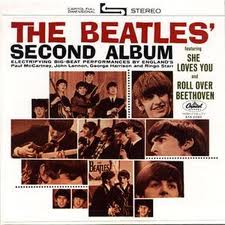
The first Beatles album released in North America isn’t what you think it was. Capitol Canada got the jump on us by issuing their second British LP, what we know as Meet The Beatles! a couple months ahead of Capitol US, under the augmented title Beatlemania! With The Beatles. That was followed by Twist and Shout, the Canadian version of their first LP Please Please Me. The final Canadian-exclusive Capitol release was The Beatles’ Long Tall Sally, which incorporated the British EP of the same name with four tracks already released on the Beatlemania! album. The cover design was virtually identical to Capitol US’s The Beatles’ Second Album. From here on Capitol Canada followed the U.S. releases, beginning with A Hard Day’s Night.

beatles LongTallySallyBeatlescover       Beatles Second Album cover

Nor was their time wasted with Tony Sheridan. Their first professional recordings were backing the English singer on five tracks in 1961, although they were credited then as The Beat Brothers. “My Bonnie” (Polydor, 1962) would be the single that brought them to the attention of their future promoter Brian Epstein. And these recordings would be twice issued, as The Beatles with Tony Sheridan and Their Guests, augmented by six tracks featuring Danny Davis & the Titans (MGM/Atco, Feb. 2, 1964, chart peak 68); and then as Ain’t She Sweet, featuring an entire side devoted to British Invasion band the Swallows (Atco, Oct. 5, 1964).

Beatlesmgm w Tony Sheridan      beatles aint she sweet

Here’s a misleading list of all the Beatles’ albums from 1964:

-Official British releases for 1964: 

Long Tall Sally (EP, June 19)

A Hard Day’s Night (July 10)           

Beatles for Sale (Dec. 4)

beatles hard days nite uk      original_461

-Beatles releases by Capitol Records for 1964:         

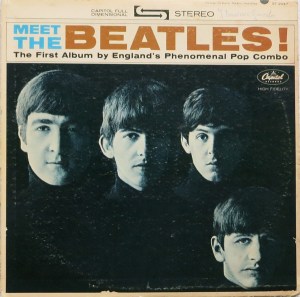
Meet the Beatles (January 20)        

The Beatles’ Second Album (April 10)    

Something New (July 20)    

The Beatles’ Story (Nov. 23)

Beatles ’65 (Dec. 15)

beatles meet the beatles     beatles something newbeatles 65   beatles_hdn_1__us 11435.1513990640.1280.1280

-Vee Jay LPs: 

Introducing the Beatles (Jan. 27)

Songs, Pictures and Stories of the Fabulous Beatles (October)      

The Beatles vs. the Four Seasons (Oct.)     

Jolly What! England’s Greatest Recording Stars: The Beatles and Frank Ifield On Stage (Feb. 26)

[reissued in October as The Beatles and Frank Ifield On Stage]  

Hear the Beatles Tell All (Nov.)


-Reissues of 1961 recordings with Tony Sheridan:  

The Beatles with Tony Sheridan and Their Guests (Atco, Feb. 2)

Ain’t She Sweet (Atco, Oct.5) 


Mikes’ latest book, FATHERS AND DAUGHTERS, is available at amazon.com.

Mike’s Amazon page:

https://www.amazon.com/Mr.-Michael-Robbins/e/B00CMHSMYA


review–Dispatches by Michael Herr

Required reading. Michael Herr takes you under fire with him and the Marines. You’ll find yourself under siege at Khe Sahn, breath their sweat, the marijuana, the fear. Despite it all, it’ll be one of those places you can’t leave behind. There are the improbable stories of daredevil war photographers such as Tim Page and of all people the son of actor Errol Flynn, Sean. Spot on-observations abound, such as, “The Green Berets doesn’t count. That wasn’t about Vietnam, it was about Santa Monica.”

One of the most apt summaries of the war, filed while it was still going on, appears on pg. 200: “Somewhere on the periphery of that total Vietnam issue…there was a story that was as simple as it had always been, men hunting men, a hideous war and all kinds of victims. But there was also a Command that didn’t feel this, that rode us into attrition traps on the back of fictional kill ratios, and an Administration that believed the Command, a cross-fertilization of ignorance, and a press whose tradition of objectivity and fairness (not to mention self-interest) saw that all of it got space.” This book was hard to get through, not hard to read per se but harsh in its details, and may be the most honest book about the Vietnam War.

Tumblr hari-kari

tumblr logo

Tumblr has chosen a peculiar form of self-inflicted hari-kari. By now we’ve all heard of their total ban on ‘adult’ material, beginning on Dec. 17, 2018. Several artists and producers I’m following have already abandoned ship. I understand what prompted this extreme action, and I’m all for banning child pornography. But these new guidelines are broad enough to boot open the door to all manner of censorship across the Internet.

I have to wonder just how stringent the censorship search program they’ll have to use is going to be. There are literally hundreds, possibly thousands of sites and posts that may not be considered family-friendly on Tumblr. That’s been its major draw. Supposing someone posts a clip of an animal nursing its young–with its NIPPLES, of course. Will that set off the klaxons?

What’ll be next? If a person’s bog is not considered pure enough…if it’s too (OHHH!!!) politically correct, whatever that means these days, do we strike down that infidel’s webpage and block his/her access to all servers? Who’s to say where this stops, IF it stops?

We’ve seen this before. From 1930 until 1968, American motion pictures were bound by the Hays Code, which placed any films and television programs under a strict regime of self-censorship. There would be no ridicule of religion, no mention of homosexuality; men were men–white, usually, bad was bad and life went on in a virtual la-la land where good people [again, white people] always win.

https://www.npr.org/templates/story/story.php?storyId=93301189

Another example; Fredrick Werthem’s Seduction of the Innocent, published in 1954, put forth the claim that comic books promoted juvenile delinquency, which led to an inquiry by the Senate Subcommittee on Juvenile Delinquency, which led to publishers voluntarily neutering comics with the imposition of the Comics Code in 1954. Marvel Comics began to break down thee improbable standards in 1971 with a three-part story involving drug-addition in The Amazing Spider-Man # 96-98.

Seduction_of_the_Innocent

https://comicvine.gamespot.com/comics-code-authority/4015-42382/

https://en.wikipedia.org/wiki/Comics_Code_Authority#1960s%E2%80%931970s

https://en.wikipedia.org/wiki/Seduction_of_the_Innocent

In both cases, these codes were imposed by self-righteous ideologues inflating the dangers posed by their respective mediums all out of proportion, and often distorting the facts to achieve their ends. That does not appear to be the case with Tumblr at this time, but the window of exploitation is now open.

I take hope in the fact that while we may be entering a period where we will be forced to water down our artistic impulses, the day will come when new outlets of self-expression WILL arrive. The restrictions of far-right, narrow mined goons will be loosened, most likely with the passing of this generation of vipers that is set on putting these chains on us in the first place.

Tumblr by that time is likely to be either an anamoly, a platform once popular soon to be forgotten; or it will act as a compliant tool of ‘The Establishment’ the Internet was born to resist. In either case, you can’t cork a volcano, nor will the artistic impulse be caged forever.

Rubber Soul as it should be

Rubber_Soul

I’ve just realized why Rubber Soul was never one of my favorite Beatles albums growing up. I had no way of knowing better of course; did any of us know in the fall of 1965? You see the problem was, we were getting the Americanized version.

A sign of a great work of art is its openness to more than one interpretation. In his blog Psychobabble, Mike Segretto gave the impression  that certain alterations were an improvement on the original British LP; that these substitutions were more in line with the folk-rock stylings of the majority of the set. On that count, I respectfully disagree. The rock numbers [“Drive My Car” & “Nowhere Man”] I feel balanced out the introspection of “Norwegian Wood” & “In My Life”. There is very little question that the British album was the better of the two versions.

Granted the classics were all in their proper places—“Norwegian Wood (This Bird Has Flown)”, “Michelle”, “In My Life”, even “The Word”. The point is, I grew up listening to what was provided by Capitol Records. Capitol was the American distributor for EMI-Parlophone Records in the U.S. And they butchered Rubber Soul.

rubber soul UK back

The back cover of the UK release, at least the remastered CD from 2009 

rubber soul US Capitol back

Running order of the Capitol Records release

The first sin they committed was to strip four songs from the original LP, ie “Drive My Car”, “Nowhere Man”, “What Goes On” & “If I Needed Someone”. This was standard practice for Capitol: take a few songs off one Beatles album and collect as many as possible into a ‘new’ album. Something New [July 1964] may be the most egregious example of such mash-ups, and I’m saying this as someone who does in fact prefer some of the American LPs over their British counterparts.

Here’s what rubs me; two of those songs were among the strongest tracks the Fabs had done in this period; and they substituted two of the weaker tracks from the British Help! LP. If I may digress, Capitol got a lot of mileage out of that record. Over the following two  years they managed to spread those six Side-2 songs over three different albums. Most of us who grew up in the ‘60’s didn’t realize how badly we’d been gipped until the official British albums saw their first CD release in 1987. That was the year we in America finally received Rubber Soul in its full glory, as God [or the Fab Four anyway] intended.

The UK version opened with a strong lead-in, ‘Drive My Car”; the Capitol album had the temerity to replace that with the significantly weaker number, “I’ve Just Seen a Face”. Worst of all, “Nowhere Man” was also taken off the Capitol release. I never knew it was supposed to be on Rubber Soul until I listened to that damn CD for the first time–in 1998! George Harrison had originally been allotted two numbers, “Think For Yourself” & “If I Needed Someone”. I don’t know why I’m so taken with the latter number; that riff just seemed to hook me. It’s mostly the guitar. These are both decent songs, but at a time when George was just beginning to flex his songwriting muscles, Capitol cut his contributions by half.

Adding insult to injury, the one song allotted to Ringo Starr, ‘What Goes On”, the first instance in which he actually received any songwriting credit, was swapped with “It’s Only Love’, a song even John Lennon said was abysmal. Which meant Ringo got NO vocal numbers at all on our side of the Atlantic. In fact, in 1965 Ringo would appear on two, count ‘em, two tracks for U.S. release. One was “Act Naturally”, the B-side of the “Yesterday” single. “Boys” [from The Early Beatles, March ‘65] was part & parcel of the re-re-release of the Beatles’ first Parlophone album Please Please Me–from 1963.

That leaves fully half of the album dominated by Lennon compositions—on either side of the Atlantic—“Norwegian Wood”, “Nowhere Man”, “The Word”, “What Goes On”, “Girl”, “In My Life” & “Run For Your Life”. John Lennon songs tended to dominate Beatles albums up to this point. Rubber Soul would actually be the last time this was the case until the White Album sessions three years later—honestly, mostly on account of John’s growing, admitted laziness.

The four tracks that were stripped from the Capitol album would eventually conglomerate in July 1966 on the Yesterday and Today set, along with the final two orphans from Help!, Side 2, plus three more recent cuts stolen from the upcoming Revolver. And that would be the last time such butchery would be committed against a Beatles long-play.

–“It’s Only Love” was mine. I always thought it was a lousy song. The lyrics were abysmal. I always hated that song.

-John Lennon to David Sheff, The Playboy Interviews with John Lennon & Yoko Ono, @ 1981 Playboy Press

https://psychobabble200.blogspot.com/2014/08/turn-left-at-greenland-part-8-rubber.html